01.03.23 Recap: Gospel Week
- tmaley
- Jan 10, 2023
- 20 min read
Northern Virginia Catholic Bible Study & Apologetics House rules/notes… 1. Meetup is www.meetup.com/catholicbiblestudy Zoom Meeting Logon info is the same every week: Zoom ID: 861 1782 2081 Password: 406952 2. Questions encouraged. If you have questions about anything, you can ask in the chat, email the Meetup group, or me directly at ron@hallagan.net. 3. Unedited recaps of meetings are posted via Meetup after our meeting. The final edited recap is posted within a week by Taylor on our Catholic Catacombs Light website at https://catholiccatacombs.wixsite.com/website/recaps. Taylor will notify everyone on Meetup with the link. 4. Respectfulness. We will be discussing differences between religions and between Christian denominations, and agree to be respectful at all times. Specifically, Protestants are our friends and brothers in Christ; in fact, I personally owe part of my return to the faith to them! 5. No politics. It would be easy for us to self-destruct, but that’s not our goal. Our goal is to learn/understand/apply the Bible and our Catholic faith. 6. Prison fellowship – opportunities to volunteer one Saturday per month for 2 hours (12-2 or 2-4) serving Catholic prisoners at the Fairfax County Jail. Ask Ron (ron@hallagan.net) or Gina (gmasterson99@gmail.com) for details. Why do this? "I was in prison, and you visited me." – Matt 25:36 7. Catholic Prayer & Fellowship. Are you interested in praying with other Catholics during the week? Fellow member Jason Goldberg has started just this at “Catholic Prayer, Fellowship, and Spirituality Meetup.” Sign up at: https://www.meetup.com/online-catholic-prayer-fellowship-and-spirituality/ 8. I highly recommend seeing “The Chosen” TV series. We seek a relationship with Jesus Christ, which is not easy at first. It helps when we can relate to a person that we have seen and heard. They have captured the real Jesus as close as any film I’ve ever seen. https://thechosen.link/1Y1R7. 9. RSVP Reminder: Please RSVP whether you are attending the meeting or just reading the Recap notes afterwards. The more RSVPs, the more Meetup will give us exposure, which will draw more people to us, which is our way of evangelizing! Please RSVP when you get the Meetup invite weekly. Our Bible Study Format: 5 min prayers, 10-15 min Catholic topic, 40-45 min on the main topic from weekly List below: Week 1: Dec 6 - Gospel Week: Zacchaeus (Lk 19:1-10), Epiphany (Mt 2:1-12), 12 Days of Christmas, Nativity Scene-The Church Week 2: Dec 13 – Bible Week (Gen àRev): We are in EXODUS, the 2nd book of Moses, meeting #4. Week 3: Dec 20 – Survey Topics Voted on by Members: We are currently beginning Heaven.
Ö 1) Jesus’ Greatest Parables 2) Hell, Purgatory, Heaven 3) Christian Comparisons 4) Great Women in the Bible 5) World Religions 6) Book of Revelation 7) Major Heresies and Church Councils
Week 4/: Dec 27 – Member Questions 1. Love and Unity are two of the Holy Spirit’s Trinitarian descriptions. How are these different? How do they affect us? 2. The knowledge of God is “participatory.” Is that why nonbelievers have difficulty? 3. Are Charity and Love synonymous? How are they different? What are the 4 highest forms of Charity? 4. The History of the Mass going back to Cain & Abel, all leading to the sublime meaning of the Eucharist. 5. Can you review origin and meaning of the 12 statements of belief in the Creed? 6. Since you said that Gen 1-3 is likely mostly allegory, how do you think The Fall actually took place? 7. Who am I? It seems we all ask that question at some point; some ask it all the time. Can you answer this? Next Holy Days of Obligation Mary, Mother of God – Jan 1 Epiphany of the Lord – Jan 8 Opening Prayer O God who was pleased to give us the shining example of the Holy Family Graciously grant that we may imitate them in practicing the virtues of family life and the bonds of charity. May the angelic star that led the Magi to your humble stable in Bethlehem Lead us as well in our journey every day. And as You taught us to pray: Our Father Who art in Heaven, Hallowed be Thy Name. Thy Kingdom come, Thy Will be done, on earth as it is in Heaven. Give us this day our daily Bread; And forgive us our trespasses as we forgive those who trespass against us. And lead us not into temptation, but deliver us from evil. Lord Jesus Christ, Son of God, have mercy on us all. Amen. Gospel Week Zacchaeus The Epiphany Twelve Days of Christmas The Nativity Scene Zacchaeus Luke 19:1-10 Context: Starting in Luke 9, Jesus has begun his last journey to Jerusalem, winding his way through the entire country on the way. In the previous chapter (18), he is leaving Galilee and heading down the Jordan River. He preaches several parables and responds each time to challenges by the Pharisees and scribes, who were also shadowing Jesus more and more. This scene in Jericho takes place about a week before the crucifixion. Jesus decides to pass through Jericho, about 25 miles from Jerusalem. It’s not clear that he was planning to spend any time there, but he ends up doing so. It is always interesting to see how such a small decision – like stopping somewhere unexpectedly – can change the course of lives. At the outskirts of Jericho, he passes by a blind beggar on the side of the road who calls out to him “Son of David, have pity on me.” Jesus stops and heals him, and he says to the beggar, “Your faith has saved you.” Because of his preaching and healings, the crowds that follow Jesus have been growing. This healing just outside the city attracts still more. His next encounter will be with Zacchaeus. Map showing journey to Jerusalem through Jericho, the lowest, and oldest, city on earth.

Zacchaeus Luke 19:1-10

Jesus came to Jericho and intended to pass through the town. Now a man there named Zacchaeus, who was a chief tax collector and also a wealthy man. He was seeking to see who Jesus was, but he could not on account of the crowd and that he was small in stature. So he ran ahead and climbed a sycamore tree in order to see him, since he was about to pass that way. When Jesus came to that place, he looked up and said to him, “Zacchaeus, come down quickly, for today I must stay at your house.” And he came down quickly and received him with joy. When the people saw this, they began to grumble, saying, “He has gone to stay at the house of a sinner.” But Zacchaeus stood there and said to the Lord, “Behold, half of my possessions, Lord, I shall give to the poor, and if I have extorted anything from anyone I shall repay it four times over.” And Jesus said to him, “Today salvation has come to this house because this man too is a descendant of Abraham. For the Son of Man has come to seek and to save what was lost.”
Discussion: Any initial impressions? Does Jesus address any of Zacchaeus’ past sins or invite Zacchaeus to repent? What qualifies Zacchaeus to be called a descendant of Abraham? “For the Son of Man has come to seek and save what was lost.” What other parable does this remind you of? The people often grumble when they see Jesus hanging out with sinners. How might this compare with Moses? Jesus engaged another rich man in an earlier chapter and the outcome was very different. Who remembers what that is? Q: Does Jesus address any of the sins Zacchaeus may have committed? No, Jesus didn’t address any sins. He doesn’t even tell him to leave his job as a tax collector. All Jesus did was invite himself to dinner. It turns out, that’s all Zacchaeus needs. Moved by Jesus’ love and openhearted approach, Zacchaeus takes it upon himself to make restitution. He promises to do whatever is necessary to maintain his new relationship with the Lord. Q: Did Jesus invite Zacchaeus to repent? No, although Zacchaeus’ determination to amend his former ways attests to his guilt. Q: Why qualifies Zacchaeus to be called a descendant of Abraham? It was not because of his Jewish blood, but rather it was his response to Jesus that showed he was a true descendant of Abraham, a true heir to the promises of God. His response was: I will amend my ways going forward and repair any harm I’ve done in the past. Notice there wasn’t a particular poor person or group in the story in need of help. Of course that may be assumed, but the point is that Jesus is not looking to measure everything we give on the scale of your salvation. What comes before that is essential: he is looking for that inner change towards possessions such that they don’t own you, and they don’t control your everyday life. The new, inner self of Zacchaeus was what was needed; the rest flows from that. Q: “For the Son of Man has come to seek and save what was lost.” What other story of Jesus’ does this remind you of? The Parable of the Lost Sheep – the good shepherd leaves the 99 sheep behind to go save the one who wandered off. (Luke 15:4-7) In today’s story, Zacchaeus was the one sheep! Q: BTW, in Jesus Parable of the Lost Sheep, who are the 99 sheep and who is the 1? No one and every one are either one. The self-righteous who feel they don’t need forgiveness (like the Pharisees) are the 99 – and they could be anyone, including us. Those who have wandered off and know they need forgiveness are the 1, and that could be every human. Q: The people often grumble when they see Jesus hanging out with sinners. How does this compare with Moses? Why is this relevant? Jesus is the new Moses in so many ways. In this story, it is the grumbling of the people, like Moses experienced frequently. Q: Jesus engages another rich man in an earlier chapter and the outcome was quite different. Can anyone recall that and contrast these? Zacchaeus provides a contrast to the rich man who cannot detach himself from his material possessions to become a follower of Jesus (Lk 18:18-23). The rich man tells Jesus he has followed all the commandments all his adult life but wants to know what else he needs to gain eternal life. Jesus said, “You lack one thing. Sell what you have, give it to the poor and come, follow me.” The man went away sad, because he was very rich.” Jesus then talks about how hard it is for the rich to gain heaven – like a camel passing through the eye of a needle. You can’t take your possessions to heaven so you’d better not put these before God, or you will experience the needle effect. Zacchaeus exemplifies the proper attitude: he promises to give half of his possessions to the poor and not cheat again; consequently he is the recipient of salvation. The needle blocking his way was removed!

The eye of the needle is us, not God.
Q: How does Zacchaeus’ promise of restitution compare to the requirements in the Torah?
Restitution plus a fine summarizes the Jewish Biblical and historical view.
Exodus 22:1 states, “If an ox is stolen, the thief must pay back five oxen; if a sheep, the payback is four.”
By Zacchaeus offering to pay back 4x what he extorted, plus give half his riches to the poor, he far exceeded that standard.
Q: When Jesus said, “Today, salvation has come to this house,” could he have been enjoying a double entendre?
Since Jesus IS salvation, then salvation quite literally came to Zacchaeus’ house, too.
Notable #1: In ancient Israel, tradition required travelers to go to a central part of a town and wait to be invited into a home. Jesus has no problem ignoring this custom to claim one of Israel’s lost sheep.
Notable #2: Perhaps in the humor (the short Zacchaeus in the tree), the surprise, and the confusion of the sycamore encounter, the crowd missed some of Jesus’ words. His double mention of house (in verses 5 and 9) would indicate salvation for the household. While a guest in Zacchaeus’s home, Jesus no doubt mingled with the family and servants; of course, they would all share in the joy of Zacchaeus’s decisions and restitutions.
Conclusion
It may be hard to believe, but Jesus is not in heaven keeping track of our offenses and devising which punishment will be most fitting for us. No, he is standing before each one of us, like Zacchaeus, asking us to welcome him in. He knows that if we do invite him in, his affection for us and his interest in helping us will be sufficient to bring about whatever change of heart we need, and that it will bear much wisdom and fruit.
The Epiphany
The “Christmas Season” is celebrated for 12 days, starting on Christmas Day and ending on the Epiphany, traditionally January 6. In the U.S., it is moved to Sun Jan 8.
We use the occasion of the arrival of the Magi to celebrate the “Epiphany of the Lord Jesus” on January 6. Although Jan 6 is the official date around the world, some countries (like us) celebrate it on the first Sunday after Jan 1.
Myths... There are many songs, traditions, and stories over the years that convey some innocent, but erroneous, ideas. We will clarify those tonight.
Q: What does Epiphany mean?
The word “epiphany” comes from the Greek word for “manifestation,” “to make known,” “to reveal,” or “sudden insight or perception.” As it is applied in Christianity, it refers to the unveiling of who Jesus was to the world: the long-awaited Savior who turned out to be God incarnate, and who came not only for the Jews – who had spent 2000 tough years preparing for it – but for every people and nation on earth. The Christian Epiphany specifically refers to commemoration of the manifestation of a divine Messiah (Christ) to the gentiles in the persons of the Magi, on the 12th day after Christmas.
Q: Why do we use the arrival of the Magi to celebrate the “Epiphany of our Lord Jesus”?
The key part of the Magi’s identity is that they were Gentiles who had been called. Up until this point in the Christmas story, only Jews had found their way to Bethlehem. This detail cannot be overlooked, for it is clear that the Gospel is going out to the entire world.

The Visit of the Wise Men – Matthew 2:1-12
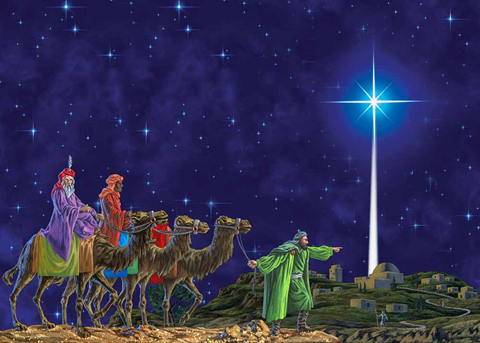
Now when Jesus was born in Bethlehem of Judea in the days of King Herod, behold, Magi from the east arrived in Jerusalem, saying, “Where is the newborn king of the Jews? We saw his star at its rising and have come to do him homage.”
When King Herod heard this, he was greatly troubled, and all Jerusalem with him. Assembling all the chief priests and the scribes of the people, he inquired of them where the Messiah was to be born.
They said to him, “In Bethlehem of Judea, for thus it has been written through the prophet: ‘And you, Bethlehem, land of Judah, are by no means least among the rulers of Judah; since from you shall come a ruler, who is to shepherd my people Israel.’”
Then Herod called the magi secretly and ascertained from them the time of the star’s appearance. He sent them to Bethlehem and said, “Go and search diligently for the child. When you have found him, bring me word, that I too may go and do him homage.”
After their audience with the king they set out. And behold, the star that they had seen at its rising preceded them, until it came and stopped over the place where the child was.
They were overjoyed at seeing the star, and on entering the house they saw the child with Mary his mother. They prostrated themselves and did him homage. Then they opened their treasures and offered him gifts of gold, frankincense, and myrrh.
And having been warned in a dream not to return to Herod, they departed for their country by another way.
Discussion: Who were the Magi? When did the Magi visit occur?
How many were there? What did Herod do and is it reasonable to think he could do this?
What is unique about Bethlehem? What are the meanings tied to the three gifts of the Magi?

Q: Who were the Magi?
The “Wise Men from the east” were the very educated religious advisors of a king; usually of the wealthy class, and experts in the “sciences” (included astrology). “From the east” could mean anywhere from Nabataea (100 mi), Babylon (600 mi), or Persia (1,200 mi).
Q: How many Magi were there?
We don’t know how many Magi there were; Scripture does not say there were three. This assumption came from the fact that they were bearing three gifts.
Q: Bethlehem was about 6 miles from Jerusalem. What was unique about Jesus being born in Bethlehem?
It was the birthplace of Joseph, who was a descendent of David, but it was also the birthplace of David.
Q: We always assume the Magi came at the birth of Christ because the Nativity scene shows it that way and the songs, too. But that’s just a popular cultural development based on a misreading of the text. Are there any clues in the passage that the Magi’s visit was not at the time of Jesus’ birth?
“… and on entering the house they saw the child with Mary his mother.”
They found the “child” (not infant) living in a “house” in Bethlehem (not in a stable). The best estimate we have is 1-2 years old.
Q: How could Jesus be 1-2 years old and still reside in Bethlehem? Did the Holy Family stay there after Jesus was born? Did they not return to Nazareth after his birth?
They did not return to Nazareth right away because they fled to Egypt first to escape the danger of Herod. When Herod died, they returned to Israel but went to Nazareth.
Q: We are not covering Herod’s killing of the other children in Bethlehem today, but do you think it was possible Herod would send his soldiers to Bethlehem to kill all the children under the age of two?
Yes, very conceivable. Herod was a psychopath. He had killed his wife and half his children already because he was paranoid about a challenge to his throne. You can imagine his reaction when the Magi told him the new king of the Jews had been born to Israel!
Caesar Augustus, who placed Herod on the throne and protected him, was quoted saying, “I would rather be Herod’s pig than his son.”

Q: What were the meanings of gifts of gold, frankincense, and myrrh?
You may recall, many Jews were expecting multiple messiahs because of the varied prophesies – a kingly messiah, a priestly messiah, and a suffering messiah (Isa 52, 53; Psalms 22, 31, 38, 41, 69). Instead, Jesus was all of them at once. The three gifts from the magi:
· Gold – Jesus, the kingly messiah
· Frankincense – Jesus, the priestly messiah. It is made from the resin of the Boswellia tree for making perfume and incense. Since the time of the Exodus, it was used as sacred incense in the Tabernacle that God had them build in the desert.
· Myrrh – Jesus, the suffering messiah. Myrrh was an ointment made from the sap of the thorny myrrh tree. There were two applications for our purposes: First it was used to anoint priests and kings and in our case, the “Messiah” which is Greek for “anointed one,” or “Christos” in Latin, or Christ. Second, it was used to embalm dead bodies, because it slowed decay and had a nice scent. That is quite meaningful since Jesus came to die for us.
Q: Although the prophecies foretold that eventually all people (Jews and Gentiles) would be invited to receive God’s divine favor, it would still be an earth-shattering reality. Why?
Such a shift would be the most universal, multicultural, diverse, tolerant, inclusive act in human history. It was inconceivable to think that everyone – all tongues, tribes, and peoples – could dwell together in peace. Until this radical inclusion, people were defined by their geographical or cultural associations. In the new covenant, however, all men and women are invited to come together and be true brothers and sisters to one another, and in doing so, children of God.
No longer would God’s covenant hinge upon a physical blood line. Nor upon one’s status in life, whether king or servant. The covenant was now open to anyone who hears the word of God and gives their lives to it. Salvation is now based on a decision, an act of freedom from sin, and a person’s way of life.
Q: Was the star a supernatural phenomenon or a natural phenomenon?
Many have identified certain astrological phenomenon that took place around this time. Then again, it was unlikely to have been an ordinary star because it did not rise and set like ordinary starts but led them on their journey from the east. Early Church Fathers actually thought it was some form of angel, since angels have been represented as stars at various times in Biblical history.
Angels can become people, so I presume they could take on the aura of a star, too. Whatever it was, it sufficient enough for them to make an expensive journey. It doesn’t seem that Herod and the people of Jerusalem saw anything. Then, when they departed Jerusalem, it was there again, stopping just over where Jesus was five miles away. Does that sound like a star to you?
Q: The Epiphany is a snapshot of how God reaches out to man, and man’s response. Do you see the interesting contrast?
One unfortunate reality of the God–Man nexus is captured by the Magi’s reception in Jerusalem. We were not ready for God. Perhaps the more wealthy and comfortable we get, the harder it will be for us to make room for Him. Not a good long range plan.
The other reality is how the shepherds and the (non-Jewish) Magi didn’t hesitate to drop everything and go to Him.
This reality is no different today. Herod represents the world at large; and the Magi and Shepherds represent the rest who have decided to take up the cross and follow Him home.

Q: Any other contrasts?
The Magi were not educated in God’s ways, but this shows you that God puts into humans a desire for truth, wherever it may take us. You could also say the Magi were as far away from Yahweh in every conceivable way, yet He called them. And they came. So, how far away we are is immaterial to God.
Interestingly, Herod’s chief priests made no effort to come find the Messiah, and they knew the prophecy – they are the ones who told Herod and the Magi about Bethlehem. What could they have been thinking?

As cunning and dangerously paranoid as Herod was, I can imagine the conversation he had with his chief priests:
Herod: “These pagan Magi come from another country and know about a prophesied Jewish king that has been born right under our noses, and you didn’t?!”
Chief Priest: “No, your majesty, these pagan stargazers know nothing, trust us. Yes, the prophecy says Bethlehem, but the time is not now. Send the Magi there and have them report back to you. Tell them you want to know so you can worship him, too. And if they report back that they have found him, then we can eliminate this false Messiah before he can cause us any trouble!”
Regardless of what the conversation was, we can see that just because a person appears to be close to God – such as the chief priests who prayed in the Temple and were supposedly watching for the Messiah – does not mean they were moving towards God. In fact, many Temple leaders over the years were moving away from God, teaching that the rituals and rubrics of worshipping God were more important than the heart and spirit of the teachings themselves.
The lesson for all of us is the absolute importance of evaluating where we stand vis-a-vis God, all the time. Are we closer than last year? Closer than last week? If not, we may need to consult our angels.
Q: The “Epiphany of the Lord, Jesus” is not limited to the Magi visit. What other events may be considered part of the Epiphany?
1) The Visit of the Magi
2) The Baptism of Jesus - God announced from that Jesus was his son & the Holy Spirit descended on him like a dove. The whole Trinity was present!
3) The Wedding at Cana - Jesus’ first miracle in public showed who he was.

Underground Catechism
The Twelve Days of Christmas Song – Catholic News Agency:
The song, "The Twelve Days of Christmas" is an English Christmas carol. From 1558 until 1829, Roman Catholics in England were not permitted to practice their faith openly. Someone during that era wrote this carol as a catechism song for young Catholics. It has two levels of meaning: the surface meaning plus a hidden meaning known only to members of the Church. Each element in the carol has a code word for a religious reality which the children could remember. The "True Love" one hears in the song is not a smitten boy or girlfriend but Jesus Christ, because truly Love was born on Christmas Day. The partridge in the pear tree also represents Him because that bird is willing to sacrifice its life if necessary to protect its young by feigning injury to draw away predators.
According to Ann Ball in her book, HANDBOOK OF CATHOLIC SACRAMENTALS:
Two turtle doves The Old and New Testaments
Three French hens Three theological virtues: Faith, Hope, and Love
Four calling birds Four gospels of Matthew, Mark, Luke, and John.
Five golden rings First five books of the Old Testament
Six geese a-laying Six days of creation
Seven swans a-swimming 7 gifts of the HS: Prophesy, Serving, Teaching, Exhortation, Contribution, Leadership, and Mercy
Eight maids a-milking Eight beatitudes
Nine ladies dancing 9 fruits of the HS: Charity, Joy, Peace, Patience, Goodness, Gentleness, Fidelity, Self-control, Chastity
Ten lords a-leaping Ten Commandments
Eleven pipers piping Eleven faithful Apostles
12 drummers drumming Twelve points of belief in The Apostles' Creed
Is the Nativity Scene a snapshot of the Church?
Q: How does the Nativity Scene – with its animals, shepherds, wise men, Mary & Joseph, and Jesus – represent the Community of Saints and the Body of Christ, otherwise known as the “Church”?
It is a nearly universal practice among Catholics to have a nativity set in our homes and surely in our parishes. Not only does the nativity set remind us of the birth of Christ, it is also a miniature replica of the Church.
In the scene we see saints (Jesus Mary and Joseph), we see sinners (all the rest), we see the rich (the Magi), and we see the poor (Mary Joseph, Jesus and the shepherds). We see the learned (the Magi) and the simple (the shepherds). We see the angels. There are Jews and Gentiles (the Magi are Gentiles and the rest are Jews). In this midst of this diverse scene, Jesus is found!
While it may seem “institutional” to ponder the Church on Christmas Day, please remember that it is not. If that’s all it was, I would not be here. The Church is not an institution, it is the Body of Christ and he is the head of the Body, the Church and we, his members (cf Col 1:18; 1 Cor 12:27).
It will benefit us to ponder each year Christ’s presence in the Nativity setting and what it shows us about his entire Body, the Communion of Saints – the Church.
Closing Prayer
Lord, we thank you for the blessing of reading your Word together
Especially as we followed your star, leading us to your humble stable in Bethlehem.
May we meditate on the beauty of what you did for us, and the humility by which you did it.
May your love and grace follow each of us as we return to our daily lives,
refreshed and blessed by you – and of course, taking you with us!
Hail Mary, full of grace the Lord is with thee. Blessed art thou among women, and blessed is the fruit of thy womb, Jesus. Holy Mary, Mother of God, pray for us sinners now and at the hour of our death.
Amen!
Movie Fellowship Gathering – Wednesday, January 11th at 8:00 pm.
The movie: “ST. GIUSEPPE MOSCATI - DOCTOR TO THE POOR” (English subtitles)
From Anna: “I found this movie to be such an inspiration and food for the soul. I can appreciate and see the connection on what you were teaching us about the different virtues and how this Saint handled each difficult situation....I personally loved it and thought others may too.”
Here are the details on meetup:
The Zoom will open at 7:45 pm for fellowship
The movie will begin at EXACTLY 8:05 pm.
The runtime is 2 hours and 40 mins so we will finish about 10:45
JOIN US for a night of fellowship watching a lovely movie. St. Giuseppe Moscati was a medical doctor in Naples, Italy during the early 20th century. This full-length feature movie tells his compelling story.
His brilliant research led to the discovery of insulin as a treatment for diabetes. Before examining a patient or engaging in research, he would place himself in the presence of God. He encouraged his patients to receive the sacraments and treated poor patients free of charge.
When Mount Vesuvius erupted in 1906, Dr. Moscati evacuated a nursing home in the endangered area, personally moving the frail and infirm patients to safety minutes before the roof of the building collapsed. He also served beyond the call of duty during the 1911 cholera epidemic and treated some 3,000 soldiers during World War I.
Giuseppe Moscati died in 1927 at 46 yrs old, was beatified in 1975 and declared a saint by Pope John Paul II in 1987. His feast day is November 16.
Online event:
https://us02web.zoom.us/j/88005003901
The following is a link of the trailer I found on Youtube . https://www.youtube.com/watch?v=30TmB6Ahm5Y
Jesus flight to Egypt Matthew 2:13-16, 19-20
The greatest in the OT is Moses, who is also prefigures Jesus in numerous ways, most famously the First Passover and Last Passover (Last Supper). But in today’s readings there are other comparisons.
When the magi had departed, behold, the angel of the Lord appeared to Joseph in a dream and said, “Rise, take the child and his mother, flee to Egypt, and stay there until I tell you. Herod is going to search for the child to destroy him.”
Joseph rose and took the child and his mother by night and departed for Egypt. He stayed there until the death of Herod, that what the Lord had said through the prophet might be fulfilled, “Out of Egypt I called my son.”
When Herod realized that he had been deceived by the magi, he became furious. He ordered the massacre of all the boys in Bethlehem and its vicinity two years old and under, in accordance with the time he had ascertained from the magi.
When Herod had died, behold, the angel of the Lord appeared in a dream to Joseph in Egypt and said, “Rise, take the child and his mother and go to the land of Israel, for those who sought the child’s life are dead.”
Q: Where are the comparisons in today’s readings with Moses?
Pharaoh hears of a child that will be born to the Hebrews who will rise up against Egypt, so he seeks to eliminate him.
Herod hears that the Messiah will be born in Bethlehem and seeks to eliminate a potential future rival.
Moses flees Egypt to escape certain death by Pharaoh.
Joseph and Mary take Jesus and flee to Egypt to escape certain death by Herod.
Pharaoh has all boys two years of age and under drowned in the Nile.
Herod has all boys two years of age and under put to the sword.
Moses returns to Egypt to save the Hebrews and free them from slavery in Egypt.
Jesus returns to Israel to save Israel and humanity from slavery to their sins.
Both came back to bring people to the Promised Land
“Out of Egypt I called my son.” – Hosea 1:11
“I will raise up for them a prophet like you from among their fellow Israelites, and I will put my words in his mouth.” –Dt 18:18


Comments