01.09.24 Bible Timeline Tuesday
- tmaley
- Jan 15, 2024
- 17 min read
Updated: Feb 6, 2024
Northern Virginia Catholic Bible Study & Apologetics

Every Tuesday, 7PM-8PM
This meeting is a lecture/Q&A format. It is free.
House rules/notes…
Our meeting/classes are In-Person at St. John Neumann Catholic Church 11900 Lawyers Road, Reston, VA 20191 https://saintjn.org/ (usually held downstairs in Room 5), or ONLINE via Zoom (see #2).
To sign up for Zoom notifications and to receive the Meeting Recaps, go to www.meetup.com/catholicbiblestudy and join us! The Zoom Logon is the same every week: Zoom ID: 861 1782 2081 Password: 406952.
After each meeting, I send out Meeting Recaps of what we discussed. Please remember these recaps are unedited and without the pictures. The edited version with pictures will be posted before the next class on the Website – https://catholiccatacombs.wixsite.com/website. Taylor will notify everyone at that time and provide a link.
Questions encouraged. If you have questions, we ask that you keep them on topic and brief. You can ask in the chat box during the class, or email through Meetup.com, or email me at ron@hallagan.net afterwards.
Respectfulness. We will be discussing differences between religions and between Christian denominations, and we agree to be respectful at all times. Protestants especially are our friends and brothers-in-Christ; in fact, I personally owe part of my return to the faith to them!
No politics. It would be easy for us to self-destruct, but that’s not our goal. Our goal is to learn/understand/apply the Bible and our Catholic faith.
Catholic Prayer & Fellowship. Are you interested in praying the rosary, etc. with other Catholics during the week? Follow fellow member Jason Goldberg at https://www.meetup.com/online-catholic-prayer-fellowship-and-spirituality/. Daily/weekly prayer is saintly!
“The Chosen” TV series. All of us seek a relationship with Jesus Christ, which is not always easy. It can help if we have seen and heard Him. The Chosen captures Jesus better than any show I have ever seen. Highly recommended.
RSVP Reminder: Please RSVP whether you are attending the meeting or just reading the Recaps afterwards. The more RSVPs, the more Meetup will give exposure to “Catholic Bible Study” – a good thing!
Catholic Catacombs Website: https://catholiccatacombs.wixsite.com/website
Bible Study Format: Each week of the month has a repeating topic, as noted below.
Each meeting: 5 min greet, prayer, 10-15 min Catholic topic, 40-45 min main topic.
Week 1: Gospel Week
Week 2: Bible Week (Gen to Rev): We are in The Book of JUDGES.
Week 3: Survey Topics Voted on by Members:
x 1) Jesus’ Greatest Parables x 2) Hell, Purgatory, Heaven x 3) Comparative Religions
4) Great Women in the Bible 5) Book of Revelation 6) Major Heresies and Church Councils
Week 4: Member Questions:
Can you provide a brief review of the origin/meaning of the (12) statements in the Creed?
How do I live my Christian faith at work when my faith is not accepted there?
Angels – who are they, what do they do? Do we really have guardian angels? What about devils/demons?
Please explain exorcisms. Do they happen, are they real?
What should our response be to those who ask us about priestly sex abuse?
What about the atheist who leads a good life? Can I be a person be good apart from God?
Miracles since the NT
What’s the difference between Charity and Love? What are the highest forms of charity?
How can I get more excited by the Mass?
Was King David good or bad? Was Emperor Constantine good or bad? Was he even Christian?
Why does God allow suffering?
Major holy days in the Liturgy of the Church
January 8: The Baptism of the Lord
February 14: Ash Wednesday, beginning of Lent
Feb 14 – Mar 28: Lent (ends on Holy Thurs/Last Supper)
We will review a different apologetics or exegesis term each week...
Apologetics and Exegesis Terms
Apologetics – to defend a belief.
Catholic Apologetics– to defend the Catholic faith using reason, tradition, & Scripture.
Exegesis – the study and interpretation of Scripture (it’s what we do here every week; you are all exegetes).
Eschatology (Greek, eschaton=last/end): the study of End Times: the Second Coming of Christ (called Advent (Latin),
Greek Parousia), Judgement Day, Heaven & Hell. In exegesis, you will hear Parousia (pair-oo-sia) more than Advent.
Bible = The OT = The Torah (Pentateuch, Books of Moses), the Prophets, the Writings (Wisdom, Novellas)
The NT = The Gospels and the Epistles (Epistles: New Test Letters (Paul), Catholic Letters, and Revelation).
Best Bibles – The Didache Bible, Ignatius Edition; Ignatius RSV 2nd Catholic edition; Augustine Bible; Douay Rheims (Jerome). Starters: Bible Basics for Catholics-Ave Maria press.
Church – Greek kyriakon house of the Lord: building for Christian worship; the whole body of Christian believers.
Ark of the Covenant: a) The golden chest holding the 10 Commandments; b) Mary’s womb holding the Word of God
Tabernacle - the portable sanctuary used by the Israelites in the wilderness during Exodus the from Egypt and then in the Temple in Jerusalem by Solomon (and again later by Herod). Latin tabernaculum – tent; temporary dwelling place.
Temple – Latin templum - space set aside for sacrifice/worship; replaced the Tabernacle; the Temple in Jerusalem.
Synagogue – Jewish house of worship often w/facilities for religious instruction. Greek synagogue: assembly/gathering.
Church Authority – The Church is the only authority given by Jesus Christ to interpret the Word of God: "Whatever you bind on earth will be bound in Heaven" (Mt 18:18-20). Otherwise, there could be a different interpretation for every Scriptural passage for every person who ever read them, resulting in division vs unity (which is why there are 10,000 different Protestant churches and 17+ Eastern Orthodox churches). Catholic Church teachings are nothing more than the Church’s interpretation of that which has already been revealed by God, either through Scripture or what has been handed on from Apostolic Tradition. This body of the Church’s interpretation is called the “Magisterium” and it is not superior to the Word of God, but its servant. The Church cannot make up anything outside what has been handed to it, but rather guards and teaches it (CCC#86, 890). The Church believes that Divine Revelation ended with the Apostles.
Doctrine refers to all of the official teachings of the Church. They fall into three categories:
Those that the Church teaches authoritatively but not infallibly. Elements within these can change.
Those which the Church teaches infallibly.
Dogma: Those teachings which the Church has infallibly taught to be divinely revealed.
“Theological Opinions” are teachings that express a pope’s views in a subject but are not doctrine/not binding. Encyclicals fall into this category.
Heresy is the rejection of dogma. If someone rejects a teaching belonging to the first or second categories of
doctrine, it may be very sinful, but it does not rise to the level of heresy.
Epiphany – Epiphany means a sudden revelation, appearance, or manifestation from above. In Christianity, it refers to the revelation of Jesus Christ as Savior of the World to the gentiles (Magi) 12 days after Christmas.
Theophany means the appearance of God, such as Yahweh to Moses on Mt. Sinai, or at the Transfiguration. Note “phany” in both words, from the Greek phainein = to appear. [Theo=God + phany=appear]
Eucharist –the Lord’s Supper. The bread & wine become Jesus’ body/blood. From Greek eucharistia = thanksgiving.
Mass – the celebration of the Last Supper/Eucharist. “Mass” is from the Latin missa meaning “to send (out).”
Evangelize – to make the Kingdom of God present in our world.
Forgiveness – letting go of past harm to God or others; it presumes repentance, which presumes changes in behavior
Mercy – withholding harsh treatment or judgment that is justified.
God as Father/He/Him – scriptural tradition (God is not a gender); God does set the gold standard for fatherhood.
Man – generic for mankind, humanity.
Deism – belief in a supreme being/creator who does not intervene in the universe, or who is indifferent to it.
Theism – belief in the existence of God or gods, especially the believe in one God who is creator of the universe and is actively engaged in some way, intervening in it and sustaining a personal relationship with his creatures.
Atheism – the belief that gods or spirituality of any kind do not exist.
Agnosticism – the belief that God may, or may not, exist – we just can’t know. … polytheism and pantheism
Preternatural – means “outside the natural”; refers to a unique state of grace Adam & Eve were in before the Fall.
The “World” – as used in the Bible, this term pertains to the nonreligious, secular world, or our material, temporary lives. In fact, the word “secular” (Latin seaecularis) = worldly/temporal. Biblically, “this world" usually has a negative connotation, i.e., “The fall of man resulted from our choosing this world/ourselves over God.” This world is not intrinsically bad, as God made all things good. It is man that reduces it to something less. The earth is home to all our “worldly temptations” that seek to block the light of Heaven in our lives.
“A lie travels all the way around the globe while the truth is still putting on its shoes.” – Mark Twain
Add: Concupiscence, Octave, Justice, Mercy, Patience, Kingdom, Righteous, Hyperbole, Soteriology
Opening Prayer
LORD
As we read about your Baptism and the Book of Judges tonight,
We thank you for helping us understand how these events moved humans down the path of salvation history.
May our increased knowledge of your ways increase the fire that is our faith in You!
And as you taught us to pray…
Our Father
Who art in Heaven, Hallowed be Thy Name.
Thy Kingdom come, Thy Will be done, on earth as it is in Heaven.
Give us this day our daily Bread;
And forgive us our trespasses as we forgive those who trespass against us.
And lead us not into temptation but deliver us from evil.
Lord Jesus Christ, Son of God, have mercy on us all.
Amen.
Today
Question about Mary’s ritual purity after the birth of Jesus
Gospel Reading – The Baptism of Our Lord, Mark 1:7-11
The Book of Judges
Quote of the Week:
Whether you're an entrepreneur, a writer, a teacher, a stay-at-home-mom, or a designer, you have an unfair advantage. You have the God who is "able to do immeasurably more than all we ask or imagine" living inside of you (see Ephesians 3:20). Let that truth inspire you, like Joseph, to boldly take on the problems nobody else will touch. When you succeed, give God the glory and you will have succeeded again.
Question raised last week:
Jewish ceremonial laws in the OT stated that women were ritually unclean for 40 days after birth because of blood from the birth. The woman was restricted from various activities during this time, so how could she have attended Jesus’ circumcision and presentation at the Temple, which occurred in our reading last week?
Scripture tells us that Mary and Joseph were required by Jewish Law to make two appearances in the temple following the birth of Jesus. The first when Jesus was eight days old (the circumcision), and the second being 40 days after his birth (the Presentation).
Their first temple visit was to carry out the law of circumcision, a mark of the covenant the Lord made with Abraham, requiring every male born in Israel to be circumcised when eight days old, and to bestow a name on the child.
It is important to remember that because Jesus was born a Jew, and that both Mary and Joseph were Jews, they would have been devoutly observant of the Law of Moses, which required strict obedience to many laws and ordinances. Mary and Joseph would have performed all required of them with great exactitude in all matters that pertained to Jesus.
Thus, according to the Law, Mary and Joseph would have brought Jesus to the temple at eight days old to be circumcised and to receive the name of Jesus, which means Savior, the name rightfully His “for He came to save the people from their sins."
Their second temple visit (40 days after Jesus' birth) was in fulfillment of the law of purification and the law of the firstborn.
The Law of Purification. The law of purification – given through Moses to the children of Israel in the wilderness – regarded the ceremonially cleansing procedure required for women after childbirth, which continued on down through the centuries to the time of Jesus Christ.
The Mosaic Law stated that new mothers were ritually impure (due to an issue of blood) and must remain in retirement 40 days following the birth of a son (80 days for a daughter) in preparation for purification.
Leviticus 12:1-6 says that for the first seven days, every woman who had borne a child was considered unclean to so great a degree, that whoever touched her was also unclean. For thirty-three days more, she remained unclean, but to a lesser degree, allowing the child to be taken for circumcision and naming on the eighth day according to the law. However, she still could not partake in the solemnities of public worship until her time of purification was over. At the conclusion of this term, she was required to bring certain sacrifices to the temple, by which the offering would remove the status laid on her by the law, and she was restored to all purity and cleanness as before. This was the law of purification after bearing a son. For a daughter, the time of separation was doubled.
Law of the Firstborn – Out of Egyptian Bondage. In connection with the ceremony of purification was the law of the firstborn, where all Israel's firstborn were to be sanctified and dedicated unto God in His holy sanctuary. This was in observance of the deliverance of every firstborn of Israel from the curse of death God placed upon all firstborn of Egypt. This curse was pronounced because of Pharaoh's continued refusal to free the children of Israel from bondage.
Therefore, in compliance with the law of purification and law of the firstborn, Mary and Joseph went to the temple to be proclaimed clean, offer sacrifice, and submit Jesus for presentation and sanctification before God.
When the time came for the purification rites required by the Law of Moses, Joseph and Mary took him to Jerusalem to present him to the Lord. – Luke 2:22
At the temple, the sacrifices offered for the purification of women after childbearing were offered for Mary. According to custom, Mary waited in the outer Court of the Women until the sacrifice for her was made, and then she was able to enter the temple proper. It was then that Mary and Joseph encountered the aged, devout Simeon and the Prophetess Anna.

Gospel Reading for The Baptism of Jesus Christ 1/14/24
Context: The baptism of Jesus brings the season of Christmas to a close and opens up the season of Ordinary Time. The Church’s use of the term “Ordinary Time” does not mean commonplace but instead the order of events in the life of Christ. In the Liturgy, there is the Christmas season, Ordinary time, Easter season, Ordinary time, and back again.
Simply put, we are moving now from Nativity to Ministry.
Like most of Mark – the shortest of the Gospels – his account of the baptism of Jesus is fairly brief. As I have mentioned in the past, Mark is all action and moves quickly from one event to the next. His favorite word seems to be “immediately.”
Mark 1:7-11
This is what John the Baptist proclaimed: “After me will come One mightier than I, the straps of whose sandals I am not worthy to stoop down and untie. I baptized you with water, but He will baptize you with the Holy Spirit.”
It happened in those days that Jesus came from Nazareth of Galilee and was baptized in the Jordan by John.
And immediately coming up out of the water, He saw the heavens split open, and the Spirit descending upon him like a dove.
And a voice came from the heavens, “You are my beloved Son; in You I am well pleased.”

Q: We know who Jesus is, but what about John’s audience? Put yourself in their shoes. John does not say the Messiah is coming; he says someone mightier than him is coming. What would they think? Why didn’t John just come out and say “Messiah”?
If we look at this prophecy in Isaiah, it will help us answer this. This is from Isaiah 40:
A voice proclaims in the wilderness, prepare the way of the LORD!
Make straight in the wasteland a highway for our God!
Every valley shall be lifted up, every mountain and hill made low;
The rugged land shall be a plain, the rough country, a broad valley.
Then the glory of the LORD shall be revealed, and all flesh shall see it together; for the mouth of the LORD has spoken.
Go up onto a high mountain, Zion, herald of good news!
Cry out at the top of your voice, Jerusalem, herald of good news!
Cry out, do not fear!
Say to the cities of Judah: Here is your God!
Here comes with power the Lord GOD.
– Isaiah 40:3-5, 9-10a
Q: Does Isaiah refer to the Messiah?
No, and it’s also the reason John doesn’t say “Messiah” – because he is referring to Isaiah’s prophecy, which says the Lord God is coming.
Q: What does the word “baptize” mean?
Anoint Bless Immerse Sanctify Glorify
Immerse. Therefore, the more correct term of John is John the baptizer.
Now, there seems there are two types of baptism, right? One with water (John’s), and one that is soon to come with the Holy Spirit (Jesus’).
What kind of baptism was John’s?
Jewish baptisms in the Old Testament prefigured the coming baptism of Jesus. They were baptisms of repentance only since John had no power to absolve people of their sins.
Therefore, John’s baptism was a call to repent, to “prepare” the way for the Lord, as even Jesus’ forgiveness is not possible without our repentance.
When Jesus comes up out of the water, who shows up for the celebration?
The crowds Mary The Holy Spirit God the Father
The HS and Father. There is a lot going on here: The sky opens up, the Holy Spirit descends on him like a dove, and the Father announces who Jesus is.
We have our first experience in the NT of the Holy Trinity – Father, Son, and HS – all uniquely/distinctly present.
It is not a dove that comes down; it is the HS who comes down upon him like a dove. The dove, like the Holy Spirit, is a symbol of the unity and peace. The grace bestowed on us in baptism thus makes us all members of the one Christ in one body, the Church.
The Father announces the identity of Jesus.
The old baptism immersed us in water. In the new baptism, we are immersed in the Holy Spirit. The first was important but symbolic; the second is life changing. Emphasis on life. Not only a new life now, but also a new life with Heaven as its destination.
Q: Why did Jesus get baptized?
Jesus had no sin, but he came to take away the sins of the world. It was proper then, that he immerse himself into the water of sinners. As he came up to experience the Holy Spirit and Father, Baptism was thereafter transformed. It was just as John had said.
As Jesus afterwards said to Nicodemus:
“Unless a man is born of water and the Spirit, he cannot ender the kingdom of God.” – John 3:5
Q: What about “the sky was split open”? Where else in the NT do we hear the words “split open”?
The Greek word used is “schizo” = to tear open, or to split in two.
We hear this word again when Jesus dies on the cross and the curtain to Holy of Holies in the Temple is split in two.

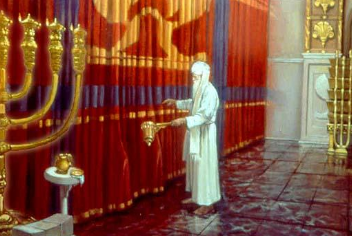

Q: Does this word link these two events in any distinct way of which you can think?
This baptism is the forerunner of the crucifixion!
Jesus is sinless but willingly plunges himself into the sinful waters of humans to take them on. He raises himself up out of the water and the sky splits open and God is present to everyone. One could say now he sanctified the waters.
Likewise, Jesus is sinless but willingly accepts his crucifixion as punishment for our sins, and he is raised up on the cross. When he dies, the Temple curtain that separated man from God is torn in two, and God and humans are no longer separated.
By accepting the Baptism in the Jordan by John the Baptist, Jesus was showing us what had to be. In a sense, he was knowingly signing his death certificate.
We also join Christ in his Baptism and Crucifixion, especially when we take up our crosses – whatever suffering we may have in this lifetime. How many of you have heard Paul say, “we are baptized into Jesus’ death”? (Rom 6:3-4)
The baptism and the crucifixion become the matching bookends of Jesus’ ministry on Earth.
This is the other reading for this day…
Isaiah 42:1-4
Thus says the LORD:
Here is my servant whom I uphold, my chosen one with whom I am pleased, upon whom I have put my spirit; he shall bring forth justice to the nations, not crying out, not shouting, not making his voice heard in the street. A bruised reed he shall not break, and a smoldering wick he shall not quench, until he establishes justice on the earth; the coastlands will wait for his teaching.
Where are we so far in our Biblical Timeline?
We left off at the end of the Book of Joshua and now we enter the period of the Judges - which takes us from Joshua’s death to the birth of Samuel.

Bible Timeline
Genesis – (12,000-2200 BC) Ch 1-11: Adam to Noah to Nimrod and the Tower of Babel (called pre-“history”)
(2,100-1,800 BC) Ch 11-50: Abraham, Issac, and Jacob, 12 sons/tribes, Joseph into Egypt 🡪 slavery
Exodus – (1,400-1300 BC) Moses – out of Egypt/slavery to Mt. Sinai to the promised land/40 years in the wilderness.
(Leviticus, Numbers, Deuteronomy - all take place during the 40 years in the wilderness.)
Joshua – (1350-1250 BC) Conquest of Israel and the division of land among Israel’s twelve tribes.
Judges – (1250-1050 BC) “Israel” ruled by 12 Judges from Joshua to King Saul
Ruth – (1100 BC/during Judges) Ruth the Moabite was the unlikely, great grandmother of King David.
1 & 2 Samuel (1050BC- 980 BC) King Saul and King David

The Book of Judges Author: Unknown, Date Written: 1050-517 BC
The Biblical concept of “judge” is not the same as ours; “judges” were people who were seasoned warriors, sometimes chosen directly by God, sometimes by the people, who were given the mission to protect Israel from enemy attacks and to take possession of the territory given them. Once peace was established, their role was to administer justice.
In most cases their authority did not extend to all Israel but usually just one tribe or group of tribes. This explains why there is no chronological succession in the line of Judges. Sometimes we find a number of Judges contemporary with each other.
Trouble
When Joshua was alive, the people were faithful. Any of their successes were because of Joshua’s faithfulness and insistence on following God’s instructions. After Joshua and other elders passed, the following generation failed to do what Moses and Joshua had instructed them to do. The people forgot what God had done for them and also failed to teach it to their children. Without the teachings of Moses to rely upon, the next generation did what you would expect – they became captivated by the gods of their neighbors. These gods were primarily Baal and Astarte.
Baal was a major Canaanite deity manifested through thunderstorms. Astarte, a Canaanite female deity and consort of Baal, represented the Canaanite cult. Infants were burned alive as a sacrificial offering to these deities. During the horrific screams and stench of charred human flesh, congregants would engage in bisexual orgies. So it was with the descendants of the cursed grandson of Noah (Canaan), son of Ham.
The Israelites were living in a multicultural, polytheistic environment, which God warned them about. Regardless of the roadblocks humans keep erecting, God will find ways to move them towards monotheism.
Thus began a cycle of sin and deliverance which came to define this period of the Israelites history. The cycle begins with idolatry (worshipping pagan gods and their immoral rituals) and neglect of the weak – the poor, sick, elderly, widows, and orphans. These fallen behaviors were then followed by the “Lord’s judgement at the hands of the nations” (read: lifting His protection), which resulted in the people being conquered and falling into suffering and servitude. This eventually led to the people’s repentance upon which the Lord would send them a “judge” to help them reassert control and re-establish peace for a period of years – until the cycle started again.

“In those days there was no king in Israel and all the people did whatever was right in his own eyes.” – Judges 21:25
BTW, this cycle does not stop with Judges. It pauses for periods of time during the reigns of King David and King Solomon, but otherwise it is the standard operating procedure (modus operandi) of the entire Old Testament. But then, this too has a lesson for us.
What is the lesson of this cycle?
Humans had to learn that no matter their effort, even when the rules had been written down for them (Ten Commandments), man cannot save himself. The Fall of Man was the same thinking – “we don’t need God, we can do this on our own.” However, the powers God gave man will only thrive in relationship to Him, not separately.
But we should also not look down on the Israelites because we would probably have been guilty of the same thing. In fact, this cycle is not so different from what most Christians experience in the New Testament – that includes us – except for the complete forgiveness that Jesus offers us.

The Judges
As noted above, there were twelve judges named in the Book of Judges, with six of them being major (bolded):
Major Minor
Othneil Tola
Ehud Shamgar
Deborah Jair
Gideon Ibzan
Jephthah Elon
Samson Abdon
The early Judges were better (morally) than the later Judges, perhaps because they were closer to Joshua and so followed him more faithfully. However, they got worse and worse as time went on. I’m not kidding – really bad. Next month, I will share 4-5 examples of this, which will take us to the end of Judges. Then we will do a short detour into the Book of Ruth before tackling the First Book of Samuel.
Next week 12/19, we will discussing the Great Women in the Bible, which just so happens to be around the time of the Judges: Deborah, Ruth, and Hannah.
4600
Closing Prayer
LORD
Lord, we thank you for the blessing of reading your word together.
We ask that these words of life, truth and hope continue to impact us in the week ahead.
May your love and grace follow each of us as we return to our daily lives, refreshed and blessed by you.
Together, let us ask Mary for her intercession in our lives…
Hail Mary, full of grace, the Lord is with thee.
Blessed art thou among women, and blessed is the fruit of thy womb, Jesus.
Holy Mary, Mother of God, pray for us sinners,
now and at the hour of our death.
Amen.


Comments