02.10.26 - | Lent | Repentance Sermon | Anger and Lust | Intro to New Testament |
- tmaley
- Feb 12
- 12 min read
Opening Prayer:
O LORD
Thank you for your promise that where two or three of us are gathered in your name, You are there.
We ask for Your help to open our minds and hearts tonight so that Your Word breaks through and changes our lives.
And as you taught us to pray together…
Our Father, who art in heaven, hallowed be your name.
Your kingdom come, your will be done, on earth as it is in heaven.
Give us this day our daily bread,
And forgive us our trespasses as we forgive those who have trespassed against us.
And lead us not into temptation, but deliver us from evil. Amen!
Major holy days: Ash Wednesday – the beginning of Lent, Feb 18
St. Joseph – March 19
The Annunciation – March 25
Mass or Confession anywhere/anytime: www.masstimes.org
TODAY:
Reflection – LENT is a Week Away, Confession,
Gospel Reading for 6th Sunday of Ord Time (2/15): Sermon on the Mount #3 – Mat 5:17-30
Bible Timeline: Intro to the New Testament
Quote of the Week:
“If you learn everything except Christ, you learn nothing. If you learn nothing except Christ, you learn everything.” – St. Bonaventure
Reflection: Lent and Repentance
Lent is a week away. For Christians, as we prepare for Easter it is a time of sacrifice and repentance.
Sacrifice, properly speaking, should be based on love. What Jesus did for us – coming here, living, and dying – was for love. If you sacrifice your time or money for someone you care about, that’s love. If you decide to give up chocolate or alcohol for Lent, or visit the elderly or lonely friends, if you do it for love of God, then they count!
Repentance – reviewing our mistakes with God should be a regular thing in our lives. Nightly is best while memories are fresh: Was I wrong about anything today? Can I acknowledge and articulate it? What I could have done differently? What might I do next time? When you have this conversation before Almighty God, watch what happens. No therapist on earth can touch God’s personal touch in your healing, growth, and continued improvement.
Confession. Christ also gives us the Sacrament of Confession. The difference between personal repentance and sacramental repentance are, at a minimum, these two things: certainty and grace.
1) Certainty of forgiveness.
When we go to God with our sins just in our heads, there is amount of uncertainty in the process. Do we truly articulate our sins? Do we express regret and that we will try not to repeat the sin? Do we ask for forgiveness?
In confession, these steps are complete and our forgiveness is certain. As GK Chesterton once said, “The reason I became Catholic was because I knew my sins were forgiven.” Certainty!
This Sacrament was important enough that Christ made it his first act after his Resurrection. In the Upper Room, he gave this solemn duty to the Apostles on Easter Day: “Jesus breathed on them and said, “Receive the Holy Spirit. If you forgive the sins of any, they are forgiven; if you withhold forgiveness from any, it is withheld.” – John 20:23
Mark Twain once said, “If you always tell the truth, you don’t have to remember anything.” Well, we can apply this to confession. If we go to confession, we don’t have to remember our sins ever again. They’re gone. Just think of the therapeutic value of this… we carry around psychological baggage all the time. Not after confession!
The inmate I currently mentor at the jail was depressed about the guilt of his crime, saying that he doesn’t think he can let it go. He had repented and received absolution from a priest. I asked him if he trusted that God forgave him. He said yes. So I told him that if he trusted God’s forgiveness, then he needs to let God take it from him. To hold onto it is to say to Him, “I don’t trust you.” He immediately agreed to start practicing this as soon as he got back to his cell.
Grace is supernatural strength to do better next time, which automatically comes to us in every sacrament.
That’s one of the Holy Spirit’s roles – delivering grace – especially in the Sacraments. With grace comes wisdom!
Jesus in the Upper Room on Easter Day
Confession Roadblock: Some people are hesitant or afraid to go to confession. A funny but true comment from St. John Damascene, “We have no shame when we sin, but we are ashamed to confess our sins.”
No doubt we have a mix of people here tonight – some who may go regularly, some who may not have been in a long time. But the truth is it couldn’t be made any easier. It’s anonymous and it takes all of 5-10 min, unless you are my brother Bill.
Anonymity. Why the screen?
Confidence of penitent (you and me) to be open and honest.
It’s easier to remember we are speaking to Christ when we are not looking at the priest. Remember, the priest is acting “in personal Christi” (in the person of Christ). It’s Christ forgiving us, not the priest!
It is helpful for the priest because it enables him to maintain the privacy of the penitent and shift focus away from personal interaction and towards his spiritual role in the sacrament.
I have done occasional face-to-face confessions at retreats and I don’t mind – some of them have been good; but as a rule, I prefer the screen.
How often are we required to go?
As often as you can or need to. Some go weekly, some monthly, some quarterly. The Church says we should go at least once a year, ideally during the Easter season. That season begins next week on the 18th!
So, everyone should make the effort this Lent – you’ve got 40 days – and you can be completely anonymous and choose any church – here is the link to find the times anywhere – www.masstimes.org. It is cathartic, you will feel relieved, and that’s one of the gifts. God doesn’t want us carrying around our guilt baggage – we can serve Him better without that. Remove it, let it go, feel lighter! We can go forward and be better people so much easier.
Suggestions for daily reflections during Lent:

Sunday’s Gospel Reading:
Sermon on the Mount #3 – Matt 5:17-30
Anger, Lust, Temptation
Context
This part of the Sermon on the Mount was probably the most controversial of Jesus’ day. He seems to offer a series of antitheses – opposites/challenges – to Moses’ commands, by saying, “You have heard… But I say…”. However, these are not challenges at all. In anticipation of this interpretation, Jesus makes it clear at the onset by saying, “Do not think I have come to abolish the law or the prophets. I have not come to abolish but to fulfill.” Nevertheless, that didn’t stop a heresy or two from using Jesus’ comments as reason to reject the Old Testament completely (i.e., Marcionism).
What does Jesus mean by the law and the prophets?
That was how the Old Testament was referred to. The “Laws of Moses” was the first five books of the Bible (Genesis, Exodus, Leviticus, Numbers, Deuteronomy) and “The Prophets” referred to the rest of the books.
One can look at the Mosaic Laws as a downpayment, or deposit, on humanity’s salvation. Jesus’ instructions in no way abrogate the teachings of the Old Testament; rather, they build on them; they “complete” them. In fact, Jesus’ quote above says “fulfill,” but the translation from Greek would more accurately be “complete.”
The Church offers two version of the reading for Sunday – a longer one and a slightly shorter one. We will be doing the shorter one. Still, there is a lot of content, so rather than reading it all at once and then circling back, we will read it and stop at each point that we need to reflect. Many volumes of books have been written on each of Jesus’ statements, but I will do my best to give you the most salient points in the time we have.

Matthew 5:17-30
Jesus said to his disciples: "Do not think that I have come to abolish the law or the prophets. I have come not to abolish but to fulfill. Amen, I say to you, until heaven and earth pass away, not one iota, or one tittle, shall pass away from the law, until all things have been fulfilled.
An “iota” was the smallest letter of the Greek alphabet, and a tittle (jot) was a dot used in the letter. Jesus couldn’t be more explicit that he was not canceling the Mosaic laws, he was completing them, taking them to their next level.
Therefore, whoever breaks one of the least of these commandments and teaches others to do so will be called least in the kingdom of heaven. But whoever obeys and teaches these commandments will be called greatest in the kingdom of heaven.
Jesus’ reference to least and greatest in the kingdom suggests there are different rewards for good and bad behavior (following the commandments). Is Jesus referring to God’s earthly kingdom or Heavenly kingdom?
Both. Rewards in this earthly kingdom of God are full of grace and closeness to God. Rewards in the eternal kingdom are degrees of glory in our beatific vision.
What does “degrees of glory in our beatific vision” mean?
Think of the hierarchy of angels. The highest angels – the Seraphim – are the closest to God. This is often depicted as a spatial thing, but God is outside space and time. It means they apprehend/experience God’s glory the fullest of all the angels. Likewise, humans will apprehend/experience the presence and glory of God in accordance with our faith and works on earth. That being said, we also know we will have perfect happiness in Heaven.
How can we have greater or lesser experiences of God, yet all have perfect happiness?
Dante describes it best. He compares our beatific vision to vases, and each of us has a different size vase, corresponding to our faith and works on earth. Mother Teresa’s vase will obviously be larger than someone who barely just squeaked in on his deathbed; but you see, both of their vases will be overflowing with happiness. You and I may not be able to comprehend Mother Teresa’s large vase of happiness, but it won’t matter because your own happiness is overflowing, even if it is the size of a thimble.
This doesn’t mean we will be sitting around all day looking at God as some beatific pictures suggest. Remember, there will be a new (or renewed) Heaven and Earth, and our experiences will be totally different as well since we will have glorified bodies (the laws of our physical natures will be subservient to our spiritual wills). So, I expect to be doing some extraordinary mountain climbing in the next life – with the Lord!

I tell you, unless your righteousness surpasses that of the scribes and Pharisees, you will not enter the kingdom of heaven.
This tells us that “works alone” (i.e., checking all the boxes of what we are supposed to do) – will not be enough. The Pharisees were experts at that. But as Jesus pointed out, our works have to be centered around our faith – and love of God and neighbor – not our accomplishments.
"You have heard that it was said to your ancestors, you shall not kill; and whoever kills will be liable to judgment. But I say to you, whoever is angry with his brother will be liable to judgment; and whoever says to his brother, 'Raqa,' will be answerable to the Sanhedrin; and whoever says, 'You fool,' will be liable to fiery Gehenna.
Jesus knows that anger is usually what leads to hatred and violence, so he is telling us we need to check our anger when it starts and not let it get the better of us. Note the initial feeling of anger is not the sin. Sin is our consenting to the anger by letting it continue. Anger has a power all its own, and where it leads is never good.
Therefore, if you bring your gift to the altar, and there recall that your brother has anything against you,leave your gift there at the altar, go first and be reconciled with your brother, and then come and offer your gift. Settle with your opponent quickly while on the way to court. Otherwise your opponent will hand you over to the judge, and the judge will hand you over to the guard, and you will be thrown into prison. Amen, I say to you, you will not be released until you have paid the last penny.
Forgive us our trespasses as we forgive those who trespass against us. We expect endless forgiveness from God, but not to give it. God is telling us to practice now – in this lifetime.
Secondly, note Jesus’ last comment – we won’t be released until we have paid the last penny. This is yet another allusion to Purgatory.
"You have heard that it was said, You shall not commit adultery. But I say to you, everyone who looks at a woman with lust has already committed adultery with her in his heart.
No doubt this disturbed Jesus’ audience severely! But again, he is not saying that lustful thoughts are a sin when they first appear in your mind. It’s what we do with them next that counts. If we entertain them further, that’s an invitation to continue. That’s consent. That is the adultery he’s referring to. You can see Jesus simply wants us to practice controlling our own minds.
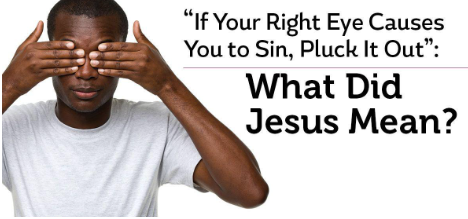
If your right eye causes you to sin, tear it out and throw it away. It is better for you to lose one of your members than to have your whole body thrown into Gehenna. And if your right hand causes you to sin, cut it off and throw it away. It is better for you to lose one of your members than to have your whole body go into Gehenna.
Jesus often speaks with hyperbole, which is exaggeration to make a point. Of course he doesn’t want people to cut out their eyes and cut off their hands, but he does want us to not forget how important it is to catch temptation early rather than later. The more we let it sit in our minds, the greater the chance we will fall. Do not grant your consent!
As St. Alphonsus Ligouri said, continue calling upon Mary and Jesus nonstop until the temptation ceases!
Bible Timeline

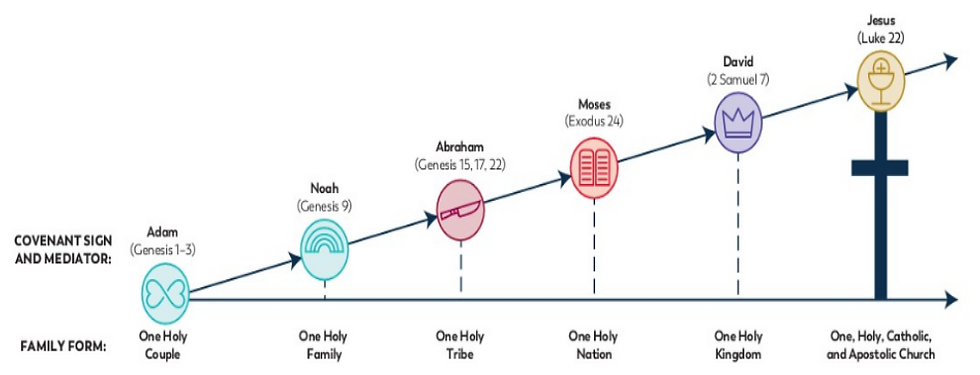
The Covenant Timeline
Although we generally only discuss two primary covenants – the Old Covenant and the New Covenant, this can also be broken down into six covenants, based on what is called “family form.”
Where we left off…
We finished the Old Testament with Maccabees 1 & 2 (160 BC) and a mention of Herod the Great (37-4 BC).
Once the Maccabees were successful, they violated the Mosaic priestly succession at the Temple by combining the political leader and chief priest roles. Consequently, a group of rebellious priests, called Essenes, claimed the Temple worship was corrupted. They left Jerusalem and established communities (now called Qumran) about 20 miles east of Jerusalem on the Dead Sea, to await the coming of the Messiahs.
The Essenes considered themselves the true Jews, and they still played a role in Jerusalem in Jesus’ time. Did the Essenes have a physical presence in Jerusalem?
Yes, there was an “Essene Quarter” in Jerusalem, which is where the Upper Room was located.


Introduction to The New Testament
As we move into the New Testament, we will again not read all 27 books, but will the continue the “Biblical Narrative” theme, which for us will be the Gospel of Luke and the Acts of the Apostles.
To start off, we do a review of all the books again so we have the big picture and can see where we are.

Canonical Order of Bible Books
Although the Bible might make more sense if we read it chronologically, it was originally organized by content. Chronological would be slightly complicated in that most books were not written right after the events themselves, and some were written centuries after the events occurred. Saint Jerome, the church scholar who translated the first complete Christian canon of the Bible into Latin in 405, arranged the seventy-three books into categories of content. This became the order of the canon that most Bibles have today.

Old Testament 46 books + New Testament 27 books = Total Bible 73 books

This view is to show you the books that the Protestants removed from the Bible in the 16th century.
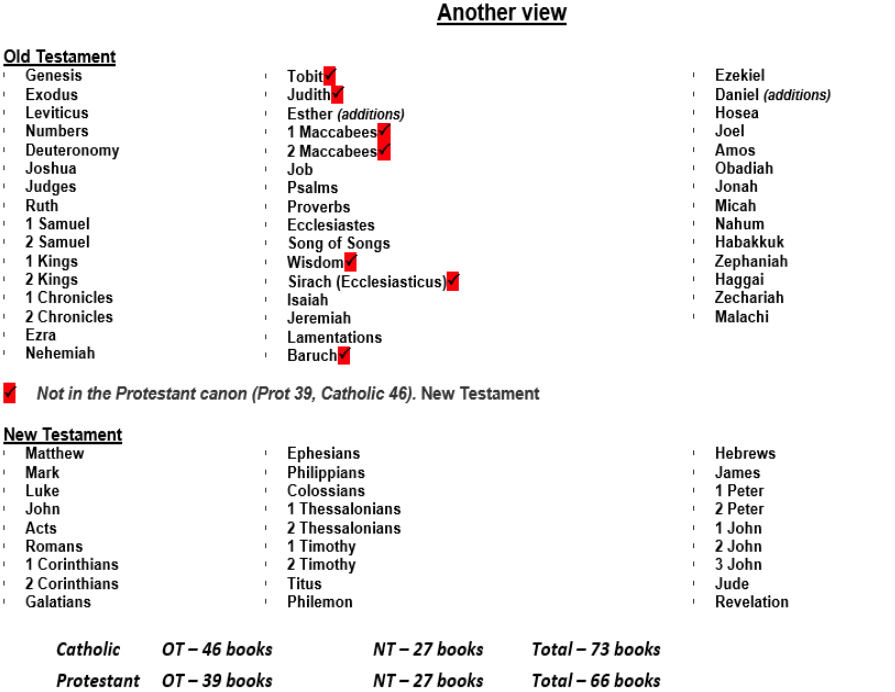
Protestants will reverse the statement above and say that the Catholics “added” seven books to the Old Testament. What do we say to that?
Catholics have been using the same books that were used at the time of Jesus, called the Septuagint.
Who knows what the Septuagint is and how it came to be?
The Septuagint refers to the Hebrew scriptures that were translated from Hebrew to Greek by Hebrew scholars about the year 250 BC. This is what the Apostles used and what Church continued to use until it finalized our current Bible in 382 AD at the Council of Rome. It included all 46 books that we currently have in the OT.
Why would Protestants object?
For one, these books have many Catholic ideas in them (i.e., praying for the dead). Second, Protestants will point to the Hebrew Bible which also doesn’t include these books. However, it is useful to know that the Hebrew “Bible” wasn’t created until a century after Jesus, and they would have had their own reasons to reject these books, such as references to the Messiah that seemed to point to Jesus such as the suffering messiah, or the incarnation in Baruch. Another example: Wisdom 2:12-20 speaks to the wicked plotting against the “son of God” who claims all righteousness. But you should also remember that one of the books the Jews they reject is the only book in the Bible that celebrates Hanukkah, which Jews still celebrate today. Which book is that? The Book of Maccabees.
But all this is about the Old Testament. We are beginning the NT, of which all Christians agree, there are 27 books. And our Biblical narrative that we will be following will utilize two books: the Gospel of Luke and Acts of the Apostles.

Which of the 4 Gospels is the longest?
Luke. Matthew has more chapters (28 v 24), but Luke has more words (19K vs 18K).
Who writes more of the New Testament, Paul or Luke?
Luke. Paul has more books (13 v 2) but Luke has more words (38K vs 33K).
Who is the author of Acts?
Luke.
Next month: The Gospel of Luke
Closing Prayer
Come, Holy Spirit
Fill the hearts of your faithful; kindle in them the fire of your love.
Send forth your Spirit and they shall be created.
And you will renew the face of the earth.
Hail Mary
Full of grace, the Lord is with thee.
Blessed are thou among women, and blessed is the fruit of thy womb, Jesus.
Holy Mary, Mother of God,
pray for us sinners now and at the hour of our death.
Amen.


Comments