03.17.26 - | Death of Lazarus | Intro to Eucharist |
- tmaley
- Mar 31
- 15 min read
Northern Virginia Catholic Bible Study & Apologetics 3/17/26
👉🏿 👉🏾 👉🏽 👉🏼 👉🏻 👉Watch the class recording here.👈 👈🏻 👈🏼 👈🏽 👈🏾 👈🏿
Every Tuesday, 7PM-8PM. This meeting is a lecture/Q&A format. It is free.
Meetings on Meetup: www.meetup.com/catholicbiblestudy. Sign up to get reminders and notes.
Zoom information for Tuesday nights: Zoom ID: 861 1782 2081 Password: 406952.
Afterwards, classes are posted on our Catholic Catacombs Website: www.CatholicCatacombs.org
House rules/notes…
RSVP Reminder: Please RSVP whether you are attending the meeting or just reading the Recaps afterwards. The more RSVPs, the more Meetup will give exposure to “Catholic Bible Study” – a good thing!
Questions. We encourage questions although we ask that you keep them on topic and brief. You can ask during the meeting, or in the chat box, or if you prefer you can email us through Meetup.com, or Ron directly: ron@hallagan.net.
Recaps. Within a day or two after each meeting, we will post the edited meeting notes of our discussions on our website, www.catholiccatacombs.org. Taylor will notify everyone when this is posted and provide you with a link.
Respectfulness. We will be discussing differences between Christian denominations and religions in general, and we seek to be respectful at all times. Protestants especially are our friends and brothers-in-Christ; in fact, I personally owe much of my return to the faith to them!
No politics. It would be easy for us to self-destruct, but that’s not our goal :). Our goal is to learn, understand, and apply the Bible and our Catholic faith to our everyday lives.
“The Chosen” TV series. All of us seek a relationship with Jesus Christ, which is not always easy. It can help if we have seen and heard Him. The Chosen series captures Jesus better than any show I have ever seen. Highly recommended.
Catholic Prayer & Fellowship. Are you interested in praying the rosary, etc. with other Catholics during the week? Follow fellow member Jason Goldberg at https://www.meetup.com/online-catholic-prayer-fellowship-and-spirituality/.
Cursillo. Interested in meeting weekly over coffee to discuss how God is involved in your personal and professional life? Join Cursillo (cur-see-yo). Initiation involves a 3-day retreat at Mission Hurst in Arlington. For men’s groups, contact Ron (ron@hallagan.net) and Jennifer Pence (Jennifer.pence@gmail.com) for women’s groups.
Dynamic Catholic. Interested in receiving daily inspirations to grow closer to God and the Catholic Church, not to speak of the many educational resources? Visit and sign up for Matthew Kelly’s powerful insights, quotes, and reflections at www.dynamiccatholic.com
Our Bible Study is a combination of Exegesis and Apologetics.
Study and interpretation of Scripture A reasoned defense of the faith
Each meeting is (roughly) as follows:
min Apologetic Reflection
min Upcoming Gospel Reading
30 min Weekly topic/theme
1 hour
Week 1: Gospel Week – we study several Gospel stories, especially the tough ones.
Week 2: Bible Week – we are working our way through the Bible. We are studying the New Testament.
Week 3: Questions and Survey Topics chosen by Members:
1. Explanation of the Mass and Eucharist 2. The Dead Sea Scrolls 3. Catholicism related to modern cosmology? 4. The 7 Gifts/Fruits of the HS & 7 Deadly Sins 5. Does doubting one’s faith mean we are failing God? 6. How do we experience the Love of God? 7. The Communion of Saints 8. Comparative Religions 9. Catholic vs Protestant beliefs
Week 4: Apologetics:
Gen 1-3 (Creation Story, Adam & Eve, the Fall of Man, The Meaning of the Trees)
Faith and Doubt
Deeper meanings of the Mass
Don’t forget to RSVP.
Taylor will send a link to everyone with today’s notes.
The class is recorded if you want to listen to it anytime.
I will ask for volunteer readers…
Opening Prayer
Lord, in your great generosity, heal our sickness … May we receive the bread of angels,
the King of kings and Lord of lords … with the purity and faith … that will help to bring us to salvation.
As Jesus taught us to pray… together
Our Father Who art in Heaven, Hallowed be Thy Name.
Thy Kingdom come, Thy Will be done, on earth as it is in Heaven.
Give us this day our daily Bread;
And forgive us our trespasses as we forgive those who trespass against us.
And lead us not into temptation but deliver us from evil. Amen.
Major holy days: LENT: Wed, February 18 through Thurs, April 2
St. Joseph – March 19
The Annunciation to Mary – March 25
Mass or Confession anywhere, anytime: www.masstimes.org
TODAY:
Lenten Reflection: Marriage
Reading for The 5th Sun of Lent (3/22), The Death of Lazarus, John 11:1-45
Member Topic: The Mass and Eucharist
NOTE: There ae 5 Tuesdays in March so no class next week 3/24 (I am traveling). Week 4 will resume Tues, 3/31.
Quote/Term of the Week – St. Joseph
St. Joseph has two feast days on the liturgical calendar. The first, on March 19, celebrates Joseph as the husband of Mary and the second, on May 1, celebrates St. Joseph the Worker. The Feast of St. Joseph the Worker was instituted by Pope Pius XII in 1955 to recognize the dignity of work.
"The humble craftsman of Nazareth not only personifies before God and the Holy Church the dignity of the worker (and work) but he is also always the provident guardian of you and your families." – Pope Pius XII, St. Peter's Square, May 1, 1955.
Lenten Reflection on Marriage

Jesus’ teachings on the Sermon on the Mount (Mt. 5-7) were so incredible that people wondered if he came to replace – or destroy – the Mosaic Law, including the Ten Commandments. Jesus responded in Mt 5:17…
“Do not think I have come abolish the Law or the Prophets; I have not come to abolish them, but to complete them.”
Does this mean that the laws/commandments in the Old Testament are still valid and true?
Yes. They are still the foundation for all Jesus’ teachings.
For example, murder is still wrong (5th Commandment), but Jesus points to the anger inside of us that leads to violence, telling us to address this anger in our minds and hearts while there’s still time, before it manifests as far worse things. Jesus is “raising the bar,” but he is actually raising the bar on our ability to love more. Also recall that Jesus called his instructions “Beatitudes,” which means “Happy are…” He is telling us that his words will lead us to happiness. Again: the 6th Commandment says adultery is wrong, but Jesus says the more important challenge is to not allow ourselves to lust after others in our minds. By catching this early and stopping the temptation from going further, he is teaching us “mental self-control” so that we can serve a higher love: putting others before our own self-satisfaction.
Another way to understand Jesus’ words is in the marriage covenant. Every husband and wife brings their past experiences (~ Old Testament behaviors) with them into their marriage, but together they begin to create something new and unique. In marriage, we make this new covenant with God, but each spouse is the beneficiary of the higher love. Note also that neither person abolishes their past nor destroys the people they once were. Rather, they keep what was good and leave behind that which no longer serves the higher love of spouse and family. Everything we learned before finds its fulfillment in the new life that is forged together. Over time, we raise children to live out this new life and this higher love. In this way, the family is emulating the Trinity.
Easter Reflection – Temptation and Identity

Temptation and Identity are related. The seeking of that elusive “I AM” is the Fall of Man.
When Lent began almost a month ago, we discussed Jesus meeting the Devil in the desert. Jesus came to give humanity a new start, a new life, ongoing forgiveness, and open the gates of Heaven to us. In this desert encounter, Jesus let Satan know that God was declaring a new battle to win back the souls of humans. His baptism signified this renewal, and now he would reverse the three temptations of our first parents at the Fall. Let’s analyze the Devil’s motives a little further.
Overall, the Devil seeks to undo our identity as sons and daughters of God, and when we lose our identity, we lose our purpose. When God breathed his spirit into us (Gen 2:7), we not only received a spiritual nature and free will but also our “primary identity” as sons and daughters of God. I say primary because we still possess an amazing uniqueness as individuals, which is also a gift from God – no two of us in all of history are the same. True, we have become prodigal sons and daughters (runaways), but we are finding our way back to Him.
This “primary identity” is critical because it informs everything we do. God is the only objective truth and thus the only guide for all that is true and good, right and wrong. This is the “foundation of rock” on which Jesus says we are to build our lives. We can build our unique lives endlessly on that foundation. Every other form of “self-identification” is an exercise in “I AM” – which means we are trying to replace our foundation with ourselves. This is building our life on sand, not rock.
If we look around us today, we can see how strong humanity’s desire for identity is. If our identity remains tied to the Giver/Source, then we will flourish and not get knocked over by the winds of life. If it is not tied to God, then we will desperately pursue its replacement, although every mountain we climb in search of it will be just be another empty suit.
The Death of Lazarus
Context
The raising of Lazarus is a long reading, taking up all of John 11. The reading doesn’t quite go to the end of the chapter, which is when the Pharisees get word about what Jesus did and plot to have him arrested. They don’t believe Jesus raised anyone and decide that if people get riled up any more than they are, the Romans will come and destroy the Temple and they will all lose their safe, status positions, if not their lives. As the high priest, Caiaphas, said famously,
“It is better that one man should die for the people than for the whole nation to perish.” – John 11:50
How is Caiaphas’ statement far truer than he imagined?
In was indeed better that one man should die for the people than for all of humanity to perish.
You may remember that Lazarus is the brother of Martha and Mary. They lived in Bethany, approximately 2 miles southeast of Jerusalem on the other side of the Mount of Olives.
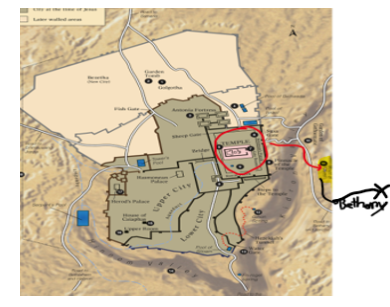
All three of them were very close friends of Jesus. Earlier, the Gospel of Luke (10:38-42) records the story of when Jesus visits Mary and Martha. Who remembers that story? Which woman sat listening at Jesus’ feet and which one was upset at doing all the serving by herself?

When Jesus called to Lazarus to come out of the tomb, Lazarus stumbled out with his hands, feet, and head bound by burial cloths. I would imagine it had to look like a scene from one of the old Sci-fi flicks like The Mummy.
Of course, Lazarus’ movements were hindered by the wrappings, so Jesus commanded them, "Unbind him and let him go." Lazarus was unbound, set free, and he stepped into new life.
What was the difference between Lazarus’ being raised from the dead and Jesus being raised from the dead? TayQuiz
Lazarus would die again. Jesus started something new, being the first human to rise and live forever. This is what Paul means when he said Jesus was the “first fruits of those who have fallen asleep.” – 1 Cor 15:20.
The raising of Lazarus is Jesus’ seventh and greatest miracle in John's Gospel (in Jesus’ human life). This miracle is the final step toward the cross. It is this miracle which pushes all the buttons of the Pharisees and Sadducees and sets them on their path to kill Jesus.
This miracle also has a message for us about resurrection living. We come into this story already knowing the outcome. We know there is still one more miracle up Jesus' sleeve. Another stone will be removed. Another grave will be found empty. And a whole group of people, many of those there the day Lazarus was raised, would witness the Risen Christ and know him to be the Lord of both life and death.
Because of him, our resurrection actually begins in this life, while we are still here. Jesus calls each of us to come out from our tombs, unwrap the cloths that bind us, and be set free so that we can live the resurrection in our own lives. Jesus calls us to replace our fear with faith, to move from a self-centered life to a life of service and commitment.
The Death of Lazarus

John 11:1-7, 17, 20-27, 33-45
Now a man was ill, Lazarus from Bethany, the village of Mary and her sister Martha. Mary was the one who had anointed the Lord with perfumed oil and dried his feet with her hair; it was her brother Lazarus who was ill. So the sisters sent word to him saying, “Master, the one you love is ill.”
When Jesus heard this he said, “This illness is not to end in death, but is for the glory of God, that the Son of God may be glorified through it.”
Now Jesus loved Martha and her sister and Lazarus. So when he heard that he was ill, he remained for two days in the place where he was. Then after this he said to his disciples, "Let us go back to Judea.”
When Jesus arrived, he found that Lazarus had already been in the tomb for four days.
When Martha heard that Jesus was coming, she went to meet him; but Mary sat at home. Martha said to Jesus, “Lord, if you had been here, my brother would not have died. But even now I know that whatever you ask of God, God will give you.”
Jesus said to her, “Your brother will rise.”
Martha said, “I know he will rise, in the resurrection on the last day.”
Jesus told her, “I am the resurrection and the life; whoever believes in me, even if he dies, will live, and everyone who lives and believes in me will never die. Do you believe this?”
She said to him, “Yes, Lord. I have come to believe that you are the Christ, the Son of God, the one who is coming into the world.”
Jesus was moved and troubled, and said, “Where have you laid him?” They said to him, “Sir, come and see.”
Jesus wept. So the Jews said, “See how he loved him.” But some of them said, “Could not the one who opened the eyes of the blind man have done something so that this man would not have died?”
So Jesus, perturbed again, came to the tomb. It was a cave, and a stone lay across it. Jesus said, “Take away the stone.”
Martha, the dead man’s sister, said to him, “Lord, by now there will be a stench; he has been dead for four days.”
Jesus said to her, “Did I not tell you that if you believe you will see the glory of God?”
So they took away the stone, and Jesus raised his eyes and said, “Father, I thank you for hearing me. I know that you always hear me; but because of the crowd here I have said this, that they may believe that you sent me.” And when he had said this, he cried out in a loud voice, “Lazarus, come out!”
The dead man came out, tied hand and foot with burial bands, and his face was wrapped in a cloth. So Jesus said to them, “Untie him and let him go.”
Now many of the Jews who had come to Mary and seen what he had done began to believe in him.

Exegesis
Study/Interpretation/Explanation
Why did Jesus wait four days?
Jesus decided it was a greater message to raise someone from the dead than to heal their sickness. He was also preparing them for his own death and resurrection that was coming very soon.
The belief among the Jews (in the Mishnah) was that one’s spirit hovered over the body for up to three days. Sometimes people would wait in the hopes that the person was only in a coma. But corruption of the body set in after that so by the fourth day the person was absolutely dead. Jesus made sure everyone knew Lazarus was dead.
Jesus knew what he was going raise Lazarus, so why did he weep?
First, Jesus is distraught at the extensive human suffering caused by Satan. Remember, God loved us so much he sent his only Son to die on our behalf. Jesus is experiencing that love and sorrow in his human form.
On a personal level, he would have been broken-hearted just to see his best friends, Martha and Mary, so grief-stricken over the loss of his dear friend and their brother.
Finally, Jesus shows us that it’s a good thing to share in the suffering of others (even for men to weep). Remember, one of the Spiritual Works of Mercy calls on us to “comfort the afflicted.”
What sacrament did the great 4th century Biblical scholar St. Augustine compare the raising of Lazarus to?
Augustine saw the resurrection of Lazarus as a sign of the Sacrament of Reconciliation, and in Christian art found in the catacombs in Rome dating from the first, second, and third centuries there are over 150 representations of the raising of Lazarus symbolizing the gift of the life of grace which comes through the priest in this Sacrament.
Think of coming out of the confessional as your coming out of the tomb!

The Mass and Eucharist

I was raised Catholic. It seemed everything taught to me my first 15 years went in one ear and out the other. This was true for the Mass as well as everything else. Lots of memorization, little understanding, and no relationship with God. I was a troublemaker so my parents sent me away to a seminary for high school, probably figuring they’d kill two birds with one stone – get rid of trouble and get a priest in the family. I had major A.D.D. issues (before A.D.D. was identified) and some anger issues, so I eventually got kicked out of the seminary and became an atheist. Atheists believe in nothing, which I knew I could do in spades! In an odd sort of way, the seminary gave me some good atheist training.
My path back to Christianity started with just God and angry me; eventually, it was God as a friend. And then some Protestant neighbors/friends invited me to Bible study; then I started teaching CCD and came back to Catholicism. Looking back, God was slowly bringing me back, like breadcrumbs on the path in Hansel and Gretel.
The hardest thing for me to accept was the Mass and Eucharist. It took years. It eventually helped to learn about the first Passover in Egypt, what the blood meant, the sharing in the sacrificial meal, and the manna in the desert – all of which played into John 6 where Jesus explicitly repeats a dozen times that “he” is the new Passover meal. The Last Supper was actually the “Last Passover” for the Jews (although modern Jews don’t realize it). Jesus’ sacrifice brought the need for Jewish sacrifices to an end, because Jesus elevated it and made it eternal. Jesus’ “sacrifice” is not repeated in the Mass, it’s the same sacrifice still present, eternalized, meaning our sins continue to be forgiven from the same cross.
It also helped to understand the philosophy and theology of the bread and wine, and that it was not Jesus’ bloody human body we were consuming but his elevated, resurrected, glorified body and blood, which is like nothing we know in this material world. Although the physical appearance (clothes) of the bread and wine remain, the complete being/essence/ substance of Jesus is contained in those clothes. This is Trinitarian food for our spiritual growth, preparing us for Heaven.
Once I began to understand the meaning and truth of the Eucharist, then the Mass started looking different. If there was this degree of history and richness associated with the Eucharist, perhaps the same was true for the rest of the Mass.
Before we delve into history, let’s conclude tonight with a discussion of love.
What is highest aspiration of humans?
To love and be loved. Many might say “happiness,” but try defining that and most of it will be worldly, shallow, and temporary. Take any successful person and remove “loving or being loved” from the equation, and his/her life will lose all meaning. The truth is that happiness comes from loving and being loved.
What is the most descriptive definition of love?
“A willingness to sacrifice for another.” If you look at the 5 main loves in the Greek language – Agape, Storge, Eros, Philia, and Luda – Agape is the love spoken of in the Bible that is closest to God. The willingness to sacrifice for another – be it your spouse, your children, your best friend, or even a stranger – is the most defining characteristic of this highest love.

Where do we get this high idea of love and its centrality to the value of our existence?
God. Remember, God is love (1 John 4:8).
God breathed his spirit into us (Gen 2:7), and we’ve been smitten by this concept of love ever since.
If we seek the greatest love, and God is the greatest love, and the greatest expression of this love is sacrifice, then shouldn’t God be willing to put his money where His mouth is and show us, personally, what that looks like?
Indeed. That is why He came here despite knowing what we would do to Him. Then to go through with sacrificing Himself for no personal gain but just for our benefit surpasses all definitions of love. In fact, He slowed down time and rolled it out very carefully for our understanding during Holy Week, particularly at the Last Supper.
Finally, what does the word “sacrifice” mean?
The word sacrifice means “to make holy.” It’s Latin: facere (to make) + sacred (holy).
When we come to the Eucharistic table, in a sense we place ourselves on the altar – the bread and wine represent us – and we are saying to the Lord that “we join you in giving yourself to God.”
When we say, “Amen,” we are saying we receive the risen Lord Jesus Christ into our lives. In effect, we acknowledge, “Well, Lord, we both know I’m not perfect, and I don’t have all the answers, but I believe in You and that You love me and want to walk that path with me.”
Maranatha – Come Lord Jesus, enter, and make your home with me.
Closing Prayer
O Lord…
We thank you for the blessing of studying Your Word together.
We ask that these words of life, truth and hope enlighten our minds and strengthen our faith.
May your love and grace follow each of us as we return to our daily lives, refreshed and blessed by you.
We ask this in Your holy Name.
Amen.


Comments