05.02.23 Recap: Gospel Night
- tmaley
- May 8, 2023
- 16 min read
Northern Virginia Catholic Bible Study & Apologetics Online via Meetup/Zoom or In Person at St. John Neumann Catholic Church 11900 Lawyers Road, Reston, VA 20191 https://saintjn.org/ House rules/notes… 1. Meetup is www.meetup.com/catholicbiblestudy Zoom Meeting Logon info is the same every week: Zoom ID: 861 1782 2081 Password: 406952 2. I will send out Meeting Recaps the same night as our sessions – these are unedited versions without pictures. An edited version with pictures will be posted on our website https://catholiccatacombs.wixsite.com/website/recaps before the next meeting. Taylor will notify everyone at that time. 3. Questions encouraged. If you have questions about anything, you can ask in the chat box, email the Meetup group, or me at ron@hallagan.net. 4. Respectfulness. We will be discussing differences between religions and Christian denominations, and we agree to be respectful at all times. Specifically, Protestants are our friends and brothers in Christ; in fact, I personally owe part of my return to the faith to them! 5. No politics. It would be easy for us to self-destruct, but that’s not our goal. Our goal is to learn/understand/apply the Bible and our Catholic faith. 6. Catholic Prayer & Fellowship. Are you interested in praying with other Catholics during the week? Fellow member Jason Goldberg has started “Catholic Prayer, Fellowship, and Spirituality Meetup.” Sign up at: https://www.meetup.com/online-catholic-prayer-fellowship-and-spirituality/. 7. “The Chosen” TV series. All of us seek a relationship with Jesus Christ, which is not always easy. It can help if we have seen and heard Him. The Chosen captures the real Jesus as close as any show I have ever seen. Just watch the first two with Mary Magdalene and you will see what I mean. 8. RSVP Reminder: Please RSVP whether you are attending the meeting or just reading the Recaps afterwards. The more RSVPs, the more Meetup will give exposure to “Catholic Bible Study” – a good thing! Consider it your way of evangelizing! Please RSVP when you get the Meetup invite weekly. Our Bible Study Format: 5 min greeting/prayers, 10-15 min Catholic topic, 40-45 min on the main topic from weekly List below: Week 1: May 2 – Gospel Week: Sermon on the Mount, cont’d Week 2: May 9 – Bible Week (Gen àRev): We are in EXODUS, the 2nd book of Moses. Week 3: May 16 – Topics Requested by Members: We are currently in Comparative Religions.
Ö 1) Jesus’ Greatest Parables Ö 2) Hell, Purgatory, Heaven 3) Comparative Religions: Protestantism, Orthodoxy, Islam, Buddhism & Hinduism 4) Great Women in the Bible 6) Book of Revelation 7) Major Heresies and Church Councils Week 4: May 23 – Member Questions: 1. “Who am I?” It seems we all ask this question at some point in our lives. Some ask it all the time. How do you answer this? Also, what does it mean to be born again? Does this change the self? 2. Does the path get harder the closer we get to God? Things that seemed not so bad before now look bad. Also called Acedia. 3. Are Charity and Love synonymous? How are they different? What are the 4 highest forms of Charity? 4. Can you review origin and meaning of the 12 statements of belief in the Creed? 5. How many Gospels have the story of Jesus’ calming the storm? Are they the same story? 6. Was God full of vengeance and violence in the OT? Or was that simply an interpretation by those of that time? 7. Can you provide an intro/overview of the OT books? 8. Is sex good or bad? Week 5: May 30 – Memorial Day Weekend – No Meeting. Return as normal June 6. Catholic Catacombs Website: https://catholiccatacombs.wixsite.com/website/recaps Next major holy day(s) in the Church Pentecost Sunday – May 28 (elevation the OT Pentecost, the HS comes, the beginning of the Church) Opening Prayer As the prophet Micah wrote, “O people! The LORD has told you what is good, and this is what he requires of you: To do what is right, to love mercy, and to walk humbly with your God.” Our prayer is that we, too, learn to be open and walk humbly with You. May the Holy Spirit guide us as we learn from your famous sermon tonight. And as You taught us to pray: Our Father Who art in Heaven, Hallowed be Thy Name. Thy Kingdom come, Thy Will be done, on earth as it is in Heaven. Give us this day our daily Bread; And forgive us our trespasses as we forgive those who trespass against us. And lead us not into temptation but deliver us from evil. Lord Jesus Christ, Son of God, have mercy on us all. Amen. Matthew 5-7: The Sermon on the Mount (continued) The first 11 verses of the Sermon on the Mount are the 8 Beatitudes, which we covered in our Gospel weeks Feb 7, Mar 7, and April 4, which you can read again anytime at www.catholiccatacombs.wixsite.com/website/recaps. Now we will continue with this most famous sermon ever delivered by Jesus while on earth. Recall if you will that mountains in Scripture are the sites of theophanies (Gk: theo=God + phany=appear). In Exodus, after meeting God atop Mt. Sinai, Moses came down the mountain to deliver the Ten Commandments to the people. This time, however, Jesus takes the people up the mountainside to deliver his sermon. The New Testament imagery here was not lost on the apostles or early fathers of the Church. Jesus was the theophany and he was elevating the Covenant of Moses.


LUST
You have heard that it was said, ‘Do not commit adultery.’ But I tell you that anyone who looks at a woman lustfully has already committed adultery with her in his heart.
Q: Just as murder and violence are preceded by anger, adultery is typically preceded by lust. What is lust?
Have you ever noticed that when we allow ourselves to fall prey to our animal desires, immediate gratification becomes the boss? Our rational minds are held off at gunpoint and told to stay out of the way. That’s why Jesus said,
If your right eye causes you to stumble, gouge it out and throw it away. It is better for you to lose one part of your body than for your whole body to be thrown into hell.
Once again, we have been given free will and God is trying to teach us how to manage ourselves. Like anger above, it always starts inside of us, so that’s where we need to focus.
Q: The question was asked, what is the difference between lust and coveting in the ninth commandment?
They are very similar. Some theologians say that the ninth commandment is a sin against justice (wanting what belongs to someone else), and Jesus was calling lust a sin against temperance (sinful desire for sexual gratification).
DIVORCE
“You have heard the law that says, ‘Whoever shall put away his wife, let him give her a letter of divorce.’ A man can divorce his wife by merely giving her a written notice of divorce.’ But I tell you that anyone who divorces his wife, except for sexual immorality, brings adultery upon her. And he who marries a divorced woman also commits adultery.
Jesus was well aware of the ease with which a man could divorce his wife by merely issuing her a bill of divorce, which was particularly onerous to women. Rabbis were all over the place on strictness, with more liberal Rabbis approving of divorce for anything, such as if a man didn’t like his wife’s cooking. The question was posed to Jesus to see which side he was favoring. Instead, Jesus said they were both wrong and returned marriage its original purpose, as stated by God in Genesis 2: Man/woman shall leave their parents and hold fast to each other, and the two shall become one; and then Jesus adds, “What God has joined together, let not man put asunder” (Mt. 19:6). Jesus does leave an exception in place, “on the ground of unchastity.” This is often translated as “unless the marriage is unlawful,” with the implication that there was never a valid marriage to begin with.

OATHS Again, you have heard that it was said to the ancients, 'You shall not swear falsely, but you shall keep your oaths to the Lord.' But I say to you, do not swear at all: neither by heaven, for it is God’s throne, nor by the earth, which is his footstool… Simply let your ‘Yes’ be ‘Yes,’ and your ‘No’ be ‘No.’ Anything more comes from evil.”
My first conclusion from this is that we won’t be needing lawyers in heaven. The legal impracticality of such an ideal in today’s world tells us how far we have come as a species.
Notwithstanding, Jesus is saying that a person’s word should be all that is necessary (we still do that personally, right?). Jesus says all we need is integrity. People who value honesty and the truth don’t need oaths and contracts.
Jesus is asking: Can we still hold ourselves to this standard and practice meaning what we say and saying what we mean? Can our yesses mean yes? And, especially regarding temptation, can our noes mean no?
EYE FOR AN EYE
You have heard that it was said, ‘Eye for eye and tooth for tooth.’ But I say to you, do not resist the one who is evil. But if anyone slaps you on the right cheek, turn to him the other also. And if someone compels you to go one mile, go with him two miles.

Q: One could categorize this as one of Jesus’ hyperbolic points, but obviously he wants to leave a strong impression in our minds. What is Jesus’ point?
1) At the very least, Jesus is forbidding excessive retaliation. Humans are infamous for over-retaliating. When an eye for an eye was first given in Ex 21:24, it’s purpose was not to encourage equal retaliation but to prevent unequal responses (“you stole my sheep, so I will kill your entire family”).
2) However, Jesus is going a step further. He knows that if we don’t catch ourselves early on, anger, resentment, and vengeance will overtake us. So he is telling us to think in the opposite direction. To be able to hold your calm and not fly off the handle in anger takes courage, strength, and practice! In fact, it is like HIM.
3) Turn the other cheek: When someone insults or ridicules you, instead of giving it back to them, say, “Ok, sorry if I offended you,” or, “You have a point there, I’ll work on it.” Or something like that. The point is that if you dish it back to them, what do you think will happen? You will likely escalate the problem – fighting fire with more fire! The devil and his minions are rooting you on! But evil needs oxygen, and if you give the opposite response, it sucks the air out of the opposition. Evil has nothing to grab onto, it can’t breathe, and it disappears.
Conclusion: Jesus is saying to respond to life’s challenges with unexpected, even extreme, generosity. In other words, overcome evil with good.
LOVE YOUR ENEMIES
“You have heard that it was said, ‘Love your neighbor’ and ‘Hate your enemy.’ But I tell you, love your enemies and pray for those who persecute you, so that you may be sons of your Father who is in heaven. For he makes his sun rise on the evil and on the good and sends rain on the just and on the unjust. If you love those who love you, what reward will you get? Are not even the tax collectors doing that? And if you greet only your own people, what are you doing more than others? Do not even pagans do that?
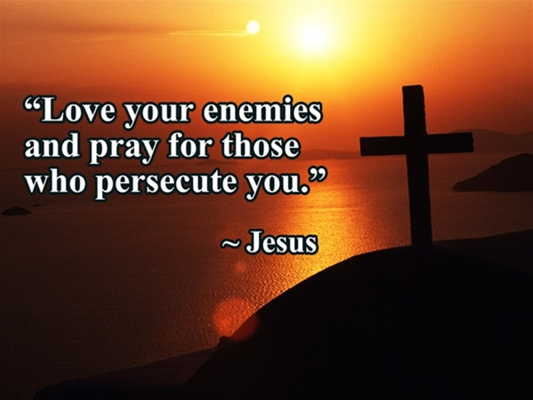
Q: How do we “love” our enemies?
First of all, love is not a “feeling.” That’s Eros. We’re talking Agape. It is to will the good of another; everyone.
So, how do we love someone we don’t like? Easy, we say a prayer for them instead of condemning them.
Think about it: if you had a choice between the disliked person as they are now, or them apologizing for their stupidity and crawling back to God for forgiveness, which would you choose? If you chose the first one, then you need more help than they do. Of course, we would want them to turn their life around, so that’s what we are praying for.
When you do this, watch how it changes your life. Resentments cause mental and physical destruction. Learn to get rid of them by praying for those who drive you crazy.
“Resentments are like drinking poison and waiting for the other person to die.”
Week One: Gospel Week
The Road to Emmaus and Divine Mercy Sunday Reading

Last week we were answering the question about the origin of the Mass and we won’t finish that until the May 23 meeting. However, the part where we left off happens to be today’s Gospel reading, the “Road to Emmaus,” which also drives home the Mass, especially the Eucharist.
The Last Supper wasn’t a chance occurrence. It was very intentional. The entire Bible – the entire history of mankind – is wrapped up in that one evening, including undoing the fall of Man, how Jesus planned to make himself present with us for the rest of time, and reopening the gates of heaven (“I am going to make a place for you” – Jn 14:3).
In the 2nd half of John 6, Jesus talks at length, repeatedly, about him coming down from Heaven as the bread of eternal life, and that those who eat this bread will have eternal life. He was so explicit that many followers – who were there just to see his miracles – left. Instead of explaining that he was just kidding, or only speaking “symbolically,” Jesus turned to his Apostles and asked, “Are you going to leave me too?” They didn’t; Peter said, “Where else will we go? You have the words of eternal life.”

Q: Now, aside from all this, and aside from what he said at the Last Supper (“this is my body”), and aside from the Apostles celebrating Christ’s presence in the “Breaking of the Bread” after Jesus left in Luke 24:35, Acts 2:42, Acts 2:46, 1 Cor 10:16-17, 1 Cor 11:28-29, and Luke 24:35, and aside from the first 15 centuries there being no question whatsoever about Jesus Christ’s presence in the Eucharist – aside from all these, why does Jesus’ presence in the Eucharist make sense?
Because everything God does from Genesis 1 onward is a marrying of the Heaven and earth, of the spiritual and physical, of God and man.
Breathing his spirit into man in Gen 2. Changing the course of human history by interacting with Noah, Abraham, Moses, and David. Heaven meets earth in the biggest way of all in the Incarnation, where God enters mankind! What was Jesus Last Supper comment, “this is my body” if not another incarnation – again, for us – before he ascends.
God wouldn’t have to come here to take a beating from us. He had other options. But, apparently, it was so important that he entered into his own creation to become one of us.
Also, why do you think we are getting our bodies back? There would be no point, unless having our bodies was an important part of God’s plan.
The Eucharist embodies all these things. The truth of the Eucharist is the truth of God’s plan for us. Why would anyone stop believing in that when the endgame is so glorious – our bodies and spirits together again in an incredible, Heavenly experience – for all time?
Sadly, the majority of Catholics today think the Eucharist is just a symbol – not really Christ, and therefore not a “real” encounter. Whether we want to blame the Church, or our upbringing, or the so-called advanced, scientific culture we live in, it’s a shame. We can do better.
By the way, combining heaven with earth is also the formula for receiving Sanctifying Grace, which is the spiritual key to the gates of Heaven. That is why all the sacraments involve some earthly component plus the Holy Spirit, which then yields Grace (i.e., Baptism is water and the HS, Confirmation is chrism and the HS…). The leading sacrament of all of these is the Eucharist, which makes the rest of the sacraments possible.
This is a pictorial of what’s happening, and if we are truly Christian, we not only need to understand it but embrace it and be excited about it…

The Incarnation, The Mass/Eucharist, The Sacraments, and Us
The Road to Emmaus - Luke 24:13-35
There are many messages for us in this story. First, note that Jesus appears to the two disciples as a stranger. They don’t recognize him. Second, Jesus begins revealing who he is by opening the Scriptures for them, beginning with Moses and all the prophets. Third, Jesus reveals himself finally in the breaking of the bread. So just on the surface, we can see that Jesus appears to them three ways: in the stranger, in the Scriptures, and in the breaking of the bread.
Now that very day two of them were going to a village seven miles from Jerusalem called Emmaus and they were conversing about all the things that had occurred. And it happened that while they were conversing and debating, Jesus himself drew near and walked with them, but their eyes were prevented from recognizing him.

Q: Why were their eyes prevented from seeing him?
Theologians say it is a combination of the power of Jesus’ glorified being – where he can bend time and space to his will, including what others see (our glorified bodies will be similar) – and the lack of faith on the part of the disciples (the reason Jesus withholds their recognition). Interestingly, Luke consistently writes about how Jesus and his disciples are moving toward Jerusalem, but suddenly these disciples are moving away from Jerusalem!
Jesus asked them, “What are you discussing as you walk along?” They stopped, looking downcast. One of them, named Cleopas, said to him in reply, “Are you the only visitor to Jerusalem who does not know of the things that have taken place there in these days?”
And he replied to them, “What sort of things?”
Q: What is Jesus doing?
Rather than criticize or lecture them right off, he walks with them and asks them to share. He comes to where they are.
They said to him, “The things that happened to Jesus the Nazarene, who was a prophet mighty in deed and word before God and all the people, how our chief priests and rulers both handed him over to a sentence of death and crucified him. But we were hoping that he would be the one to redeem Israel; and besides all this, it is now the third day since this took place. Some women from our group, however, have astounded us: they were at the tomb early in the morning and did not find his body; they came back and reported that they had indeed seen a vision of angels who announced that he was alive. Then some of those with us went to the tomb and found things just as the women had described, but him they did not see.”
Q: The disciples seem to have their “facts” more or less correct, but what is missing?
They have all the data. They just don’t have the truth. They don’t have the meaning.
Have you ever looked at the picture of a cartoon and not gotten the humor? You see all the parts, you see the characters and the words, but you ask, “Why is it so funny?” Just having all the data is not enough. There’s another pattern going on you need to find. This is their problem.
Jesus has every right to be disappointed in them for giving up but he has listened patiently. However, he is not about to let them continue down this path of despair – away from him. He is going to slowly open their eyes.
And Jesus said to them, “Oh, how foolish (thoughtless) you are! How slow (dull) of heart to believe all that the prophets spoke. Was it not necessary that the Messiah should suffer these things and enter into his glory?”
How could they forget that he had to come and pay for their sins in order to save them? As for entering into his glory, that’s what happens when you expand God’s kingdom. Glory is not about self, but about saving others.
Then beginning with Moses and all the prophets, he interpreted to them what referred to him in all the scriptures.
They are getting a Bible study class from Jesus Christ, himself! Who wouldn’t give his left arm to have walked with them. What we see first is that the OT is still not only important scripturally, but it contains great meaning as to who God is and what He is doing. All the events in the OT point towards this moment, towards God coming as the Messiah to save us, to finally crush the head of the serpent (Gen 3:15).
As they approached the village to which they were going, he gave the impression that he was going on farther. But they urged him, “Stay with us, for it is nearly evening is almost over.” So he went in to stay with them.
And it happened that, while he was with them at table, he took bread, said the blessing, broke it, and gave it to them. With that their eyes were opened and they recognized him, but he vanished from their sight.
This was no McDonald’s happy meal. This is the Eucharist and the Eucharistic formula given at the Last Supper.

Q: What is Jesus telling them by disappearing when he does?
He is reminding them of the Last Supper and connecting the dots. Their eyes were opened as they recognized him in the breaking of the bread, and then he disappeared. Jesus is telling them, “You will not see me physically much longer, but I will still be here whenever you perform the breaking of the bread in my name.”
Then they said to each other, “Were not our hearts burning within us while he spoke to us on the way and opened the scriptures to us?”
Remember the comic comment above. The breaking of the bread was the light going off and they recognized what was happening; the whole picture came together. In fact, they couldn’t even stay the night – they had to return to Jerusalem immediately. Note: they were on the road going the wrong way, and their encounter with Jesus got them turned around.
So they set out at once and returned to Jerusalem where they found the eleven gathered together with those with them who were saying, “The Lord has truly been raised and has appeared to Simon!”
Then the two recounted what had taken place on the way and how Jesus was made known to them in the breaking of the bread.
FYI – the disciples were hiding in the Upper Room – the same room where the Last Supper took place.
Q: Next Gospel Week we will pick up where this story leaves off. Who knows what happens next?
It is still Easter Sunday. This is when Jesus comes through the locked doors and surprises them all.

Conclusion.
Returning to our first message, we see that Jesus appeared to them in the stranger, in the Scriptures, and in the breaking of the bread – and this remains true across all time.
The Stranger… Jesus works through other people and hides in strangers. “I was a stranger and you welcomed me…” Mt. 25:35. When we love our neighbor, they come alive. There are no strangers to God. Yet we are surrounded by real and metaphorical strangers everywhere. Sometimes the Lord is walking right next to us and we don’t realize it. We need to look for these chance encounters and opportunities.
The Scriptures… God calls us to know him, which happens through Scripture. Jesus gave the first Bible Study class in the NT – there’s our example. The Scriptures are inspired which means they contain real truth, not worldly truth; and with many different levels they are able to meet us wherever we are – Just like Jesus did with the two disciples.
The “Breaking of the Bread” is what the Mass or Eucharist were called in the early years of Christianity. Jesus reveals who he is in the bread at Emmaus. It is the same Self he promises us in John 6 and gives us at the Last Supper.
Finally, notice how the risen Christ is only gradually manifested to them on their journey. Is this not true for all of us? The truth is that all humans are either walking towards God or away from Him. There is no static middle. We choose to be part of this story. Or not.
When the two men on the way to Emmaus didn’t recognize Jesus for that entire trip, part of it was because they did not believe. They left behind the empty tomb in Jerusalem because they decided it just wasn’t panning out as they expected. Likewise, we can go to Mass in this exact same way. We can seek to engage Jesus Christ, or not. We have free will, so he can only be present in our lives if we choose to recognize him.

Our Road to Emmaus
Closing Prayer
Dear Lord
Tonight we studied your “commandments” at the Sermon on the Mount –
The Magna Carta of the Bible –
And your walk to Emmaus on Easter day.
May we learn to incorporate these incredible teachings into our daily lives
For we know that in doing so we are become more like you, more perfect.
To assist us in this journey, we are going to enlist the help and prayers of your very own mother!
Hail Mary
Full of grace, the Lord is with thee.
Blessed art thou among women, and blessed is the fruit of thy womb, Jesus.
Holy Mary, Mother of God, pray for us sinners
now and at the hour of our death.
Amen.


Comments