06.17.25 | Topic Night | Early Fathers |
- tmaley
- Jun 19, 2025
- 16 min read
Northern Virginia Catholic Bible Study & Apologetics 6/17/25
Every Tuesday, 7PM-8PM. This meeting is a lecture/Q&A format. It is free.
Opening Prayer
Dear God, we thank you for loving us into existence so we could enter into a relationship with You.
Thank you for giving us another chance after we walked away from You.
Thank you coming here to show us how to love, how to forgive,
And then for paying for every one of our transgressions against others and against You
If we only come to you and ask.
And as Jesus taught us to pray… together
Our Father Who art in Heaven, Hallowed be Thy Name.
Thy Kingdom come, Thy Will be done, on earth as it is in Heaven.
Give us this day our daily Bread;
And forgive us our trespasses as we forgive those who trespass against us.
And lead us not into temptation but deliver us from evil. Amen.
Upcoming major holy days: The Solemnity of the Most Holy Body and Blood of Christ, June 22
TODAY:
· End of life reflection; Pentecost and Trinity wrap-up.
· Reading for Sun, 6/22: The Most Holy Body & Blood of Christ (Corpus Christi) – Luke 9:11-17
· Early Church Fathers, Councils, and Heresies
Catholic Apologetic: “So then, brothers, stand firm and hold to the traditions that you were taught by us, either by
our spoken word or by our letter.” 2 Thessalonians 2:15
This is referring to “Apostolic Tradition.” It means not everything is found in Scripture alone (Sola Scriptura).
Results of the Topics Survey
Question from LW: I had said that, before Christ came, one became a member of God’s Covenant people by circumcision. What about the women? The obligation of circumcision was obviously placed only on men. Women became part of the Covenant people by virtue of their relationship in the covenant family and their faith.
Next week, I will not be here so no class. I will be visiting some Jewish friends I’ve known since childhood. Their mother, now an atheist, is near the end of her days and turning 95, so I am going to visit. Last time I saw her, I was the atheist and she was a believer. Now the tables have turned. We’ll see if the subject comes up!
Speaking of end of life, one of our members who I pilgrimaged with in Italy – Sharon – sent me a very cool talk by Bishop Baron about the last year of one’s life. God knows when our last year (or couple of years) is at hand. Bishop Baron talks about the characteristics of these people and how they share some explainable behavior. It isn’t always that they don’t care about current events and other worldly-type things around them, but rather those things are no longer important. Those things belong to this world, and they are detaching from this world. God is easing them away, preparing them for another life that will be much different.
The bishop identifies 5 common characteristics that often define this unfolding departure from this life:
1. A subtle and profound loosening of our attachment from worldly attachments.
2. The emergence of a deep and unshakable peace.
3. A surge in interest of spiritual things.
4. A reconciliation of relationships.
5. Deep awareness that it is time.
Dying? No. It’s more about being born again.
If you know anyone in the twilight of their life here, it could be a nice thing to share. The link is below.

Pentecost wasn’t a slow spiritual awakening. It was a detonation. The Church didn’t tiptoe onto the scene — it burst into the world with power, clarity, and joy. This miracle of the Holy Spirit is the only explanation for how uneducated disciples could spread the good news about a messiah who was crucified as a criminal and elevated the poor & sinners, that took the Roman Empire by storm with no army or violence. The reason is that it is about God’s love and forgiveness. The same Spirit that flipped the lives of the Apostles upside down continued through the ages and moves within us today.
The Trinity
We discussed how “Three in One” is similar to the unity ideal of the human family (“multiplicity of one”). Humans apply this idea to everything: the best families, teams, communities, companies, and governments who put “self” last always become the most unified and successful of all.
Lastly, we know that Jesus took his/our humanity back with him to the Trinity at his Ascension. Lucifer is said to have rebelled because this would ultimately raise us above the angels. But then, God has always been about humility and raising up the lowest, for that is what love does. Now then, have you ever considered the Eucharist as God’s invitation to the Trinity? What the Ascension means is that Jesus extended the Trinitarian mystery – Multiplicity of One – to humans. God now enters into us not only through the Holy Spirit but through Jesus at the Last Supper – it’s our walk to the Trinity that begins here.
God puts His whole Self – Father, Son, and Holy Spirit – at our disposal. We can hardly count the many ways. All we are asked to do is invite Him into our lives and bring Him along for the ride.
Corpus Christi – Luke 9:11-17 – The Feeding of Five Thousand\

Corpus Christi means Body of Christ. It is a celebration of the body and blood of Christ, which was a river of sacrifice that flowed from Christ’s presence in the bread (body) and wine (blood) for all of us – since he knew he would be ascending soon – to his death and resurrection. Whereas this sacrifice is read as a solemn event during Holy Week, it is now a joyful celebration since we are looking back at it through the lens of what Jesus accomplished at Pentecost, and forward to the our walk towards the Trinity that begins with his Last Supper gift of the Eucharist.
Story Context: We are reading Luke chapter 9 which occurs in the third and final year of Jesus’ earthly ministry. The feeding the 5000 takes place in a quiet/deserted place just outside Bethsaida, a small fishing village on the northeastern tip of the Sea of Galilee.
The twelve disciples just returned from being sent out by Jesus to heal and preach for the first time on their own. The crowds have been multiplying and now we get the sense they are following the twelve disciples back to Jesus.
The day is ending. Jesus and the disciples are also saddened at the news about John the Baptist’s death. They need a break, but they won’t get one.

Although Sunday’s reading begins with Luke 9:11, I have added verse 10 to provide better context.

Luke 9:10-17 Jesus feeds 5000
On their return the apostles told Jesus what they had done. And he took them and withdrew apart to a village called Bethsaida. When the crowds learned it, they followed them. Jesus welcomed them and spoke to them about the kingdom of God, and he cured those in need of healing.
As the day was drawing to a close, the Twelve approached him and said, "Dismiss the crowd so that they can go to the surrounding villages and farms and find lodging and provisions; for we are in a deserted place here."
He said to them, "Give them some food yourselves."
They replied, "Five loaves and two fish are all we have, unless we ourselves go and buy food for all these people." For the men alone numbered about five thousand.
And he said to his disciples, "Have them sit down in groups of about fifty each."
And they did so, and made them all sit down.
Then taking the five loaves and the two fish he looked up to heaven, and blessed and broke them, and gave them to the disciples to set before the crowd.
And all ate and were satisfied.
And when the leftover fragments were picked up, they filled twelve wicker baskets.
Exegesis = Interpretation/Explanation
Non-Christians and even some Christians think this story is a miracle about sharing food, which of course is a good thing. But that’s not what this event is about. God came here to re-establish a relationship with us. As we learned about the Trinity’s nature of 3 in 1, this ‘Multiplicity of One’ is being extended to humans. In this point, Biblical history is like a movie where this mystery is unfolding. This message about the feeding of 5000 connects the Manna in Exodus – which came from God to save the Israelites in the desert – and the Bread of Life which Jesus gives to us at the Last Supper.


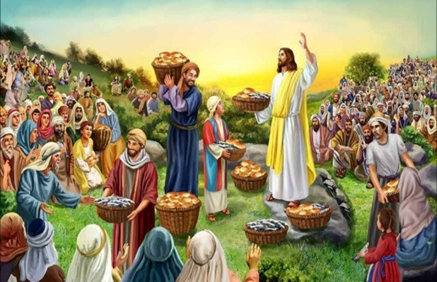

What biblical significance is there to the two pictures below?


What does the biblical number 7 represent?
Perfect or Complete (creation of the universe, 7 sacraments, 7 gifts of the Holy Spirit, etc.).
The miracle in today’s reading signifies first that what God provides never runs out; second, it shows who Jesus is – he himself is divine; third, it shows that God’s power is focused on compassion for humans, such as healing and feeding; and fourth, it connects the story of God’s bread from the Old Testament (manna – the “bread of the presence”) all the way to the Last Supper (the bread of Jesus himself, eternal life).
As for bread itself, God uses the humblest, most basic of human foods and yet one that also represents the communion of people: “breaking bread together.”
What does the biblical number 12 represent?
Twelve represents the 12 Tribes of Israel, which were scattered over the 1400 years between Moses and Jesus. The 12 baskets of “fragments” represent the remnants of these 12 Tribes that are being gathered together (12 baskets). Moreover, Jesus appointed 12 apostles to both represent and reestablish the holy people to bring them into the New Covenant, so it was only fitting that the 12 apostles collected the 12 baskets afterward.
How does the feeding of the 5000 point forward to the Last Supper?

Fathers, Heresies, and Councils of the Early Church

Early Fathers of the Church (called “Patristics”)
Review: The early church fathers were a group of thinkers and leaders who lived and wrote during earliest years of the Church, from the first century to roughly the 7th century.
The Early Church Fathers are generally grouped into three categories:
1. Apostolic Fathers – those church fathers who knew/were disciples of the twelve apostles.
2. Ante-Nicene Fathers – church fathers before the Council of Nicaea (2nd century to 325 AD).
3. Post-Nicene Fathers – church fathers after the Council of Nicaea (325 AD to the 7th century).
The Early Fathers of the Church contributed thousands of writings that we still have today. They could fill libraries. Augustine alone had over a thousand. They universally support the teachings of the Catholic Church, such as the special reverence due Mary, the Real Presence of Christ in the Eucharist, the Apostolic authority of the Church of Rome, and the existence of Purgatory, just to name a few. For many converts from Protestants, it was the study of the Early Fathers that brought them into the Church (i.e., John Henry Newman, Thomas Merton, Dorothy Day, G.K. Chesterton, Dr. Scott Hahn, Dr. John Bergsma, Dr. Taylor Marshall).
Fathers of the Church
The Fathers of the Church can be divided into three categories:
Apostolic Fathers – connected to the Apostles.
· Apostolic Documents: The Didache (70-85), Epistle of Barnabas (80-110AD), The Shepherd of Hermas (90-120)
· St. Clement of Rome: 3rd Pope (88-97AD), disciple of Peter, ordained by Peter.
· St. Ignatius of Antioch: (50-117 AD) – appointed by Peter as bishop of Antioch; later became a disciple of John.
· St. Polycarp of Smyrna: (69-155) – disciple of John.
Ante-Nicene Fathers – disciples of the disciples of the Apostles, prior to the Council of Nicaea in 325 AD.
· St. Justin Martyr (100-165)
· St. Irenaeus of Lyons: (140-202 AD) – a disciple of Polycarp
· St. Clement of Alexandria (150-216 AD)
· Tertullian (160-230 AD)
· Origin (185-254 AD)
· St. Cyprian of Carthage (200-258 AD)
· Eusebius, Bishop of Caesarea, historian (260-334)
Post-Nicene Fathers:
· Aphraates, Sage of Persia (280-345 AD)
· St. Ephraim (306-373 AD)
· St. Athanasius (295-373AD)
· St. Cyril of Jerusalem (315-386AD)
· St. Hilary of Poitiers (310-368 AD)
· St. Basil the Great (330-379 AD)
· St. Gregory of Nazianz (330-390 AD)
· St. Gregory of Nyssa (335-394 AD)
· St. Epiphanius of Salamis (315-413 AD)
· Theodore of Mopsuestia (428 AD)
· St. Ambrose (333-397 AD)
· St. John Chrysostom (349-407 AD)
· St. Jerome (347-420 AD)
· St. Augustine (354-430 AD)
· St. Cyril of Alexandria (375-444 AD)
· St. Leo the Great (400-461 AD)
· St. Boethius (480-524 AD)
· St. Gregory the Great (540-604 AD)
Church Councils
The purpose of the Church Councils is to settle questions of faith and practice, promote unity, and address other issues affecting the Church, including the latest new heresies. These councils facilitated deliberation among bishops and leaders as they sought to ensure the Church’s teachings remained aligned with its mission, with the guidance of the Holy Spirit. The goal was to preserve the integrity and constancy of our apostolic faith.
Important Church Councils throughout history
50 AD Council of Jerusalem
325 AD First Council of Nicaea
381 AD First Council of Constantinople
393 AD Council of Hippo
397 AD Council of Carthage
431 AD Council of Ephesus
451 AD Council of Chalcedon
553 AD Second Council of Constantinople
681 AD Third Council of Constantinople
731 AD Second Council of Nicaea
869 AD Fourth Council of Constantinople
1123 AD First Council of the Lateran
1130 AD Second Council of the Lateran
1179 AD Third Council of the Lateran
1215 AD Fourth Council of the Lateran
1245 AD First Council of Lyon
1274 AD Second Council of Lyon
1311 AD Council of Vienne
1415 AD Council of Constance
1431 AD Council of Basel-Ferrara-Florence
1512 AD Fifth Council of the Lateran
1545 AD Council of Trent
1869 AD First Vatican Council
1962 AD Second Vatican Council
When was the Bible established?
It was started at the Council of Hippo (393) and finalized at the Council of Carthage (397). Before this, the writings were like the Jewish Scriptures – individual books/writings on Genesis, Isaiah, etc., but the Jews never gathered them into one, unified collection until the 3rd century, AD. Nevertheless, these books from the Old Testament had been gathered and copied into Greek around 250BC in Alexandria, Egypt, called the Septuagint. This is the OT Bible that Catholics used.
The books for the New Testament were similarly separate documents in the beginning. But with Christianity growing fast and unapproved writings starting to appear, the Church decided to formalize which books were true and inspired and which were not. The Church finalized 73 books – 46 Old Testament + 27 New Testament – at the Council of Carthage in 397, which was confirmed again at the Council of Trent in 1545 after the Protestant Reformation decided to remove 7 books from the Old Testament. The Protestants have 66 books – 39 Old Testament + 27 New Testament.
What is a heresy?
A heresy is when a clergy official teaches contrary to Church dogma. Dogma are those teachings which the Church has infallibly taught to be divinely revealed (The Trinity, the Incarnation, Immaculate Conception, etc.).
Heresies occurred often in first few centuries because communications across the Roman Empire was difficult given the persecution of the Church. This meant months and sometimes years for news to get from the Church in Egypt to the Church in Rome. Meanwhile, people have a natural tendency to keep the best of what they learned about Christianity and combine it with their pagan beliefs that they didn’t want to let go of. This is why Paul wrote so many letters after he started churches all over Asia Minor and Greece – to correct errors like these.
What is Gnosticism?
Gnosticism comes from “gnosis,” meaning knowledge. They taught that only a few special people were given special knowledge from God – these would conveniently be the teachers of the sect.

Gnosticism was one of the earliest heresies, which was a collection of greatly varying pantheistic beliefs – often from Eastern religions – that flourished from before the Christian era to about the fifth century, although it continues to rear its ugly head again every few centuries (note the movie “The DaVinci Code”). Gnostic sects borrowed from the phraseology and tenets of major religions, especially Christianity. That was the key to their success – to take the best from already flourishing religions and then manipulate them to fit their own beliefs.
Gnosticism considered physical matter a form of evil, a deterioration of the spirit, and the universe as a debasement of the Deity.
How is Gnosticism similar to Buddhism and Hinduism?
Buddhism and Hinduism consider the physical realm – and especially human desire – to be the source of all suffering. Therefore, the goal is to transcend the physical realm – no matter how many lifetimes it takes – until we can shed the self entirely and merge with the Universe (Nirvana).
Gnostics believed the ultimate end of all being is to overcome matter and return to the Parent-Spirit, facilitated by a God-sent Savior (Jesus fit so perfectly!). However, because physical nature was considered evil, Jesus couldn’t possibly have become a physical human being! Therefore, his “humanity” was just an illusion, for God could not participate in evil.
Gnosticism also emphasized salvation through a quasi-intuitive knowledge of the mysteries of the universe and magic formulas indicative of that knowledge. Not everyone was given access to this knowledge. Gnostics saw themselves as a superior class, essentially different from those who lacked this saving knowledge.
When Gnosticism encountered Christianity, it adopted Christian forms of thought, nomenclature, and sacraments, claiming to be an esoteric (secret) revelation of Christ. The early Church Fathers combatted Gnosticism, affirming that matter is created by God and therefore not evil .
The movie The Da Vinci Code drew heavily from the beliefs of Gnosticism, which shows us that Gnosticism continues to return every few centuries, just dressed up in different costumes.

List of 9 most well-known heresies
2nd - 3rd Centuries
1. Gnosticism: This heresy posited a dualistic worldview, rejecting the material world as evil and promoting a secret knowledge (gnosis) for salvation. Gnostics often denied the true humanity of Christ, claiming that He only appeared to be human, which contradicted the Church’s teaching on the Incarnation.
2. Docetism: A form of Gnosticism (2nd century), Docetism asserted that Christ’s physical body was an illusion and that He did not truly suffer or die. This undermined the reality of the Incarnation and the salvific nature of Christ’s suffering.
3rd - 5th Centuries
3. Arianism: Arianism denied the full divinity of Jesus Christ, asserting that He was a created being and not of the same substance as the Father. This heresy led to significant theological disputes and was condemned at the First Council of Nicaea in 325 AD. Arianism is thought to have laid the groundwork for Mohammed and Islam, which took many similar positions – Jesus was just a very holy prophet, Mary was his virgin mother, and resorting to violence to maintain these beliefs.
4. Apollinarianism: This heresy denied the completeness of Christ’s humanity by asserting that He had a human body but not a human mind or will. It was condemned for failing to recognize the full human experience of Christ. Condemned in the First Council of Constantinople in 381 AD.
5th - 6th Centuries
5. Nestorianism: Nestorius proposed a distinction between the divine and human natures of Christ to the extent that he suggested there were two separate persons in Christ. This view was condemned at the Council of Ephesus in 431 AD, which affirmed the unity of Christ’s person.
6. Monophysitism: This heresy claimed that Christ had only one nature, which was either divine or a mixture of divine and human. The Council of Chalcedon in 451 AD rejected this view, affirming that Christ is “perfect in Divinity and perfect in humanity” in two natures.
7. Pelagianism: Pelagius (5th century AD) taught that human beings could achieve salvation through their own efforts without divine grace. This view was condemned for undermining the necessity of grace in the process of salvation.
7th Century
8. Monothelitism: This heresy proposed that Christ had two natures but only one will, which was seen as a compromise that undermined the full humanity of Christ. It was condemned at the Third Council of Constantinople in 681 AD.
9. Iconoclasm: This movement (7th century) rejected the veneration of icons and images in worship, arguing that it was Idolatrous. The Church defended the use of icons, affirming their role in teaching and devotion.
Heresies slowed down after this. After Islam, which is not technically a heresy, there was:
- Adoptionism in the 8th century (Jesus was adopted by God as his son)
- The Albigensians in the 12th century (Gnostic – physical world was evil so having kids was evil because it imprisoned another soul)
- The Free Spirits in the 14th century (Eastern/pantheism – people reach a state of spiritual perfection and their souls would merge with God and be one/same)
- Jansenism in the 17th century (emphasized human depravity, asceticism, and predestination).
Protestantism came from within the Catholic clergy in the 16th century. Does the Church consider it heretical?
No, by rejecting Papal Authority, the Protestant Reformation is considered a major schism in the history of the Christianity. The Church holds that the Reformation destroyed the unity of the faith and ecclesiastical organization in Europe, cutting off millions from the Catholic Church. There were also doctrinal disagreements that emerged over time, and those are still evolving, resulting in thousands of Protestant denominations.
Although the Protestant Reformation is historically recognized as a schism due to the rejection of papal authority and the fracturing of Christian unity, Catholic Church views those currently within Protestant communities as brothers and sisters in Christ, maintaining an imperfect communion with them and recognizing the presence of elements of truth and grace in their communities.
Finally, the Catholic Church actively seeks reunification with Protestant Christians, viewing it as a critical goal of the ecumenical movement. This endeavor is rooted in the Church's belief that the unity that Christ desires for His followers involves "full visible communion of all Christians."
The primary doctrinal differences with the Church: Sola Scriptura – private judgment, no formal church; Sola Fide – faith only for salvation (sans our cooperation in works); and no presence of Christ in the Eucharist.
How should we view humanity and religions outside the Church?
We know in Genesis that God breathed his spirit into humans (Gen 2:7). This added a spiritual nature to our physical nature; this is what made us in the image and likeness of God (Gen 1:27). Since God is perfect truth, perfect love, perfect knowledge, perfect justice, perfect mercy, and perfection itself, we seek all these things for ourselves, for that is imprinted in us. We can either seek these things with God (who is their source) or on our own (pride).
Although we desire all of God’s characteristics, these are, in a sense, God’s calling cards. We can never have them without Him. Is there any surprise that so many ancient cultures share similar stories? Think of God as the mountain of Truth, etc., and every human being and every (good) religion is climbing it – including atheists – whether they are seeking meaning, purpose, or truth – or their denial.
However, we humans can only get so far up the mountain since the top of the mountain is a spiritual, infinite place where God is. We cannot know what’s there because it’s beyond space and time. Since we can’t complete our journey for the Truth and Perfection, religions fill in the gaps as best they can (i.e., karma, reincarnation, Greek philosophy, etc.).
The only way we can know the rest of the way is if God comes down and reveals Himself. Alas, that is exactly what happens in the Bible, starting with the first man and woman, Noah, Abraham, Moses, David and finally coming Himself as Jesus Christ. Jesus was God’s revelation to humans and the Good News is that He loves us and wants us in Heaven.

Closing Prayer: Prayer to the HS
Come, Holy Spirit, fill the hearts of your faithful.
And kindle in them the fire of your love.
Send forth your Spirit and they shall be created.
And you will renew the face of the earth.
Lord, by the light of the Holy Spirit
you have taught the hearts of your faithful.
In the same Spirit, help us to relish what is right
and always rejoice in your consolation.
We ask this through Christ our Lord. Amen.


Comments