07.21.26 - Three Kingdom Parables and Dead Sea Scrolls Part I
Catholic Understanding & Biblical Defense Class 7/21/26
Opening Prayer
LORD, thank you for your promise that where two or three of us are gathered in your name, You are there.
We welcome You among us today!
We ask that You open our ears so that we hear your voice and receive your wisdom.
As Jesus taught us to pray… together
Our Father Who art in Heaven, Hallowed be Thy Name.
Thy Kingdom come, Thy Will be done, on earth as it is in Heaven.
Give us this day our daily Bread;
And forgive us our trespasses as we forgive those who trespass against us.
And lead us not into temptation but deliver us from evil. Amen.
Major holy days: The Assumption of Mary (August 15)
www.masstimes.org Mass or Confession anywhere/anytime in the world!
TODAY:
· Reflection: Parables
· Reading for 17th Sunday in Ord Time (7/26), Three Parables about the Kingdom of God, Matthew 13:44-52
· Member Topic: The Dead Sea Scrolls
Terms and Quote of the Week:
Repentance… means to turn around internally, towards God, continuously. Many of us don’t like and misunderstand the word repentance, but consider the following definition:
“Repentance is not to look down at our own shortcomings, but upwards at God’s transforming love; it is not looking backwards with self-reproach but forward with trustfulness; it is to see not what we have failed to be, but what by the grace of God we might yet become.” – St. John Climacus
Reflection on Parables
A parable is an allegorical or metaphorical narrative, usually involving analogies and providing moral instruction. It comes from the Latin parabola and Greek parabole meaning comparison, side-by-side, or juxtaposition. Jesus’s parables also involved hyperbole (intentional exaggeration) to make a point (e.g., “if you hand leads you to sin, cut it off”) and unexpected twists/riddles wherein lies deeper truths. Parables are intended to make the reader-listener think deeply about the message but Jesus’ parables go further than that – they continue to teach us over time. How? Because their meaning evolves/deepens as our relationship with God grows. And even though the message evolves and deepens, it doesn’t change because God’s Word doesn’t change.
Think of Jesus’ parables like a diamond that has a hundred faces. Each faces represents a different perspective, depending on where you are spiritually in your life. FYI, as you increase your prayer life and study of God’s Word, you change. Your relationship with God grows and with it comes grace and wisdom, which means you are never the same person. Since you are evolving spiritually, so is the depth in which you can see. God’s Word, the “Truth,” is the diamond. The many faces are the different depths of seeing the same truth.
“God’s Word keeps on meeting us wherever we are.”
Finally, parables are valuable because they are stories and, unlike mere statements of facts, stories are remembered for hundreds and thousands of generations, even if someone can’t read.

How many parables are there in the New Testament?
39

Three Parables about the Kingdom of God, Matthew 13:44-52

Context
This is the third week the Church has been reading/discussing Jesus’ Kingdom parables and today is the conclusion.
There are three parables as noted above. The first two have a twist/riddle in them; the last is pretty straight-forward.
I have divided the reading into 6 parts since Jesus makes six points for us to discuss.
Why is Jesus emphasizing the Kingdom so much?
Because that is the reason he came here. Remember, that door had been closed. By reversing the Fall of Man, Jesus opens the Kingdom back up to all humans; however, this just means the same choice that our first parents had now becomes our choice to make. So, Jesus is passionate about getting us to choose the right path this time.
What is this choice?
We have to choose to be either God-centered or self-centered; and to be self-serving or self-giving.
When Jesus says in Revelation 21:5, “Behold, I make all things new,” he is not only talking about the highly anticipated spiritual and cosmic restoration at the end of time; he is telling us he has brought the Father’s Kingdom to us here and now, and that this “new kingdom” begins the minute we make this choice.

Matthew 13:44-52
1. The Kingdom of Heaven is like a treasure buried in a field. When a man found it, he buried it again, and in his joy he went and sold all that he had and bought that field.”
2. Again, the Kingdom of Heaven is like a merchant in search of fine pearls. When he found one of extraordinary value, he went and sold all that he had, and bought it.
Exegesis (Investigation/Interpretation)
Jesus invites each of us to consider what the Kingdom of Heaven means. Notice how both individuals—the one who stumbles upon the treasure unexpectedly, and the merchant who has been diligently searching for the pearl great value – respond with wholehearted abandon once they find it.
What is the treasure?
The Kingdom of God
Twist: Why did the person who discovered the treasure in the field bury it again? Wouldn't most people who found a treasure just take it?
The person didn’t take the treasure because the Kingdom cannot be stolen. It is one thing to find the Kingdom – which the man did – but the next part falls to us. In order to attain this Kingdom for ourselves, there is a cost involved – our entire selves. We can’t gain the Kingdom if we treat it second to anything else in our life.
How does one give their entire selves to God?
We talk/pray to him all the time to run things by Him, ask for advice, seek forgiveness, etc. As we learn to yield our self-will to God’s will, then we are helping to fulfill God’s plan. Did you know that each time we decide to love, forgive, help others, pray and learn God’s Word expands God’s Kingdom on Earth. We are, in effect, practicing for Heaven. That’s what the path to Heaven looks like on Earth. That’s also what Jesus means in the famous prayer he gave us:
Thy Kingdom Come, Thy Will be Done, On Earth as it is in Heaven
Why did the merchant sell everything to buy the one pearl? Even if it was of great value, what can he do with a pearl? He can't eat it or wear it.
It’s true that the merchant can’t eat or wear the pearl, but his action signifies a commitment and willingness to sacrifice whatever is necessary to possess the Kingdom.
Also note that the first man above happened to stumble across the treasure but the merchant had been searching for this one pearl for a long time. This shows us there are people coming to God in a wide variety of ways. St. Teresa of Avila (doctor of the Church) once said, “God writes straight with crooked lines.” This is to allow for human imperfections!
How are the Apostles like the man who found the treasure and the merchant who found the great pearl?
When the Apostles discovered Christ the Messiah who came to announce the Kingdom, they left everything behind in order to follow Christ and possess the Kingdom. Thereafter, they gave their lives to expanding the kingdom.

Let’s consider another face on this diamond: You may recall that when God breathed a spirit into humans in Gen 2:7, it was then that we gained our spiritual natures. This also explains what is meant by our being in God’s image and likeness. Then, in John 1:3, we are told that everything in the universe came into existence through the Word, which is Jesus Christ. Therefore, we are not only made in the image of God, but more specifically, Jesus Christ himself.
That means that our spiritual natures have, at their foundation, the image of Christ. But though this foundation is given to each of us along with our spiritual natures, we still have free will. Therefore, we must also seek to become more Christ-like (or Christ-formed) in our lifetime; otherwise, we will end up creating our own identity, separate from God, just like Adam & Eve did. BTW, being “Christ-formed” does not mean we lose ourselves, just our self-centeredness (egos). In fact, we become more truly ourselves. We remain completely unique persons but also uniquely formed to the image of Christ. Whether we like it or not, all the drama in our lives that is related to who we are, or being our best, is nothing but the discovery and unfolding of this destiny.
You might ask, what does this have to do with our Gospel reading?! The Venerable Fulton Sheen said that in this story, the buried treasure and the pearl represent exactly this Christ-formed identity we seek – the one thing worth looking for. And the selling of everything to acquire it (our cost) is actually the surrender of our egos and our “worldly” identities.
It was once said that the greatest tragedy in life is not so much failure, but climbing the ladder of success and finding out that it is up against the wrong wall. We can spend our entire life in pursuit of goals that are meaningless, or even goals that are objectively good – but what if it is not us? When we get off the ladder, we want to make sure we are in Heaven.

3. Once again, the Kingdom of Heaven is like a net that was cast into the sea, which caught every kind of fish. When it is full, they pulled it ashore and sat down to sort the good fish into buckets. What was bad they threw away.
When it was full refers to the completion of the age and time of judgment. Who are the fishermen?
The fishermen are the angels.
They pulled it ashore refers to all humans being brought before Christ who is the Judge.
The separation of the good and bad is similar imagery to the sheep and goats in Mat. 25:32. The good will attain eternity in Heaven and the bad will be excluded from God’s Kingdom for eternity.
4. Thus it will be at the end of the age. The angels will go out and separate the wicked from the righteous and throw them into the fiery furnace, where there will be wailing and grinding of teeth.
The fiery furnace is a metaphor for Hell, a place of eternal separation from God. Weeping and gnashing of teeth is an expression we find several times in the Bible to describe the anguish and regret of those who are excluded from the Kingdom. “Weeping” indicates sorrow and despair, while “gnashing of teeth” suggests anger and frustration.

5. Then he replied, "For this reason, every scribe who has been instructed in the Kingdom of Heaven is like the head of a household who brings out of his storeroom both the new and the old."
What was a scribe in those days? TayQuiz
Scribes were the Jewish theologians in Jesus’ time. A scribe was not only the one who could write and copy sacred scriptures, he was also a teacher of the Scriptures and an expert in Jewish law.
1) What doses Jesus mean by "every scribe who is instructed in the kingdom of heaven," and 2) why is he like the head of a household who brings out both the old and the new from his storeroom?
The wisest scribes used everything at their disposal to understand and teach the word of God. The storeroom refers to the Scriptures, so the wise scribe would search the Old Testament Scriptures for all the wisdom he could find from Noah, Abraham, Moses, Solomon, and the Prophets. But the Jews knew that none of their wisdom was sufficient to overcome their continual mistakes and attain the Kingdom, which is why the prophesies of the coming Messiah gave them such hope. The Messiah was the key that would enable them to finally finish their earthly journey. Without the Messiah, the Old Testament was like a great mystery novel without the ending.
Now we know that looking at the Old Testament through the lens of the New Testament answers many of the OT mysteries. Jesus showed us this: he quoted the OT Scriptures many times as he was fulfilling them; then on Easter, the first day of his resurrection, he walked beside the two disciples on the Road to Emmaus and shed light on everything in the OT Scriptures, from how his death and resurrection was necessary for our salvation to how it fulfilled and completed the Story of Israel (Luke 23:13-35). In our parables today, Jesus tells us we need to integrate both the old and new treasures/covenants to understand the full picture of God's revelation through Christ. St. Augustine said it brilliantly:
“The New is concealed in the Old, and the Old is revealed in the New.”
What are the Dead Sea Scrolls?

The Dead Sea Scrolls were the greatest discovery of the 20th century.
In 1947, three young men from the Bedouin tribe in the West Bank were herding their goats and sheep near Qumran, a settlement on the northwest shore of the Dead Sea. One of the young men casually tossed a rock into a small cave tucked into a nearby cliff and heard a shattering sound. Surprised, the three young men entered the cave and found several large clay jars containing seven scrolls.
This discovery launched a series of archaeological digs in this cave and the surrounding areas. From 1949 to 1956, fragments of 950 additional scrolls were discovered in 12 different caves.
The Dead Sea Scrolls are the oldest known records of the Hebrew Bible, written as far back as the third century B.C. These texts contain pieces of nearly every book of the Old Testament. Over 75% of the Dead Sea Scrolls are written in Hebrew, with most of the remaining in Aramaic, and a few in Nabataean.
Also discovered in Qumran were the Essene’s “community rules scrolls.” These manuscripts truly give us a kind of "time machine" to view the world and religious environment in which Jesus and his apostles had lived.
Another captivating text is the Copper Scroll, which was written on copper instead of parchment or papyrus like the other scrolls. The Copper Scroll lists sixty-four places where gold and silver were buried, making it essentially a treasure map.
Considered one of the greatest finds is the Isaiah Scroll, which contains the entire book of Isaiah, all 66 chapters.
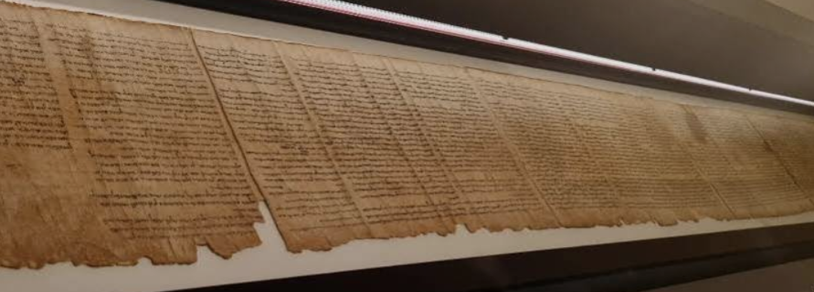
The Great Isaiah Scroll, the largest and best-preserved of the Dead Sea Scrolls
Book: Jesus and the Dead Sea Scrolls, by John Bergsma (highly recommended).
In the first section of the book called A Stunning Archeological Find, author Bergsma introduces the Essenes – an ultra-devout Jewish monastic sect who are responsible for the Dead Sea Scrolls.
Debunking the Greek Myth
Before this archaeological discovery in 1947, modern secular scholars believed early Christian practices like water baptism and dualistic theology (good and evil forces) were heavily influenced by later Greek culture. The Dead Sea Scrolls show that these were not later additions but quite native to first-century Judaism.
These same secular scholars had been proposing that the New Testament, especially the Gospel of John, was heavily influenced by later Greek philosophy (Hellenism). They argued this because John uses polarizing terms like light vs. darkness and spirit vs. flesh, which you don’t see in the other Gospels. However, as Bergsma points out, the same language is found in the Dead Sea Scrolls. This proved the Gospel of John was written in genuine first-century Jewish language by someone who actually lived at that time.
Before the discovery of the Dead Sea Scrolls, the earliest complete Old Testament manuscripts we had was a Greek translation called the “Septuagint.” Although the Septuagint was first translated from Hebrew into Greek in 250 BC, the earliest copies we have are from the 4th century A.D. (which is still much earlier than the earliest Hebrew manuscripts of the Jewish Bible, which are 9th century A.D.). The Septuagint is what Christians have been using since the time of Christ, but how accurate were our 4th century copies? The Jews considered them corrupted and do not use them. Thankfully, the Dead Sea Scrolls – which date to the 2nd and 3rd centuries BC – saved the day. They turned out to be very, very close to our current Septuagint manuscripts!
The Qumran Community & John the Baptist
As mentioned above, the monastic, Jewish community living at Qumran were called Essenes. The word “Essene” comes from the Aramaic, “hasen,” meaning “the pious” or “the holy.” The other more well-known Jewish sects were the Sadducees and Pharisees, and the lesser known Herodians and Zealots.
There were about 100-200 Essenes who lived in Qumran. They practiced daily water washings (purification), lived celibate lives, copied Scriptures, and waited for the arrival of the Messiah. Bergsma suggests that John the Baptist likely spent time in Qumran since he lived and baptized so close to them (see maps below). Even many of Jesus' actions, such as initiating his ministry via baptism in the Jordan River – were similar to the spiritual culture of the Essenes.


The Origin of the Essenes
The Essenes were originally Temple priests in Jerusalem. They believed the priesthood in Jerusalem became corrupted, so between 150-160 BC they withdrew to the desert to live out what they called the "New Covenant." They anticipated an era where God would pour out his Holy Spirit, forgive sins, and bring about Israel’s renewal. When Jesus of Nazareth emerged, he proclaimed the arrival of the Kingdom – and the New Covenant – which shows us how much first-century Judaism was already deeply connected with the Christian Messiah.

What triggered the Essenes departure from Jerusalem 160-150 BC?
The political leader of the Jews at the time (164 BC) was Judas Maccabees. Judas had his brother, Jonathan Maccabees, anointed as High Priest, even though the priesthood was supposed to be from the line of Aaron – separate from the political leaders. A number of the priests considered Jonathan and his newly chosen priests “unworthy,” prompting this group of priests to rebel and depart from Jerusalem. They left around 160 BC and settled in Qumran.
Bergsma also suggests that the following quote from Jesus likely referred to the Essenes.
For there are eunuchs who were born that way; others were made that way by men; and still others live like eunuchs for the sake of the kingdom of heaven. The ones who can accept this should accept it.” – Mt 19:12
Those who “lived like eunuchs for the sake of the kingdom” also refers to celibate priests today. This voluntary choice to enter the priesthood is seen as a higher calling, where individuals prioritize spiritual commitments over their earthly ties, echoing the sacrificial nature of Jesus’ own ministry.
Community Rules
One of the amazing discoveries were the “community rules scrolls.” The community rules governed daily life and practices at Qumran. The Essenes were trying to live a truly authentic faith, not like those in Jerusalem! One can’t help but be reminded of the many spiritual orders that Christians created over the centuries, like the Benedictine monks, and the monastic community started by St. Francis of Assisi, as they were seeking to bring the Church back closer to the original teachings of Christ.
One of the Community Rules was called the Temple Scroll, which detailed how they would run the Temple in Jerusalem after the Messiah came and put it under them.
Also found were numerous harsh communications with Jerusalem. It appears that the Essenes would advise the Temple priests every now and then, whether solicited or not. One communication was to address the question of ritual purity of pouring liquids from kosher pitchers into unkosher cups.
The question: If the pitcher was pure (kosher) but the cup was impure, and you poured the liquid from the pitcher into the cup, would the impurity of the cup travel back up into the pitcher rendering the entire pitcher impure?
Answer: Of course it would!
Next Week:
How else did the Dead Sea Scrolls support or detract from Christian teaching?
How did the Essenes prepare for the Messiah’s arrival?
What do the Jews think of the Dead Sea Scrolls?
What happened to Qumran and where did the Essenes go?
Closing Prayer
Lord, we thank you for the blessing of reading your word together.
We ask that these words of life, truth and hope enlighten our minds and strengthen our faith.
May your love and grace follow each of us as we return to our daily lives, refreshed and blessed by you.
We ask all this in your name.


Comments