07.25.23 Recap: Member Q's Night
- tmaley
- Jul 31, 2023
- 14 min read
Northern Virginia Catholic Bible Study & Apologetics House rules/notes… 1. Online via Meetup/Zoom or In Person at St. John Neumann Catholic Church 11900 Lawyers Road, Reston, VA 20191 https://saintjn.org/ 2. Meetup is www.meetup.com/catholicbiblestudy Zoom Meeting Logon info is the same every week: Zoom ID: 861 1782 2081 Password: 406952 3. I will send out Meeting Recaps the same night as our sessions – these are unedited versions without pictures. An edited version with pictures will be posted on our website https://catholiccatacombs.wixsite.com/website/recaps before the next meeting. Taylor will notify everyone at that time. 4. Questions encouraged. If you have questions about anything, you can ask in the chat box, email the Meetup group, or me at ron@hallagan.net. 5. Respectfulness. We will be discussing differences between religions and Christian denominations, and we agree to be respectful at all times. Specifically, Protestants are our friends and brothers in Christ; in fact, I personally owe part of my return to the faith to them! 6. No politics. It would be easy for us to self-destruct, but that’s not our goal. Our goal is to learn/understand/apply the Bible and our Catholic faith. 7. Catholic Prayer & Fellowship. Are you interested in praying with other Catholics during the week? Fellow member Jason Goldberg has started “Catholic Prayer, Fellowship, and Spirituality Meetup.” Sign up at: https://www.meetup.com/online-catholic-prayer-fellowship-and-spirituality/. 8. “The Chosen” TV series. All of us seek a relationship with Jesus Christ, which is not always easy. It can help if we have seen and heard Him. The Chosen captures Jesus better than any show I have ever seen. Highly recommended. 9. RSVP Reminder: Please RSVP whether you are attending the meeting or just reading the Recaps afterwards. The more RSVPs, the more Meetup will give exposure to “Catholic Bible Study” – a good thing! Catholic Catacombs Website: https://catholiccatacombs.wixsite.com/website/recaps Bible Study Format: Each week of the month has a repeating topic, as noted below. Each meeting: 5 min greet, prayer, 10-15 min Catholic topic, 40-45 min main topic. Week 1: Gospel Week: Week 2: Bible Week (Gen > Rev): We are in EXODUS, the 2nd book of Moses. Week 3: Survey Topics Voted on by Members:
1) Jesus’ Greatest Parables 2) Hell, Purgatory, Heaven 3) Comparative Religions
4) Great Women in the Bible 5) Book of Revelation 6) Major Heresies and Church Councils
Week 4: Member Questions:
1. What are blessings? Is it possible to ask for too many?
2. Jesus says in John 14:28, “The Father is greater than I.” What does this mean? I thought they were one.
3. In Genesis and somewhere else, it says that God changed his mind. In another place, it says God repented that he made humans. I thought God was unchangeable. Can you explain this?
4. Please provide an intro or overview of the OT books.
5. What’s the difference between Charity and Love? What are the highest forms of charity?
6. Can you provide a brief review of the origin/meaning of the (12) statements in the Creed?
7. How many Gospels have the story of Jesus’ calming the storm? They seem different. Are they the same story?
8. Why does God seem full of vengeance or violence in the OT? Is this a misinterpretation?
9. Can we do a Christian Meditation one evening?
10. Is “recognition” a good thing? How does pride play into it? Glory and pride discussion.
11. Angels – who are they, what do they do, and do we really have guardian angels?
Catholic Catacombs Website: https://catholiccatacombs.wixsite.com/website
Major upcoming holy days in the Liturgy of the Church:
The Assumption of the Blessed Virgin Mary (Aug 15)
Opening Prayer
O God
We gather here together in your midst to learn, to grow, and to change. Help us to move into a deeper understanding of Your truth. May we all feel safe with each other to think and to question As we share our thoughts and lives with You.
Jesus, thank you for teaching us how to pray together…
Our Father
Who art in Heaven, Hallowed be Thy Name.
Thy Kingdom come, Thy Will be done, on earth as it is in Heaven.
Give us this day our daily Bread;
And forgive us our trespasses as we forgive those who trespass against us.
And lead us not into temptation but deliver us from evil.
Lord Jesus Christ, Son of God, have mercy on us all.
Amen.
Week 4: Member Questions
1. Follow up questions to last week on the 5th Commandment from last week. What about capital punishment?
2. Follow up question on Jesus’ call to be perfect last week. What about perfectionism?
3. What does it mean to be born again?
4. How does being born again change us? How do we know we are following Jesus?
5. As we get closer to God, does the path get easier or harder?
6. Is the peace of Christ different from peace of the world?
7. Why doesn’t God just show himself?

1) A question came up about the Fifth Commandment (Thou Shall Not Kill/Murder) discussed last week. What is the Church’s position on capital punishment?
The Church had traditionally supported it because the state has the right to punish those who have murdered others and the obligation to protect society. Gen 9:6 says, “He who sheds the blood of man, by man shall his blood be shed; for God created man in his own image.” This statement is far from murder itself as its purpose is to protect society from murder. Neither did Jesus condemn capital punishment. Moreover, justice doesn’t end here on earth since perfect justice is guaranteed in the next life.
The key practical distinction in Christian theology is the difference between the individual and society, between sinful man and social justice. Each individual is a sinner and unfit to be a judge of their fellow man and thus counseled to love their enemy and not to pass judgment. The state, on the other hand, is required to pass laws and enforce them for the protection of its citizens.
All that being said, the Church in recent years has ceased its practical support of capital punishment because a) of the unreliability of evidence/the courts such that numerous convictions have been overturned many years later (and thus innocent people might be executed), and b) we now have other ways of protecting society from dangerous criminals. (CCC 2266-2267)
2) Follow up question on Jesus’ call to be perfect last week. What about perfectionism?
“Be perfect as your Father in Heaven is perfect…” – Mt 5:28
Before we tackle perfectionism, let's review our conclusions about this statement Jesus made:
1) Jesus used the Greek word telios for perfect, which points to the future, such as when a child becomes an adult, or an apprentice becomes a master. Therefore, we are being called onto a path to become more like the Father during our lives.
2) The context of Jesus’s message was love – not only to love our neighbor but our enemies (i.e., praying for them). Note the “perfection apprenticeship action” of moving our love from neighbor to love of enemy.
3) We discussed that “perfect” for humans is not the same as the absolute perfection of God; rather, each created
being has its own perfection – its best version of itself – rocks, trees, bees, bears, … and humans.
4) We discussed that even within the human species we each have our own unique perfection (best version of ourselves), based on the unique gifts God has given to us, and our openness to God in using these gifts.
5) We will all reach this perfect version of ourselves in Heaven, and the level of our perfection will be the spiritual capacity we developed in #4.

In Heaven, we will be filled with love, happiness, perfection, and adventure, such that we cannot hold another drop.
However, each of us will have our own “capacity” based on our openness and cooperation with God in this life.

Q: Perfectionism. We’ve talked about becoming perfect, but what about “perfectionism”? Isn’t that a negative? How does this fit into our discussion?
Fair question. On the one hand, it seems natural that humans seek perfection in everything they do, whether it’s in our jobs, our hobbies, our looks, our clothes, right down to how we make our beds or fold our towels. We like things clean and organized. But remember, God breathed His spirit into us so we have many of His attributes, and one of them is order or perfection. But like any of the gifts from God, we can take them too far. We must remember that we are not God so we can only approximate Him from a great distance.
The fact is, we can all be on the “perfectionism spectrum” somewhere, depending on what it is we are talking about.
Perfectionism is not considered a disorder in itself but it can be linked to disorders such as ADD, ADHD, high anxiety, or obsessive-compulsive personalities. In these cases, it is thought to be rooted in some fear or anxiety over some uncertainties in one’s life, or else not enough control over things.
One mantra to consider is to remind ourselves that only God is perfect and to call upon Him, i.e., “God, I want to be like you, help me accept my human imperfections and be happy coming close!” Perhaps one can start by learning to accept less than perfect – say 95% - and then move to 90%. 90 is okay! When I realized this, I stopped trying make my lawn look like a golf course (which was a good thing because my lawn wasn’t even close). Now I am happy if my lawn is 80% perfect :).
There’s a story about a guy who made very expensive Persian rugs. People came from all over because of his incredible designs and craftsmanship. Then one day an impressed buyer asked him if there were any imperfections at all in his rugs. He replied, “Yes, I make sure there is one imperfection in every rug.” “Why?” asked the shocked client. He replied, humbly, “Because only God is perfect.” As nearly perfect this rug-maker was, he decided on less.

3) What does it mean to be born again?
Catholics and Protestants agree that to be saved, you have to be born again. Jesus says, “Truly, truly, I say to you, unless one is born again/anew/born from above, he cannot see the kingdom of God” (John 3:3). He is talking to the Pharisee leader, Nicodemus. Then he repeats in Jn 3:5, “…unless one is born of water and the Spirit, he cannot enter the kingdom of God.”
When we as Catholics (also Lutherans and Anglicans) say that we have been “born again,” we are referring to the transformation that God’s grace accomplishes in us during Baptism.
We often miss the fact that the Sacrament of Baptism gives us new life/new birth because many of us have developed an impoverished view of the grace God gives us, thinking this ritual is merely a symbol. Not so!
Scripture is crystal clear that baptism is far more than this: our sins are wiped out, we are given Sanctifying Grace (required to enter Heaven), the Holy Spirit enters into us, and thereafter we receive forgiveness-for-the-asking. That’s a LOT.
Notice also how grace happens. Jesus connects the physical (water) and the spiritual (grace and Holy Spirit). That’s how grace works. Everything Jesus does follows this formula of spirit-physical connection, starting with his incarnation, continuing with his miracles, and then raising himself and us to new life (with a body). God created this connection between Heaven and earth in all the sacraments, starting with Baptism and most of all in the Eucharist.
Paul also calls Baptism our “regeneration” or “new creation” (2 Cor 5:17; Gal 6:15), saying we were sons & daughters of the first-fallen Adam, and then we become sons & daughters of the second Adam, Jesus Christ.
So the answer to the question, “Are Catholics born again?” the answer is a huge yes!
And the “born again date” is your baptismal date.

4) How does being “born again” change us? How do we know we are following Jesus?
Being a follower of Christ means several things:
We pray regularly and we learn to use the Holy Spirit as our conscience/sounding board (instead of our ego).
We seek to become more holy – improve ourselves – by learning to better love our neighbor (and enemies).
We seek to keep our souls clean by asking forgiveness and also asking God to assist us with our new behavior
We forgive and help others at every opportunity.
We attend Mass and receive Christ in the Eucharist at least weekly.
We seek to be happy/joyful people because we already know the end of the story: God wins. He won when Jesus conquered evil and death on the cross.
If God already won, what are we doing here?
The fall of man has been reversed, so we still have free will, but now it’s our turn. Although the “war” is over, human can still choose sides – God or self.
The best way we can help people to choose Christ is by our words, our example, our prayers, and our joyful, positive attitudes!
Paul suggestion is that we “clothe ourselves with Christ” (Rom 13:14). How do we do that?
Putting on Christ means being the best we know how to be, and that best is already in us because Christ is in us.
It’s a powerful mindset to start your day with – putting on Christ as you get up and dressed.
The closing prayer tonight will be a “putting on Christ’s clothes” prayer.

5) Does the path get easier or harder the closer we get to God?
Yes.
As we get closer to God, we become wiser and see the world more clearly. Things make more sense to us, which is a beautiful thing on the one hand, yet it raises new challenges on the other. The “right thing” becomes more obvious to us, but at the same time we see the world’s priorities and God’s are often not the same.
The closer we get to God, the wiser we become and the more we see our own flaws. This can be humbling, but humble is a good thing. Jesus, Mary, and most of the prophets and saints were humble, even though the latter didn’t begin this way.
The good news is that we also feel God’s love more intimately and appreciate more his incredible willingness to forgive us at every turn, so this relationship works well as long as you are open to seeing and addressing your own flaws. And every time you do, you gain more wisdom. That’s how the path works.
So does the path get easier or harder the closer we get to God? Yes.


6) Is the peace of Christ the same or different from the peace of the world?
Have you ever noticed how many slogans there are about peace? Perhaps no other word in our English language (except love) is more susceptible to sloganeering, and thus misunderstanding. Consider, “if you want peace, stop fighting.” The first and most famous use of this phrase was from Vegetius in 385AD: “If you want peace, prepare for war!” Other versions proliferated over the years: “If you want peace, work for peace”; “If you want peace, end poverty”; “If you want peace, defend life”; “If you want peace, work for justice”; and then there is “Give peace a chance” by the Beatles. All may be true, but is anyone clearer about peace now, or how to bring it about?
Like most virtuous qualities (justice, mercy, peace…), people often demand that others (or “the world”) possess them without first looking at themselves. It’s easy to demand peace and justice in the world, but it’s not so easy to practice them yourself. Jesus tells us that we must first develop them as inner qualities so we speak as a united mind, rather than a divided mind. A divided mind is someone who says one thing does another. Jesus called it hypocrisy, which psychologists will tell you is usually obvious to everyone but the person who is guilty of it.
Jesus’s teaching is that peace begins inside of us and it comes from God. Another word for this inner peace is equanimity, which means being calm during difficult times.
I hate to give you the tough news, but peace starts with God. It always has. In the Gospel of John, Jesus says,
“Peace I leave with you, my own peace I give you; a peace the world cannot give, this is my gift to you. Let not your hearts be troubled or afraid.” – John 14:27
This peace is not superficial freedom from conflicts or difficulties, but a deep, abiding inner peace that comes from union with and confidence in God.
As we discussed above, we should seek to be joyful people because we already know the end of the story: God wins. All that remains is for humans now is to choose sides, and the best way we can help people to choose Christ is by our words, our example, our prayers, and our positive, peaceful attitudes.
7) Why doesn't God just show himself?
Sometimes our unbelieving friends wonder why God doesn’t just appear to everyone on Earth and prove in person that He exists? If God exists, where is He? Why doesn’t He reveal himself to each generation of humans so that everyone on Earth can see and hear Him and know beyond a shadow of a doubt that He is real?
Even if God did show himself, would that really settle matters?
It doesn’t appear so. After all, He revealed Himself to our first parents, to their children Cain, Abel, and Seth; to Enoch, then Noah, Abraham, Isaac, Jacob, Joseph, Moses, Joshua, Samuel, Job, David, Isaiah, Jeremiah, Ezekiel, and Daniel, to name a few in the OT. Then He came here personally in Jesus in the first-century, working all kinds of incredible miracles, including walking on water, telling the stormy seas to settle down and they did, healing the blind, the deaf, the mute, reattaching severed body parts with the touch of His hand, and even raising the dead – twice (Jarius’s daughter and Lazarus). Yet, just after several such healings and the feeding 5,000 with 7 loaves of bread, the Pharisees and Sadducees say to Jesus,
“Show us a sign!” – Mark 8
They go so far as to say that Jesus must be a pawn of the demon Beelzebub. However, there seems to be a key shown to us by Jesus. Jesus’ miracles are not to bring belief or faith, but he does miracles because of belief/faith. He did not come to create a carnival show, which is why he so often says, “your faith has healed you.”
Yes, the miracles were a confirmation that Jesus controlled nature – he was God! But what he was also doing was showing us what Heaven looks like. Recall what our glorified bodies will be able to do in the next life.

The Pharisees, Sadducees, and scribes weren’t the only ones who saw what Jesus did and still rejected him.
Consider Judas. He was among the closest friends and disciples of Jesus. He was the treasurer of the group, yet he was a thief who eventually betrayed the Lord. One might argue that Judas never believed, but that would only further validate the previous point – he saw what only God could do, and he rejected him. And, if he did believe who Jesus was, then he still ultimately chose himself and money over God. Both possibilities make the point.
And let’s not forget a third of the angels who certainly knew who God was and still chose to go their own way. Welcome Satan and his devils!
We also have another problem: what if God appeared to everyone in their living room and left no doubt whatsoever that He existed. Would people believe because they loved Him, or because they feared what would happen if they didn’t love Him? Love requires choice.
As these examples hopefully illustrate, experiencing God first-hand doesn’t necessarily translate into loving Him and following him. There must be love on our part since it takes two to love. God is standing on the dance floor waiting for us.
A comparison has been made between worldly currency and spiritual currency.
Currency definition: something that is used as a medium of exchange, such as money.
Worldly currency is money. With money, you can do anything and buy anything, right?
Except the most important stuff, like happiness, forgiveness, love, and salvation.
Spiritual currency buys the important things. What is spiritual currency?
Faith. Faith is the transactional currency of our higher natures – of the spiritual domain.
Interesting story. In 2012, the famous atheist Richard Dawkins was questioned about his unbelief in God. When he was asked, “What proof, by the way, would change your mind?” He quickly responded by saying, “That is a very difficult and interesting question because, I mean, I used to think that if somehow, you know, a great, big, giant 900-foot-high Jesus with a voice like Paul Robeson suddenly strode in and said, ‘Here I am, I exist’ … but even that, I actually sometimes wonder if that would….” Dawkins was interrupted, but he clearly left the impression that even if God appeared to him, taking the form of a 900-foot-high Jesus with a mighty voice, even that encounter would probably not convince him.
Atheist Dan Barker also made it perfectly clear in a debate with Kyle Butt in 2009 when he said that although he believes God doesn’t exist, “if there is a hell and if the atheists get to the end of their life and discover, ‘Yep, I was wrong, there is a God….’ Then I would say to that God…‘you go to hell….you do not have my respect!’” We humans are pretty defiant, so humanity’s fall should never surprise us. It continues.
Therefore, though God has revealed Himself numerous times, numerous more times won’t likely solve anything. Where there is no faith, there can be no relationship with God.
And yet, faith the size of a mustard seed can move mountains. – Mt 17:20.
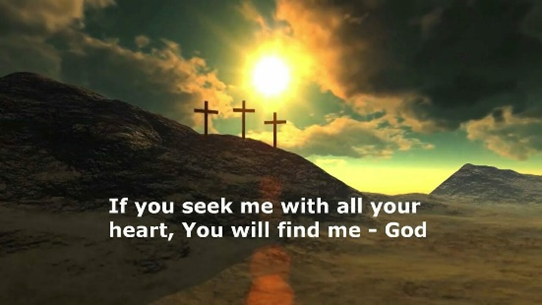
- Jeremiah 29:13
Closing Prayer
Prayer to Put on Christ’s Clothes Today
As I enter this day with You, Lord,
I will walk in your worn shoes and selfless garments,
Taking nothing with me, and taking nothing from others,
Because I need nothing except You.
Today, we share the same two lungs.
With you, I have nothing to prove; I can listen carefully to others; I can seek to understand them
And I will speak only if my words are true, necessary, and kind.
Hail Mary, full of grace, the Lord is with thee; blessed are thou amongst women, and blessed is the fruit of thy womb, Jesus. Holy Mary, Mother of God, pray for us sinners, now and at the hour of our death. Amen.


Comments