08.09.22 Recap - Bible Timeline Week - Joseph, Prime Minister of Egypt (Gen 43-50)
- tmaley
- Aug 15, 2022
- 17 min read
Northern Virginia Catholic Bible Study House rules/notes… 1. Meetup is www.meetup.com/catholicbiblestudy Zoom Meeting Logon info is the same every week: Zoom ID: 861 1782 2081 Password: 406952 2. Questions encouraged. If you have questions about anything, you can ask in the chat, email the Meetup group, or me directly at ron@hallagan.net. 3. Unedited recaps of meetings are posted via Meetup after our meeting. The final edited recap is posted on our Catholic Catacombs Light website www.catholiccatacombs.wixsite.com/website/recaps a week later. You will be notified via Meetup of both. 4. See The Chosen. Knowing Jesus Christ means being able to better relate to God. Check it out: The Chosen at https://thechosen.link/1Y1R7. 5. Respectfulness. We will be discussing differences between religions and between Christian denominations, and agree to be respectful at all times. Specifically, Protestants are our friends and brothers in Christ, and I personally owe part of my return to the faith to them. 6. No politics. It would be easy for us to self-destruct, but that’s not our goal. Our goal is to learn the Bible, explain the Catholic faith, and help members develop a closer relationship with the Father, Jesus Christ, and the Holy Spirit in their daily lives. 7. Catholic Prayer, Fellowship, and Spirituality Meetup led by fellow member Jason Goldberg: https://www.meetup.com/online-catholic-prayer-fellowship-and-spirituality/ 8. Prison fellowship – opportunities to volunteer one Saturday per month for 2 hours (12-2 or 2-4) serving Catholic prisoners at the Fairfax County Jail. Ask Ron (ron@hallagan.net) or Gina (gmasterson99@gmail.com) for details. Why? "I was in prison and you visited me." – Matt 25:36 RSVP Reminder: Please RSVP whether you are attending or just reading the notes afterwards. The more RSVPs, the more Meetup will give us recognition, which will draw others to us, which is our way of evangelizing! Bible Study Format: 5 min prayers, 10 min Catholic topic, 45 min main topic from the weeks listed below Week 1: Aug 2 – Gospel Week: Mary & Martha (Lk 10:38-42); Teach us to Pray (Lk 11:1-5,9-12); The Kingdom is like… (Mt 13…) Week 2: Aug 9 – Bible Week (Gen àRev): Joseph, Prime Minister of Egypt (Gen 43-50) Week 3: Aug 16 – Survey Topics Voted on by Members: We are currently on #2 Purgatory (final) à Next is Heaven I (Dante)
Ö 1) Jesus’ Greatest Parables 2) Hell, Purgatory, Heaven 3) Christian Comparisons 4) Great Women in the Bible 5) Why is there suffering? 6) World Religions 7) Book of Revelation 8) Major Councils/Crusades/Inquisitions
Week 4: Aug 23 (31) – Open Mic Week (anything goes!): Here are some open questions - we need to prioritize the top 3-4 monthly:
1. Can we have elevator responses for the Crusades and Inquisitions?
2. How should we be celebrating/honoring the Sabbath Sunday?
3. How does the possibility of other intelligent life in the universe affect our Catholicism?
4. What race was Jesus?
5. What is Sanctifying grace vs actual grace?
6. What is justice? Is it always good? Is Babylon from God or just natural justice? If one suffers but the results are good, is that justice?
7. Are Charity and Love synonymous? How are they different? What are the 4 highest forms of Charity?
8. What is the Heresy of the Good Serpent?
9. The love and unity of the Holy Spirit are two of its Trinitarian descriptions. How are they different? How does they affect us?
10. The knowledge of God is “participatory.” Is that why nonbelievers have difficulty?
Upcoming Catholic Holy Days
Solemnity of the Assumption of the Blessed Virgin Mary Mon, August 15
Opening Prayer
We ask that you continue to send your Holy Spirit among us as we listen to your Word.
Let us not be like the scribes who could not hear your meaning
but let your Word penetrate our minds and transform us like the North Star that guided the direction of the Wise Men.
Mary Queen of Heaven, we ask for your intercession to lead us to your Son, Jesus Christ.
You who bore the Word made flesh in your womb,
help his Word dwell in us tonight.
As you taught us to pray...
Our Father who art in heaven, hallowed be your name.
Your kingdom come, your will be done, on earth as it is in heaven.
Give us this day our daily bread,
And forgive us our trespasses as we forgive those who have trespassed against us.
And lead us not into temptation but deliver us from evil.
Amen.
Bible Timeline – Where Are We?

Tonight: Gen 40-41 – Joseph Dreams Again, becomes P.Minister
Gen 42-44 – Joseph’s Brothers come to Egypt
Gen 45 – The Truth Revealed
Gen 46-50 – Israel Migrates to Egypt, Jacob dies. Joseph lives to 110.
End of the Book of Genesis. Next: Book of Exodus – 2nd book of the Penteteuch/Torah
Where did we leave off last month?

Joseph the slave was put in charge of the household of Potiphar, captain of the guard to the Pharaoh.
Joseph wouldn’t sleep with Potiphar’s wife, so she pretended Joseph tried to rape her and Potiphar put him in prison.

“But the Lord was with Joseph and gave him favor in the sight of the keeper of the prison.” – Gen 39:21
After a while, the keeper of the prison liked Joseph so much he let him run all the affairs of the prison.
Genesis 40 – The Baker and the Butler
Sometime later, an incident occurred that caused Pharaoh to become so angry with his chief butler and chief baker that he had them put in prison.
It was the same prison Joseph was in.
Both the baker and the butler had a strange dream one night and Joseph saw that they were both deeply troubled. When he offered to help, they told him their dreams. Joseph interpreted their dreams, which happen to include that Pharaoh would be releasing them from prison after three days. Joseph’s interpretations came true. However, they forgot Joseph and he remained in prison another two years.

Genesis 41 – The Pharaoh’s Dreams
One night, Pharaoh had a very troublesome dream. Two troublesome dreams!
The next day, he called all the magicians and wise men of Egypt, but none could interpret the dreams.
Pharaoh’s chief butler overheard all this and entered the fray to inform Pharaoh about the man in prison who could interpret dreams. He explained how this prisoner, Joseph, correctly interpreted his dreams and the baker’s dreams.
Pharaoh sent for Joseph immediately.
When Joseph was brought to him, the Pharaoh explained his two dreams.

Q: Does anyone know the Pharaoh’s dream?
Seven fat cows came out of the Nile and began to graze. Then seven skinny, scrawny cows came out of the Nile and ate the seven fat cows. The second dream: seven ears of grain, plump and ripe, were growing out of one stalk. Then suddenly another stalk appeared sprouting seven ears of grain, but these were thin and blighted by the east sun. The seven blighted ears then ate the ripe, plump ears.
Joseph told Pharaoh that both dreams were one and the same, but that “double dreams” meant it was coming from God and coming soon.

Then Joseph explained the dreams to Pharaoh: the first seven fat cows and plump ears of grain meant that there will be seven years of very fruitful harvest throughout the land. However, the seven skinny cows and ears of grain mean that there will be seven years of horrible famine, which will consume the land.
Regarding what to do, Joseph told Pharaoh he should select a man both discreet and wise and set him over the entire land; then appoint overseers to take one-fifth of its produce from all of Egypt for each of the seven plentiful years, which will then be stored up to supply Pharaoh’s kingdom for the following seven years of famine.
This proposal sounded wise to Pharaoh and so he discussed it with his advisors and they all agreed. Pharaoh asked them if any of them had heard so wise a man who also had the support of his god?
Pharaoh called Joseph and said that he had selected a wise and discreet man to oversee his land and this plan, and it was him, Joseph. Pharaoh have him a signet ring, a gold chain around his neck, fine linen to wear, a chariot, and servants, and said,
“I am Pharaoh and no man shall lift a hand or foot in all of Egypt without your consent.” – Gen 41:44
(And to think he was in prison only the day before.)
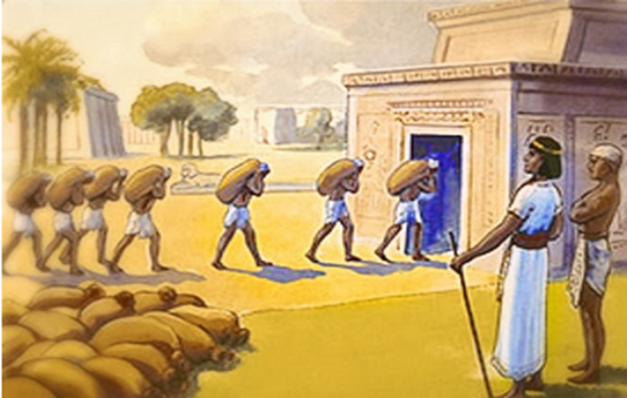
“Now in the seven plentiful years the ground brought forth abundantly. Joseph collected all the food produced in those seven years of abundance in Egypt and stored it in the cities… Joseph stored up such huge quantities of grain … that he stopped keeping records because it was beyond measure.” – Gen 41:47-49

During the seven plentiful years, Joseph married Asenath, the daughter of the Priest of On, and they gave birth to two sons, Manasseh and Ephraim.
Then the 7 years of plenty came to an end and the seven years of famine began.
When all Egypt began to feel the famine, the people cried out to Pharaoh for food. Then Pharaoh told all the Egyptians, “Go to Joseph and do what he tells you.” – Gen 41:55
And so Joseph opened the storehouses. Word spread, and soon all the world came to Egypt to buy grain from Joseph, because the famine was severe everywhere. Joseph, son of Jacob/Israel, sold into slavery, had not only saved Egypt but also the world surrounding Egypt.
Note 1: Seven-year famines are well documented in Egyptian and in other ancient Near Eastern documents, including during the time that this story was thought to have occurred (around 1700 BC).
Note 2: Famines are devastating. In the second rainless season, not only would the flocks and herds begin to languish, but the landowners and servants would begin to become enfeebled from insufficient nourishment and begin to die of low fever and those other diseases which follow in the train of famine. This famine in Egypt and Canaan alone killed tens of thousands of people.
Chapter 42 – Famine in Canaan
Back in Canaan, Jacob’s clan was suffering as well. Jacob had seen the caravans pass by and learned that they had been able to purchase food supplies in Egypt. Jacob sees his sons doing nothing, and so he finally tells them to go to Egypt immediately and buy what they can so that they don’t all die.

Ten of Jacob’s sons leave for Egypt. Joseph keeps his youngest, Benjamin, with him (the only other son from Rachel). He had already lost Joseph, and so he was not about to send Benjamin with them.
Arrival in Egypt
When the 10 brothers arrive in Egypt, Joseph sees them and recognizes them; but he pretends not to know them and proceeds to treat them like foreigners, even using an interpreter! The brothers do not recognize Joseph; for one, he is a grown man (now in his 30s); secondly, he is dressed as an Egyptian royal official.
Joseph begins questioning them. He doesn’t like their answers and accuses them of being spies!
The brothers proclaim, “It is not so, my lord, we are honest men! We are 12 brothers, the sons of one man who lives in the land of Canaan. The youngest brother is now with our father, and one is no more.”

Joseph tells them he does not trust them but that he will give them a chance to prove they are not spies. He will keep one of the brothers while the others return to their homeland. If they bring back their youngest brother, then he will believe them. The brothers are horrified, knowing Jacob will not allow this. With the threat of losing Benjamin, Judah steps forward to argue with Joseph, to no avail. The brothers turn to one another to discuss their predicament:
They said to one another, “Surely, we deserve to suffer these things because of what we did to our brother. We saw how distressed he was when he pleaded with us for his life, but we would not listen; that’s why this distress has come on us.”
Reuben replied, “Did I not tell you not to sin against the boy? But you wouldn’t listen! Now we must give an accounting for his blood.” – Gen 42:21-22
They did not realize that Joseph could understand them. Joseph turned away from them and wept, but then turned back and spoke to them again. He had Simeon taken from them and bound in their presence and commanded his servants to give the remaining brothers all the provisions they came to purchase, and then he sent them on their way. He also had his servants put the silver payments the brothers had made back into their sacks.
Q: What do you think about this encounter that neither Joseph nor the brothers expected in a million years?
One of the classic encounters in all of history.
Q: How do you think Joseph has responded so far?
Joseph is obviously going through a lot of emotions right now. He hasn’t been able to hardly process it. All in all, his brothers are very fortunate, although they don’t realize it.
Q: Do you think there is a reason Simeon was picked to remain behind in prison?
Normally, it would be the oldest, which would be Reuben. But Reuben was the least guilty of what happened to Joseph and tried to stop it. Simeon was the eldest of the guilty brothers.
The Brothers return to Jacob
When they came to their father Jacob in the land of Canaan, they told him all that had happened to them.
As they were emptying their sacks, there in each man’s sack was his pouch of silver! When they and their father saw the money pouches, they were frightened. Their father Jacob said to them, “You have deprived me of my children. Joseph is no more and Simeon is no more, and now you want to take Benjamin. All these evils are upon me!”
Then Reuben said to his father, “You may put both of my sons to death if I do not bring him back to you. Entrust him to my care, and I will bring him back.” -- Gen 42:29-37
Jacob refuses their request. He fears now more than ever that this would be the end of Benjamin.

Chapter 43-45 – The Famine Continues
The famine continues to worsen, and Jacob realizes there is no other option but to let Benjamin go. He is grieved beyond words.
He tells his sons to return all the silver from their original trip and to double the amount.
The brothers and Benjamin depart for Egypt.

From Hebron Israel to Goshen, Egypt is about 200 miles, or 10 days at 20 miles/day.
Arrival in Egypt
When the brothers arrived in Egypt and stood before Joseph, they attempted to explain that somehow the silver ended up in their bags, and so they brought it back to him and begged forgiveness. Joseph waved their concerns off and ordered them to dine with him.
As the night progresses, Joseph can’t maintain himself any longer and finally tells his brothers who he is.
Then Joseph could no longer control himself before all his attendants, and he cried out, “Have everyone leave my presence!” So there was no one with Joseph when he made himself known to his brothers.
And he wept so loudly that the Egyptians heard him, and Pharaoh’s household heard about it.
Joseph said to his brothers, “I am Joseph! Is my father still living?” But his brothers were not able to answer him, because they were terrified at his presence.
Then Joseph said to his brothers, “Come close to me.” When they had done so, he said, “I am your brother Joseph, the one you sold into Egypt! And now, do not be distressed and do not be angry with yourselves for selling me here, because it was to save lives that God sent me ahead of you. For two years now there has been famine in the land, and for the next five years there will be no plowing and reaping. But God sent me ahead of you to preserve for you a remnant on earth and to save your lives by a great deliverance.”
Joseph continued, “So then, it was not you who sent me here, but God. He made me father to Pharaoh, lord of his entire household and ruler of all Egypt. Now hurry back to my father and say to him, ‘This is what your son Joseph says: God has made me lord of all Egypt. Come down to me; don’t delay. You shall live in the region of Goshen and be near me—you, your children and grandchildren, your flocks and herds, and all you have.”
Then he threw his arms around his brother Benjamin and wept, and Benjamin embraced him, weeping.
Joseph goes to Pharaoh to request permission. Pharaoh insists his whole family come to Egypt and be given the best land. Goshen is chosen which also served to keep them somewhat separate from the Egyptians, who looked down upon “shepherds.” Pharaoh sends provisions with the brothers, along with extra carts and horses, and a whole retinue of servants to help with the move.
When the brothers arrive in Canaan and tell Jacob everything, Jacob does not believe them – especially when they told him Joseph was alive! However, Jacob comes around and finally says, “My son Joseph is alive! I will go and see him before I die.”
Chapter 46-49
Jacob is still worried but God spoke to him in a vision at night and says, “Do not worry. I will go with you to Egypt, and I will bring you back again. You will die in Egypt but Joseph will be with you to close your eyes.”
As they approach Egypt, Jacob sends Judah ahead to let Joseph to meet them in Goshen.
Joseph met his father Jacob in Goshen. It was an emotional affair.
Jacob meets Pharaoh and gives Pharaoh a blessing. Pharaoh asks Jacob how old he is. Jacob answers 130.
Jacob, his sons and their families and all their grandchildren, great grandchildren, and entire household of servants settle in Goshen.
When Jacob meets Joseph’s two sons, he blesses the younger one, Ephraim.
Jacob lived 17 more years and died at 147.
Note: It is interesting that, out of all the brothers, Jacob sends Judah ahead to prepare for their arrival. This is a clan leadership role and indicates Judah has found some favor again with Jacob.

Pharaoh sends another retinue with Joseph to take Jacob back to Canaan so he could be buried alongside his fathers and Rachel.
With Jacob dead, the brothers are suddenly worried that Joseph will change his mind and kill them, so they make up a story and tell Joseph that Jacob’s dying words to them was that he should forgive them. Joseph weeps – perhaps because he knew they were lying – but it didn’t matter because he had forgiven them anyway. He now knew in his heart that the Lord made it all happen to save his people.
“You intended to harm me, but God intended it for good to accomplish what is now being done, the saving of many lives.” – Gen 50:20
It must be noted that before Jacob died, he does not bless his first three sons. Instead, he blesses his fourth son, Judah, stating the following amazing prophecy:
“The scepter will not depart from Judah…until it comes to whom it belongs.” – Gen 49:10
Q: What does this mean?
Judah not only becomes a major tribe in the Promised Land, but it is where Jerusalem will be located. Judah is also the line from which King David comes. After Israel splits into two kingdoms in 930BC, “Judah” is the name retained for the Southern Kingdom. Finally, we know that Jesus is from the line of King David – the line of Judah!
Chapter 50
Joseph stayed in Egypt, along with his father’s family, for the rest of his life. He made an agreement with the Israelite people that when they finally return to Canaan, they must carry his bones back and bury him alongside Abraham, Isaac, and his mother and father, Jacob and Rachel.
Joseph lived to 110 years.
END OF GENESIS
Review
Joseph’s story, especially with regards to his dishonest brothers, provides us with a good example of how to respond to injustice with charity, inviting self-reflection on the part of the guilty; no doubt a reflection time for Joseph, too; and finally forgiveness. The text hides very little when it comes to the flaws of our faith ancestors – in this case conspiring and carrying out an injustice at almost every turn, and then covering up their tracks. Commentators have noted how such behavior requires people to constantly look over their shoulders and suspect the worst from everyone else, because that’s how they are.
Q: When God assured Jacob to go ahead to Egypt, he didn’t mention that his clan would be there for another 400 years in slavery. Was this an oversight?
Perhaps Jacob was unable to hear it. Nevertheless, Joseph's tragedy became the prelude to God fulfilling His prophecy to Abraham in Genesis 15:
Then Yahweh said to Abram, 'Know this for certain, that your descendants will be exiles in a land not their own, and be enslaved and oppressed for four hundred years. But I shall bring judgment on the nation that enslaves them and later this they will leave, with many possessions. For your part, you will join your ancestors in peace; you will be buried at a happy old age. – Gen 15:13-15
Q: Joseph went through some difficult times due to evil deeds committed by others (his brothers, the wife of Potiphar…). Some people have asked, does God direct evil our way in order to get His way?
Unequivocally, no! God never wills evil or directs evil. But He does respect free will, and He may allow such evil to proceed by the hands of others – and then He uses those events to help bring about some good. The same can be said about Jesus on the cross. Knowing what humans would do, He came anyway. True, God allowed the crucifixion to happen, but then He used that to benefit humans greatly.
Therefore, when suffering occurs, it does not mean God has abandoned us. Although if we abandon God, the possible purpose of any suffering will be lost on us.

Q: What are our choices when suffering comes our way?
This is always easier said than done, but it doesn’t change the truth of it. We need to practice internalizing this thought process, because it doesn’t come automatically to us when we are in the midst of suffering. We basically have three choices when dealing with suffering:
1) We can ask God to help us through the suffering and to let us join our suffering to Christ’s suffering. This does not mean that Jesus’ suffering was not sufficient in some way – not at all. But we can add to his gift to us by imitating him and returning it. If nothing else, our suffering will be deposited into our treasury in heaven, or we can ask for it to be distributed to help others (i.e., the poor souls in Purgatory).
2) We can ask God to help us through it, but then also pray by asking how this suffering might bring about some greater good in our lives. Sometimes this silver lining will not be clear until the dust has settled; sometimes it will be sooner, but it will come.
3) We can be miserable about the injustice of our suffering, complain to everyone, blame others, and even curse God. If we choose this option, then only one thing is certain – your suffering will have been meaningless, and you will have made a lot of other people suffer along with you.
Q. At the end of the meeting, I was asked if I could comment on the fact that Joseph – the hope of Israel – married the daughter of Pharaoh's head priest.
The Bible only states that Pharaoh gave Asenath, daughter of the priest of On, to be Joseph’s wife (Gen 41:45). However, Jewish Mishnah (traditions/commentaries) have long held that Joseph refused to marry Asenath at first because of her religion; and that Asenath loved Joseph and was determined to marry him so she learned about his religion and converted, throwing all her pagan idols out her window to prove it. Jewish religion permits conversions, so all was well in Hebrewland. This is an old tradition passed down over the ages and there is no way to verify its accuracy, but it sounds great so I’m accepting it.
Q: Thinking back over Joseph’s life, can you see how he might have been a “forerunner” of Jesus Christ? How many parallels can find between them?
Joseph became Prime Minister at the age of 30.
Jesus began his ministry at the age of 30.
Joseph was sold into slavery for 20 pcs of silver.
Jesus was sold to his executioners for 30 pcs of silver (inflation).
Joseph was betrayed by his brothers, the sons of Jacob/Israel.
Jesus was betrayed by his brothers – not only Judas but the sons of Israel (the Jews).
Joseph's brothers believed he was dead, but he was found to be alive and became the savior of his family.
Jesus was believed to be dead, but he was resurrected from the dead and became the savior of the world.
Joseph escaped death by going into Egypt.
Jesus escaped death by going into Egypt.
Joseph forgave those who persecuted him.
Jesus forgave those who persecuted him from the cross.
God used Joseph’s terrible misfortune to do accomplish great things.
God used Jesus’ suffering, crucifixion, and death that humans inflicted on him as payment for sins and the forgiveness we now receive for-the-asking, thus opening the gates of heaven to humanity.
Finally, Joseph was the link that facilitated the covenant promise from One Holy Tribe (Abraham) to One Holy Nation (Moses).
Jesus took the Chosen Ones of God from One Holy Kingdom to One Holy Catholic & Apostolic Church (to the entire world).

Closing Prayer
Father in heaven, we thank you for sharing your Word with us tonight.
We thank you for revealing your heart to us.
We thank you for letting us journey with the patriarchs,
With Abraham & Sarah, Isaac and Rebekkah, and with Joseph, Leah, and Rachel.
We thank you for letting us be a part of Joseph and his tragedy but also his triumph through tragedy.
In many ways, we can see him foreshadowing your Son:
sold into captivity by his brothers, never losing faith, rising again to save the world around him.
All for You and in Your name.
Thank you for reminding us that that we can trust You even in the darkest of times.
And now we will ask your sweet, holy mother to intercede on our behalf:
Hail Mary, full of grace the Lord is with thee. Blessed art thou among women, and blessed is the fruit of thy womb, Jesus. Holy Mary, Mother of God, pray for us sinners now and at the hour of our death. Amen.


Comments