08.23.26 - Peter's Declaration & the Dead Sea Scrolls IV
- tmaley
- 11 minutes ago
- 16 min read
Catholic Understanding & Biblical Defense Class 8/18/26
Every Tuesday, 7PM-8PM (EST), 🖥️Zoom ID: 861 1782 2081 🗝️Passcode: 406952
Join to receive notifications and study notes on Meetup: www.meetup.com/catholicbiblestudy
Past classes are posted on our Catholic Catacombs Website: www.CatholicCatacombs.org
House Rules and Catholic Resources…
1. RSVP Reminder: Please RSVP whether you are attending the meeting or just reading the Recaps afterwards. The more RSVPs, the more Meetup will give exposure to “Catholic Bible Study” – a good thing!
2. Questions. We encourage questions although we ask that you keep them on topic and brief. You can ask during the meeting, or in the chat box, or if you prefer you can email us through Meetup.com, or Ron directly: ron@hallagan.net.
3. Respectfulness. We will be discussing differences between Christian denominations and religions in general, and we seek to be respectful at all times. Protestants especially are our friends and brothers/sisters-in-Christ; in fact, I owe much of my return to Christianity to them. Therefore, any critique of our brethren is in loving pursuit of apostolic truth.
4. No politics. It would be easy for us to self-destruct, but that’s not our goal :). Our goal is to learn, understand, and apply the Bible and our faith to our everyday lives.
5. Word on Fire. Bishop Robert Barron has reached millions through his 10 min Sunday homilies, podcasts, educational series and certifications, bibles, and other lectures and apologetics. www.wordonfire.org
6. Hallow App. Daily prayers and reflections, especially for the high holyday seasons. www.alex@mail.hallow.com
7. Catholic Answers – www.catholic.com. Best site for Catholic Apologetics there is.
8. Dynamic Catholic. Interested in daily inspirations to grow closer to God and the Church, not to speak of the many educational resources? Sign up for Matthew Kelly’s powerful insights, quotes, and reflections at www.dynamiccatholic.com.
9. “The Chosen” TV series. All of us seek a relationship with Jesus Christ, which is not always easy. It can help if we have seen and heard Him. The Chosen series captures Jesus better than any show I have ever seen. Highly recommended.
10.Cursillo. Interested in meeting with other men or women weekly over coffee to discuss God in your personal and professional life? Join Cursillo (cur-see-yo). Contact Jennifer Pence (Jennifer.pence@gmail.com) for more information.
11. Online- Catholic Prayer & Fellowship. Are you interested in praying the rosary, etc. with other Catholics during the week? Follow fellow member Jason Goldberg. Link: https://www.meetup.com/online-catholic-prayer-and-fellowship/
Bible Study Format
Our Bible Study is a combination of Exegesis and Apologetics.


Each meeting is (roughly) as follows:
15 min Apologetic Reflection
15 min Upcoming Gospel Reading
30 min Weekly topic/theme
1 hour
Week 1: Gospel Week – we study several Gospel stories, especially the tough ones.
Week 2: Bible Week – we are working our way through the Bible. We are studying the New Testament.
Weeks 3 & 4: Survey Topics chosen by Members (explanations of our faith & apologetics):
1. Prison Ministry Stories 2. Plenary Indulgences 3. Gen 1-3 (Creation Story, Adam & Eve, the Fall of Man)
4. Faith vs Doubts – does having doubts make us bad Christians? 5. Explanation of the Mass & Eucharist
6. Dead Sea Scrolls 7. Catholicism vs modern cosmology 8. Gifts/Fruits of the HS, 7 Deadly Sins
9. How to experience the Love of God 10. The Communion of Saints
11. Comparative Religions 12. Catholic vs Protestant beliefs
· Don’t forget to RSVP.
· Taylor will send a link to everyone with today’s notes.
· The class is recorded if you want to listen to it anytime.
· I will occasionally ask for volunteer readers…
Opening Prayer
LORD, thank you for your promise that where two or three of us are gathered in your name, You are there.
We welcome You among us today!
We ask that You open our ears so that we hear your voice and receive your wisdom.
And as Jesus taught us to pray …
Our Father
Who art in Heaven, Hallowed be Thy Name.
Thy Kingdom come, Thy Will be done, on earth as it is in Heaven.
Give us this day our daily Bread;
And forgive us our trespasses as we forgive those who trespass against us.
And lead us not into temptation but deliver us from evil. Amen.
Major holy days: All Saints Day (Nov 1)
August Memorials: St. Monica -27, St. Augustine-28
September Memorials: Mary’s Nativity-8, Archangels Michael, Gabriel, Raphael-29
www.masstimes.org Mass or Confession any time of the day, anywhere in the world!
Today’s Agenda…
Reflection: The Virtue of Temperance
Gospel Reading for 21st Sun in Ord Time 8/23: Peter’s Declaration Jesus is Christ, Matthew 16:13-20
Topic: The Dead Sea Scrolls IV – Recap and Conclusion
Follow up to last week:
1. I said that the Trinity wasn’t in the Bible. The idea was clearly given to us by Jesus (i.e., “I and the Father are One,” and “I will send you the Holy Spirit”, etc.), but we just didn’t give it the word “Trinity” (Tri+Unity) until the 4th century.
2. Is Mary’s bodily assumption into Heaven different than Enoch and Elijah?
Yes. Enoch and Elijah will still face death (lose their mortal bodies) before the final resurrection of the dead at the end of time. Mary, however, was given her glorified body at her Assumption. She is truly the first human to receive the fruits of Christ’s Resurrection.
Reflection: The Virtue of Temperance
What is a Virtue?
Virtues are good habits, morally and otherwise. Their opposites are vices, which are bad habits, morally or otherwise. The more habitual a good is the easier it is to live it, and the easier it is to discern and avoid bad choices when they come.
What is Virtue of Temperance?
Temperance is the virtue of self-control (moderation). It especially applies to all our lower animal appetites (instincts), such as food, drink, sex, and other desires and emotions, which are intended to be good but can become vices (like addictions) when they gain the upper hand. The temperate person moderates desire and is never enslaved to excess or extremes.
Temperance is moderation and restraint in the things that are good and total abstinence from the things that are not good.

Matthew 16:13-20
Peter’s Profession of the Christ and Jesus Proclaims the Founding of His Church…
Context:
In the previous chapter (the Canaanite Woman) and this chapter, we follow Jesus from Tyre & Sidon to the Sea of Galilee where he feeds 4,000 (different than the earlier 5,000), and now on to the region of Caesarea Philippi…
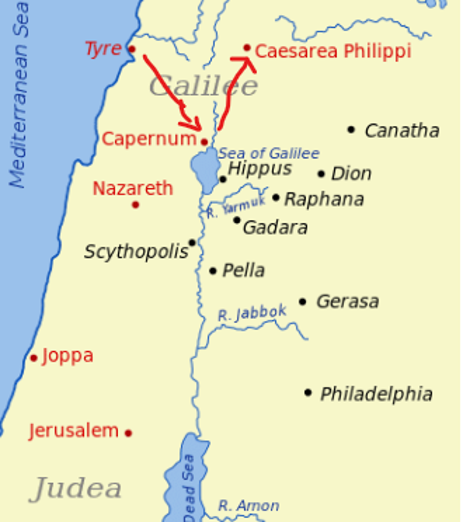
Caesarea Philippi – about 20 miles north of the Sea of Galilee – was a name given by Herod the Great in honor of the Roman Emperor, and included a Roman temple. This region was the northernmost boundary of the Promised Land at the time of David and Solomon, representing where many of the lost 10 tribes of Israel lived before the Assyrian conquest in 721 BC. The prophecies said the Messiah would gather all the lost sheep of Israel, which is why Jesus is visiting all these places now.
There are two significant revelations in today’s reading: First, the divine identity of Jesus, which is revealed by Peter of all people; but, as Jesus pointed out, it didn’t come from him but from God. Second, this exchange simultaneously reveals who will be the leader of the disciples and of Jesus’ Church - Peter. God picked a man with many faults, which is good news for us. If Peter can be picked by God for this role, then we have great hope for Heaven amidst our own mistakes, if we just repent.

Matthew 16:13-20
Jesus went into the region of Caesarea Philippi and he asked his disciples, "Who do people say that the Son of Man is?"
They replied, "Some say John the Baptist, others Elijah, still others Jeremiah or one of the prophets."
He said to them, "But who do you say that I am?"
Simon Peter said in reply, "You are the Christ, the Son of the living God."
Jesus said to him in reply, "Blessed are you, Simon son of Jonah. For flesh and blood has not revealed this to you, but my heavenly Father. And so I say to you, you are Peter, and upon this rock I will build my church, and the gates of the netherworld shall not prevail against it. I will give you the keys to the kingdom of heaven.
Whatever you bind on earth shall be bound in heaven; and whatever you loose on earth shall be loosed in heaven."
Then he strictly ordered his disciples to tell no one that he was the Christ.
Exegesis (Investigation/Interpretation
“Blessed are you, Simon son of Jonah. For flesh and blood has not revealed this to you, but my heavenly Father.
This is the first explicit revelation given to the Apostles that Jesus is both Messiah and the Son of God. Jesus used Peter’s inspired response as his time to announce both the Church and Peter’s role in it.
“And so I say to you, you are Peter, and upon this rock I will build my Church, and the gates of the netherworld shall not prevail against it.” (Note, “Peter” and “rock” are the same: i.e., You are Petra and upon this Petros I will build my Church.)
Why does Jesus rename Simon Peter?
A change in the name of a servant of God signifies a change in destiny, as in Abram's name change to Abraham (“father of multitudes”) and Jacob’s name to Israel (“one who struggles with God” = the new name of the chosen people). Peter in Aramaic means “rock.” In the Old Testament, "rock" was a word first used to describe Abraham as the physical father from whom the children of Israel were hewn (Isaiah 51:1-2). Now Jesus uses the word as a personal name signifying a change in Simon's destiny as the leader and foundation "rock" of Jesus' Church.
“… and the gates of the netherworld shall not prevail against it.”
The netherworld (Hades) is the name for the “realm of the dead,” which means Jesus is promising that his Church will never die. In fact, his Church will totally overcome death itself at the end of the age.
“I will give you the keys to the Kingdom of Heaven. Whatever you bind on earth shall be bound in heaven; and whatever you loose on earth shall be loosed in heaven.”
What does Jesus mean by these keys to the Kingdom and binding/loosing?
Keys to the Kingdom: In ancient times, the person in charge of the day-to-day affairs of the kingdom had titles like Prime Minister or Chief Steward, which is what is meant by having the “keys to the kingdom” (see Isaiah 22:22). This is what Jesus is doing with Peter. He is elevating Peter to a kind of Chief Priest or Prime Minister over the other Apostles (Ministers) and over the Church. The name “Pope” was a later term, which was just an endearing name for father, “papa.” The Pope’s other titles are the “Bishop of Rome” and the “Vicar of Christ.” Vicar means representative (it’s where we get the word vicarious). Therefore, the “Vicar of Christ” means the Pope is Jesus’ earthly representative.

Bind and loose: Let’s look back to similar wording used in Isaiah 22… “open and shut” mean the same thing:
I will place the keys of the House of David on his shoulder; what he opens, no one will shut; what he shuts, no one will open. – Isaiah 22:22
What does “bind and loose” refers to?
1) To forgive sins and to pronounce penance for sins to reconcile sinners to the Church (confirmed in John 20:23)
2) To give authoritative teaching and make judgments concerning correct doctrine (confirmed in 2 Peter 1:20)
3) To discipline the congregation of the faithful when some fall into error by imposing or later lifting the ban of excommunication (confirmed in Matthew 18:15-18).
“Blessed are you, Simon son of Jonah. For flesh and blood has not revealed this to you, but my heavenly Father. And so I say to you, you are Peter, and upon this rock I will build my Church.”
Do you notice anything unusual about Jesus’ reference to Simon’s name?
Simon’s father’s name was John, not Jonah. Just to prove this wasn’t a misunderstanding (Jonah is close to John), we find that Jesus correctly refers to Peter’s father’s name (son of John) 1:42 and John 21:15. Here are the translations:

It appears Jesus changed his surname to “son of Jonah.” Why? Might there be a connection to the prophet Jonah?
Jonah was also a Galilean who around 750 BC was sent by God to the Gentile people of Nineveh, the capital city of the Assyrian Empire (the greatest at the time), to tell them to repent and to acknowledge the God of Israel. Now Jesus will send the Galilean, Simon-Peter, to Rome, the capital city of the Roman Empire (the greatest empire ever) to tell the Gentiles of the Roman world to repent and to accept Jesus as Lord-God and Savior.
You can’t make this stuff up.
Speaking of Peter’s position and authority over the Church, when was the first “written” instance we have of the “Bishop of Rome” having authority over the other Christian bishops and churches?
In 96 AD, Pope St. Clement of Rome (3rd pope and a disciple of Peter’s) wrote his “Letter to the Corinthians,” where he warned them to respect the office of the bishop and against thinking they could create their own leadership.
Note: the first time we find something in writing does not mean that was the first time a term was used. It usually implies that the practice was already in place for some time. For example, we find “Catholic Church” first showing up in St. Ignatius of Antioch’s epistle (a disciple of St. John’s) in 107 AD. He used it casually, suggesting it had been in use for some time, and that was in the first century.
“Where the bishop appears, there let the people be, just as where Jesus Christ is, there is the Catholic Church.”
- St. Ignatius of Antioch (a disciple of John’s) in his Epistle to the Smyrnaeans in 107 AD
What is meant by the “Chair of Peter”?
The term “Chair of Peter” replaces the Jewish “Chair of Moses” that referred to the authority of the Chief Priest. The Chair of Peter is a symbol of the apostolic authority that Christ gave to Peter and that is handed down to his successors, the Bishops of Rome.

There is actually a Chair of St. Peter located in St. Peter’s Basilica in the Vatican. Tradition holds that it is the original wooden seat used by St. Peter whenever he preached or taught the Christians in Rome. The chair was later encased in bronze, and is an impressive work of art. There is even a feast day that honors the Chair of Peter (Feb 22).
Then Jesus said to the crowds and to his disciples: “The teachers of the law and the Pharisees sit in Moses' seat. So you must be careful to do everything they tell you. But do not do what they do, for they do not practice what they preach. – Mt 23:1-3

Notice the sling holding Peter’s arm that has the keys. It is strange in appearance, but profound in meaning. The sling is a reminder of human weakness. The weight of the keys of Peter is far too great to be borne by mortal strength; the pope must rely on the divine aid that Christ promised to His Vicar on earth. It is the Holy Spirit that guides the hand that holds the keys, not any human ability.
Summary
The Church is built not on a worldly foundation of any kind but on a mystical foundation, born of Peter’s faith in revealing Jesus as Christ and Son of God. The Church is neither democratic nor aristocratic – it is charismatic (vivified, guided, enriched, and protected by the Holy Spirit). And this is where its power comes from.
Apologetics
Why do Protestants think Peter was not given authority over the Church?
Protestants say that Jesus wasn’t referring to Peter in the 2nd reference to rock when he said, “You are Peter and upon this rock I will build my Church.” They say the 2nd rock had nothing to do with Peter. Let’s examine this argument.
Remember, Peter’s name was Simon up to this point, and Jesus changes it to Petros (Rock). The Gospel is written in Greek and “Petros” is Greek for rock. There was no name for Peter prior to this. It was like giving him the name Rocky.
The actual verse in Greek says, “You are Petros, and upon this Petra I will build my Church.”
Notice that Jesus uses two versions for the word rock: Petros and Petra. “Petra” is the normal word for rock, which happens to be a feminine noun, and Petros is the masculine version of Petra, because Jesus is applying it to Peter.
Now that should suffice except that some Protestants – 1500 years after Christ – said that Petra just meant Jesus was building the Church on a rock, not Peter. That doesn’t explain why Jesus changes Peter’s name to Rock or why Jesus says all the next amazing things to Peter (“I give you the keys to the kingdom,” etc.).
But all that is neither here nor there because, although the Gospel is written in Greek for its universal reach, that isn’t the language Jesus and the Apostles spoke on a day-to-day basis, which was Aramaic. In Aramaic, there is only one word for rock regardless of gender (Cephas/Kephas–2 spellings), so Jesus would have used the exact same word twice.
At the end of the say, the Apostles and Church knew what Jesus meant, which is no different from what we understand it to be today.
All this being said, we all agree the Church is founded on Christ. Jesus wasn’t saying it was founded on Peter; he said, “upon this rock I will build MY Church.” He was simply saying that Peter (his position) will be the earthly head of his Church.
“Blessed are you, Simon son of Jonah. For flesh and blood has not revealed this to you, but my heavenly Father. And so I say to you, you are Peter, and upon this rock I will build my Church.”
The Dead Sea Scrolls – Part IV, Recap and Conclusion
Recommended: Jesus and the Dead Sea Scrolls, by John Bergsma
RECAP
1. The Dead Sea Scrolls were the greatest discovery of the 20th century.
- 950 scrolls found in 12 caves
- Scrolls were dated from the first to third centuries BC.
- They supported the Bible that Christians (Catholics) were using.
- They debunked the 20th Century secularists who were trying to diminish the truth and historicity of the Bible.
2. The Origin of the Essenes
The Essenes were a group of Temple priests who rebelled against the invalid appointment of priests by Judas Maccabeus in 160 BC (he also made his brother, Johnathan Maccabeus, the Chief Priest). They left Jerusalem because of this corruption and started their community called Qumran to prepare for the coming of the Messiah(s). When finding their new home, they literally followed the quote from Isaiah…
A voice cries out: In the Wilderness prepare the way of the Lord, make straight in the desert a highway for our God.” – Isaiah 40:3
3. Who else fulfilled this quote from Isaiah 40:3?
John the Baptist.
The Essenes also taught some of things John the Baptist and Jesus taught, especially the importance of repentance and Baptism.
John the Apostle (4th Gospel) also used similar language to the Essenes. A few examples: Sons of Light 12:36, Spirit of Truth (14:17, 15:26), Light and Darkness (6:28).
Judean Wilderness (Desert)




The red line indicates roughly where Joshua would have crossed with the Israelites and the Ark of the Covenant.
Today, we will conclude with:
· Essenes in Israel
· Areas of Disagreement
· What happened to the Essenes
· What to Jews today think of the Dead Sea Scrolls
Essenes in Israel
The Essenes were not confined to Qumran. The Jewish historian Josephus estimated there were over 4,000 practicing Essenes throughout Israel, some in every town. Although the Essenes of Qumran were like celibate monks, the Essenes outside of Qumran married but still had strict religious customs. Jerusalem had its own “Essene Quarter” in the southwest part of the city, which is where the Upper Room was thought to be.

Areas of Disagreement
Although there was likely involvement and interaction between John the Baptist and Jesus with the Essenes, they disagreed on some key things, which probably caused them to part ways. Although there are a half dozen points of disagreement, I will mention the top three below. Still, it is worth mentioning that that many of John’s and Jesus’ first disciples were likely Essenes.
1. Love. On the Sermon on the Mount, Jesus said, “You have heard it said, ‘You shall love your neighbor and hate your enemy.’ But I say to you, love your enemies and pray for those who persecute you.” – Mt 5:43-45. Now the statement about loving your neighbor is a requirement in the Torah (Leviticus 19:18), but where was it said that you must hate your enemies? It wasn’t in the Torah, so we assumed that it was an unofficial cultural teaching. Alas, we suddenly find this statement in the Dead Sea Scrolls! Not only was that an interesting find given what Jesus said, but the point here is that it highlights the accepted view of enemies. The Essenes especially believed that only they among all the Jews were truly God’s people. They were to love one another and hate outsiders. In fact, in Community Scroll #1QSI, there are blessings for the people of the community and a long list of curses which the people were to recite against their enemies.
Obviously, Jesus radically disagreed and taught the opposite if anyone wanted to be his follower.
2. Oaths and Secrecy. The Essenes were to take an oath that they would not disclose any of their doctrines to others, not even if they were compelled to do so at the hazard of his own life (scroll Wars, 2.8.7). And those who became part of the Council of the Community could not reveal any secrets hidden from Israel which at the risk of apostasy.
Jesus not only warned against oaths, but he also taught exactly the opposite regarding secrecy, saying, “Nothing is covered up that will not be uncovered, and nothing that is secret will not become known. What I say to you in private, reveal to everyone; what you hear whispered, proclaim from the housetops.” – Mark 4:22.
3. Ritual Purity. We have already seen at many points how concerned the Qumran Essenes were with ritual purity. Everything had to be kept in its proper place; the profane and the holy had to be clearly distinguished and separated, as well the different grades of holiness. You may recall the Community Letter to the Pharisees about pouring liquid from a ritually pure (kosher) pitcher into an unkosher cup. They informed the Pharisees that the unpure cup would cause the liquid to be impure and the impurity would travel back up into the pitcher, making it profane and undrinkable!
Here is another excerpt from a Community Scroll having to do with new members being initiated into the group:
“Now after a time of their preparatory trial is over, they are parted into four classes; and so far are the juniors inferior to the seniors, that if the seniors should be touched by the juniors, they must wash themselves, as if they had intermixed themselves with the company of a foreigner.”
Jesus disagreed sharply with all these attitudes. Unlike the Qumran community, the community of Jesus was open. There was no hierarchy of people – Jesus taught that all men and women stood equally before God. Jesus welcomed everyone as followers. As you know, the Pharisees were also ritual addicts. Recall how upset the Rabbis were when Jesus healed people on the Sabbath. Jesus had to explain to them more than once that God prefers mercy to rituals and sacrifices.
We can laugh or be amazed at their strictness, especially because of the life and death priority the rules were given. On the other hand, their zeal was impressive. Too bad they couldn’t direct that kind of attitude towards forgiveness and love of neighbor.
Where did the Essenes go?
When the Romans destroyed Jerusalem in 70AD, they knew about the Essenes and Qumran. They headed there next and destroyed them. However, the Essenes knew they were coming and hid their scrolls in the Dead Sea caves nearby.
What do the Jews think of the Dead Sea Scrolls today?
There are a number of Jewish Hebrew “Masoretic” texts (oldest version – Middle Ages) that do not line up with the texts in the Dead Sea Scrolls. The Jewish response has been to treat the Scrolls as interesting, informative, and useful, but they mostly kept their own Masoretic text unchanged.

Closing Prayer
From the DSS Thanksgiving Hymns scroll:
O Lord,
Your holy spirit illuminates the dark places of the heart of your servant, with light like the sun.
I look to the covenants made by men, worthless.
Only your truth shines, and those who love it are wise and walk in the glow of your light.
From darkness you raise hearts.
Let light shine on your servant.
Your light is everlasting.
Hail Mary, full of grace,
the Lord is with thee,
Blessed are thou among women,
and blessed is the fruit of thy womb, Jesus.
Holy Mary, Mother of God,
pray for us sinners,
now and at the hour of our death.
Amen.


Comments