09.21.23 - Topic Night - Women in the Bible
- tmaley
- Sep 25, 2023
- 19 min read
Northern Virginia Catholic Bible Study & Apologetics House rules/notes… 1. Online via Meetup/Zoom or In Person at St. John Neumann Catholic Church 11900 Lawyers Road, Reston, VA 20191 https://saintjn.org/ 2. Meetup is www.meetup.com/catholicbiblestudy Zoom Meeting Logon info is the same every week: Zoom ID: 861 1782 2081 Password: 406952 3. I will send out Meeting Recaps the same night as our sessions – these are unedited versions without pictures. An edited version with pictures will be posted on our website https://catholiccatacombs.wixsite.com/website before the next meeting. Taylor will notify everyone at that time. 4. Questions encouraged. If you have questions about anything, you can ask in the chat box, email the Meetup group, or me at ron@hallagan.net. 5. Respectfulness. We will be discussing differences between religions and Christian denominations, and we agree to be respectful at all times. Specifically, Protestants are our friends and brothers in Christ; in fact, I personally owe part of my return to the faith to them! 6. No politics. It would be easy for us to self-destruct, but that’s not our goal. Our goal is to learn/understand/apply the Bible and our Catholic faith. 7. Catholic Prayer & Fellowship. Are you interested in praying with other Catholics during the week? Fellow member Jason Goldberg has started “Catholic Prayer, Fellowship, and Spirituality Meetup.” Sign up at: https://www.meetup.com/online-catholic-prayer-fellowship-and-spirituality/. 8. “The Chosen” TV series. All of us seek a relationship with Jesus Christ, which is not always easy. It can help if we have seen and heard Him. The Chosen captures Jesus better than any show I have ever seen. Highly recommended. 9. RSVP Reminder: Please RSVP whether you are attending the meeting or just reading the Recaps afterwards. The more RSVPs, the more Meetup will give exposure to “Catholic Bible Study” – a good thing! Catholic Catacombs Website: https://catholiccatacombs.wixsite.com/website Bible Study Format: Each week of the month has a repeating topic, as noted below. Each meeting: 5 min greet, prayer, 10-15 min Catholic topic, 40-45 min main topic. Week 1: Gospel Week: Week 2: Bible Week (Gen to Rev): We are in EXODUS, the 2nd book of Moses. Week 3: Survey Topics Voted on by Members:
x 1) Jesus’ Greatest Parables x 2) Hell, Purgatory, Heaven x 3) Comparative Religions
4) Great Women in the Bible 5) Book of Revelation 6) Major Heresies and Church Councils
Week 4: Member Questions:
2. Can you provide a brief review of the origin/meaning of the (12) statements in the Creed?
3. Why does God seem full of vengeance or violence in the OT? Is this a misinterpretation?
4. Can we do a Christian Meditation one evening?
5. Angels – who are they, what do they do, and do we really have guardian angels?
Apologetics/Exegesis Terms
Ark of the Covenant – a) The golden chest containing the Ten Commandments; b) Mary’s womb containing the Word of God
Tabernacle - the portable sanctuary used by the Israelites in the wilderness from the Exodus from Egypt to the building of the Temple in Jerusalem by Solomon. Latin tabernaculum – tent; temporary dwelling place
Apologetics – to defend a belief.
Catholic Apologetics– to defend the Catholic faith using reason, tradition, & Scripture.
Exegesis – the study and interpretation of Scripture (it’s what we do here every week; you are all exegetes).
Eschatology – (Greek, eschaton=last/end): the study of the End Times: the Second Coming of Christ (also called
“Parousia”), Judgement Day, Heaven and Hell.
Church – a building for public Christian worship; the whole body of Christian believers. Greek kyriakon house of the Lord.
Synagogue – a Jewish house of worship, often having facilities for religious instruction. Greek synagogue an assembly, meeting, or gathering
Temple – Latin templum a space set aside for worship; Judaism – the original Temple in Jerusalem where sacrifices occurred.
Eucharist –the Lord’s Supper. The consecrated bread and wine. Comes from Greek eucharistia = gratefulness, thanksgiving.
Mass – the celebration of the Last Supper/Eucharist. “Mass” is from the Latin missa meaning “to send (out).”
Evangelize – to make the Kingdom of God present in our world.
God as Father/He/Him – scriptural tradition (God is not a gender); God does set the gold standard for fatherhood.
Man – generic for mankind, humanity.
Theophany – a divine appearance. Greek: theo (god) + phaneia (appearance).
Preternatural – means “outside the natural”; refers to the preternatural grace Adam & Eve had before the Fall.
The “World” – pertaining to this world or our temporary life here. Also, secular (Latin seaecularis – worldly/temporal). In the Bible, it is used negatively – “fallen man chooses the world/himself over Heaven/God and gets what he asks for.”
Opening Prayer
Dear Lord
Thank you for your promise that where two or three of us are gathered in your name, You are there.
This statement makes it clear that You are now here with us for this discussion tonight!
We welcome Your guidance as we begin our study of the most amazing women in the Bible
By better understanding them, may we better understand ourselves and the truth You have given to the world.
And as You taught us to pray:
Our Father
Who art in Heaven, Hallowed be Thy Name.
Thy Kingdom come, Thy Will be done, on earth as it is in Heaven.
Give us this day our daily Bread;
And forgive us our trespasses as we forgive those who trespass against us.
And lead us not into temptation but deliver us from evil.
Lord Jesus Christ, Son of God, have mercy on us all.
Amen.
Major liturgical events in the Church
Influential Women in the Bible

OT: Eve (Zoe), Sarah, Rebecca, Rachel, Leah, Miriam, Rahab, Deborah, Ruth, Hannah, Bathsheba, Jezebel, Esther
NT: Elizabeth, Mary Magdalene, Mary, Martha, Mary of Nazareth.
Bible and Salvation – Overview
As you may have heard me mention in the past, the Bible is not a history book. The Bible is not a science book. The Bible is a book about faith and love, good and evil, sin and redemption. In most cases, there are historical accounts, but that isn’t its purpose.
The Bible is not about how and when the universe and humans were created, although one can draw inferences, but rather why God created us and why we are here now.
If the Bible is about good, evil, and redemption, what exactly do they mean?
· Goodness is God, love, and forgiveness.
· Evil is (or comes from) love of materialism and self over God.
· Redemption means being given another chance to move from the 2nd category back into the 1st category.
Q: Why did salvation become necessary?
Salvation became necessary after God breathed spiritual natures into humans, including free will, and we used our freedom to choose ourselves over God.
‘Salvation’ obviously means to be saved, but from what? From ourselves, from slavery to sin and to this world, from desolation, from death, from an eternity without God. It specifically refers to the second chance that is given to humans.
Doorway of Salvation
Man closed the gates to God and Heaven by being disobedient. Being disobedient needs defining – it means man did not trust the goodness of God and instead chose a self-serving, self-glorifying path. After this mistake, when questioned by God, instead of apologizing or seeking forgiveness, they refused to take responsibility and blamed others (Adam blamed both God and Eve, and Eve blamed the serpent).
The “Doorway of Salvation” was created when God decided to pay for our sins Himself, through Jesus Christ. Jesus came and reversed the Fall of Man and reopened the gates of Heaven. This “doorway” is just the beginning of a relationship with God that we develop throughout our lives by involving Him in our efforts, our failures, and our forgiveness.
Q: Jesus continues to combine heaven and earth, spiritual and material, which makes sense since humans are uniquely body and spirit. This point is most illustrated in the Incarnation. Why would God bother with the incarnation if both aspects weren’t important. How did Jesus make continue to manifest this reality in Christianity?
The Sacraments – they are all “outward signs of inside grace.” All have physical + spiritual components to be valid.
Jesus’ Baptism bookends: Start: His baptism with John the Baptist brought the whole Trinity into play.
Finish: Ascension: “Baptize all nations in the name of the Father, the Son, and the Holy Spirit.”
So, then, Baptism became our doorway, after which we enter the Stairway to Heaven. This stairway is our life, and our life is a growing relationship with the Father, Son, & HS, and it is filled with trials, temptations, many large and small mistakes, continual forgiveness, wisdom, and renewal. This relationship ends in Heaven when our new life begins.

Salvation History
Although the Bible is made up of “books,” it should be seen as a single story. From the Fall of Man in Genesis to the Book of Revelation at the end of the New Testament, this “story” is the Story of Human Salvation, or “Salvation History.”
The salvation story does not end with the NT but continues to our day. Some say that we are in the “Messianic Age” which Jesus ushered in by his Death and Resurrection, but Messianic Age also refers to his Second Coming (the Parousia), so it can be confusing. I would agree that it is more clear and accurate to say that we are in the “Age of the Holy Spirit,” who came to us because of Christ, in Baptism, the Sacraments, and in our souls/consciences to assist us through this life.
The continuing Salvation Story now refers to the fact that Heaven is open for business and humans have been given a second chance. This means we all get to make our own choices now, just like our first parents did in Genesis. Whether we choose to fall again or not is an individual choice – our choice. God doesn’t judge us so much as we judge ourselves by our choices in this life (including the asking for forgiveness), and these determine the conditions of our immortal future.
Influential Women in the Bible
The subject of our study today is about the women who were instrumental in this story of salvation, from Genesis to the Gospels, although we should include the last book of Revelation since Mary shows up again there. Since I am only a man, I took a class called Influential Women in the Bible from a female theologian at the St. Paul Center for Biblical Theology.
However, I should warn you that the women aren’t all heroes. Of course, neither are the men! In fact, most of the Bible is full of human failures, mostly men! BTW, this in itself testifies to Bible’s truth, for who writes stories about one’s God by detailing one embarrassing event after another showing even heroes to be selfish, untrustworthy, lying, or unfaithful? All that being said, in my own meaningless opinion, women are often better than men. But that’s not a very high bar.

As for getting started, where else would we begin but with Eve (Zoe in Greek), the mother of all the living (Gen 3:20). The reason for starting with Eve and early Genesis is that this sets the stage and gives us context for all that is to come – not just about women but about everything.
Genesis 1
After the creation of the universe – light, the sun, moon, and stars, earth, plant life and the animals – we find ourselves in the proverbial “6th Day” of creation.

The Church does not profess a literal 6 days. Even Augustine in the 5th century said this number of days was metaphorical. However, we should note that there is both a poetry and logic to the description of the six days (i.e., the top row of days is “filled” by the corresponding days in the lower row).
What the Church requires us to believe about our origins is that God breathed his spirit into us (Gen 2:7)and this is what made us in the image and likeness of God. With this spirit, man gained a spiritual mind, a free will, and an immortal soul.
Mankind arrives on the scene at the end of Day Six after the animals. Man was likely evolving long before this – the Church does not tell us what to believe about the science of it but has no objection to evolution, if that was God’s plan.
In Gen 1:28-29, God gives man dominion over the earth: every plant, tree, fruit, birds, fish, and the animals. In Gen 2:19-20, God lets man name everything. Naming is always a right of a creator. Assigning this right to man is a sharing of power.
When we say “man,” it refers to man and woman in Gen 1.
So God created man in his own image, in the image of God he created him; male and female he created them.” – Gen 1:27
Q: Why does God give “man” dominion (lordship) over His creation?
He made mankind in his image. He wants man to share not only in His creation but he gave us the ability to create, too. God’s creation didn’t end with the Big Bang, or with earth, or with humans. It is ongoing, and we have been invited to participate in it. Naming things was just the beginning.
Q: How can we participate in ongoing creation?
Everything we do that is good, helpful, constructive, builds up, or unifies contributes to God’s creation. On the other hand, everything we do which is selfish, destructive, tears down, or divides subtracts from creation. In the end, all that man subtracted from creation will be removed/wiped away. Everything that was good will be retained and made new. The reason is because God does not waste the good that he creates, including us. At the end of each “day” in Gen 1, it says, “and God saw that it was good.”
Q: What about the 7th Day of Creation? What was that about?
The “Day of Rest” (the Sabbath) was, as Jesus said correcting the Pharisees, “was not created for God but for man.” The rest was not to lay around but to give our lives governed by this world a rest. The world gets parked at the door and we live a day of love, reflection, and spiritual renewal for the week ahead. This was to ensure we stayed on path for Heaven. In this sense, the 7th Day represents Heaven. Man was invited into the 7th Day but didn’t make it. That door has been reopened by Jesus.
Man and Woman

In Genesis 1, at the end of the sixth day, God speaks of creating man and woman together, giving them both dominion over the earth. Genesis 1 was about the creation of the universe and the earth, culminating in man at the very end.
In Genesis 2, a second creation story, it delves into man and woman in more detail, and then Gen 3 is about the fall of man (mankind). Right now, we are discussing Gen 2.
It says God made man from the dust of the earth. The word “Adam” means dirt/ground/earth. This does not necessarily mean man was formed like clay from the mud, although that’s possible. It means he was taken from the earth, which could easily mean he was the most advanced “human animal” at that time.
God decides man needs a helpmate, so he decides to create woman to be his helper.
Joan Watson says that before we jump to conclusions about being called “helper,” let’s look first at the Hebrew word used in Gen 2:18, ezer. If we look elsewhere to see how this word is used, we find it used often, and most times it refers to God as man’s helper (Ex 18:4, Dt 33:26,29, Ps 33:20, 70:5, 115:9, 121:2, 124:8, Hos 13:9). So “helper” is not in any way denigrating or else it would be denigrating for God as well. Helper means advisor, facilitator, helper-to-completion.
The point is that man is not complete and needs support – a helper, for he cannot do it alone. In fact, we read in Gen 1:27 that it is “male and female” that we are made in the image and likeness of God, not either one by itself.
This “helper” needs to be equal to him in dignity and in relationship with God. One obvious reason is because the Trinity is a communion of equal persons in love, and we are in that likeness. Equal does not translate as “same” or “identical,” for then there would be no point to having both. Man and woman have different but complementary roles just as the Father, Son, and HS have different but complementary roles.
That being said, let’s look at some of the differences.
Notice that Eve was not created the same way as Adam, who was created from the earth (Gen 2:7). Woman is not taken from the ground but rather “from the side of Adam.” Essentially, Adam is being divided into two persons, equal in nature and dignity, but separate and complementary in their physicality. They are truly made for each other, from each other.

The thinking for this is threefold:
1) so they can learn to love and become one like their creator (the Trinity),
2) so they can multiply and populate heaven, since God intends to share it,
3) because that is how love works; love expands and reaches outward.
It is no surprise, then that the first thing God tells them to do is give themselves to each other in marriage so they can become “one flesh” (Gen 2:24).
Another fascinating discovery is that the actual word for making Eve is wayyiben, meaning to “build,” which a) implies careful, painstaking craftsmanship, and b) is the same term God uses when He is instructing Moses to build the Tabernacle and Ark of the Covenant. One Hebrew tradition is that this means if man is intended to be the priest in the relationship, the woman is the temple! I have found similar Christian interpretations on this.
If we hearken back to the word “build,” we can begin to see that the Ark of the Covenant which contains the Ten Commandments (words) of God is eventually fulfilled in Mary, the true Ark of the Covenant, containing Jesus the Word of God. You can see why Mary has come to represent the Church (Temple).
Another Hebrew tradition for the words being used for male and female are instructive here.
- Male is more pointed, direct, outwardly-driven towards action.
- Female is more indirect, inwardly-driven, even contemplative.
- They both overlap and share in each of these but there are definite complementary distinctions.
- Not only do male and female have complementary physical distinctions but their spiritual distinctions are complementary, also.
What man and woman have in common are spelled out in the Catechism of the Catholic Church (CCC 356-358). The following are what gives both (all humans) “dignity” = nobility/worthiness:
1) Only mankind can know and love God, his Creator.
2) Only mankind can intimately share in God’s knowledge and love.
3) Only mankind can freely give of themselves to each other and to God in love.

Adam & Eve were given everything they needed, but they need to learn how to use the gifts God gave them. The first and foremost was obedience (trust in God). In Gen 2:15-17, God tells man to till and keep the Garden (be a steward) and eat whatever he likes, but not to eat of the Tree of Good and Evil or else he will die. There was also a Tree of Life.
Q: What is the meaning of the Tree of Life, which was not prohibited?
This tree suggests that man was mortal but that being able to eat of the Tree of Life enabled him to continue living unhindered by death. Augustine says that the cross of Jesus was the new Tree of Life. When we eat of it, we shall never die.
Q: What is the Tree of Knowledge of Good & Evil? What did it represent?
It represented both good and evil, the freedom to choose either and the benefits of both. Good is God and evil is not God.
It not only represented the ability to choose good or evil, but it possessed the power to decide what was good and what was evil. This was both a real and a fictitious power. Real in that man can decide what is good or evil in his life, can’t he? He does it all the time. We do it today, all the time. It is fictitious in that no matter how much we believe right is wrong and wrong is right doesn’t make it so.
We also learn that evil doesn’t come dressed up as a boogie man. He typically comes as a charming, charismatic, good-looking “friend” and seeks to convince you that things are upside down. “Good is just relative – everyone can decide for themselves, and there’s no such thing as bad, just opinions…” The thing is, when humans begin to think they can decide what is right and wrong, then evil can be 100% correct.
Q: Who is can objectively define what is good and what is evil?
Only God. It’s why he gave us the Ten Commandments to get us started. It’s why Jesus said love God and love your neighbor as yourself. These are absolute goods.
So the Tree of Good & Evil was a test. A test of obedience and a test of pride, the same vice that slayed Satan.
Q: Why was obedience important?
Obedience means to trust in the goodness of God. If we trust in God’s goodness, we will trust following Him.
For Adam & Eve to learn how to use the gifts God gave them – such as free will – they had to first learn to trust God. They had to learn faith.
Q: Why was their pride such a concern?
With free will, the first and biggest obstacle is choosing God or self. Choosing self feels powerful because our self has replaced God. The Tree of Good & Evil represented a grab for equality with God – the power to decide right and wrong for ourselves – which was breaking off from God (“I trust me, not You”) and choosing to go our own way.
Eve engages the Tree of Good & Evil
The first thing one can’t help but notice is that Eve is hanging around the Tree. Have we ever allowed ourselves to be near the things we should not be? Temptation isn’t bad by itself – it’s a trial. If we exit temptation (or kick it out), we’re good and stronger for it. But when we entertain temptation or encourage it to continue, then we are immediately in a darker place with fewer escape routes.

But the serpent said to the woman: “You will not die. For God knows that when you eat of it your eyes will be opened, and you will be like God, knowing good and evil.” – Gen 3:4

We begin to see how evil/the devil works…
1) It engages casually and friendly, seldom threateningly.
2) Rather than mentioning God’s obvious generosity about the entire Garden, he focuses on the one prohibition as unreasonably harsh and restrictive.
3) You will not die! God is deceiving you. He knows that you will learn what He knows, and you will be like Him!
The irony of this is that God does want Adam and Eve to be like Him! But not by claiming independence from Him. By eating from the Tree, they will become LESS like Him.
“And the woman saw that the fruit was good to eat, a delight to behold, and that it gave one wisdom, so she took the fruit and ate, and gave it to her husband and he ate.” – Gen 3:6
There is so much packed in this one statement it almost makes one faint. The Apostle John explains the three temptations packed into this one passage that caused the Fall of Man:
For all that is in the world—the lust of the flesh, the lust of the eyes, and the pride of life—is not of the Father but is of the world. – 1 John 2:16
The vices that John laments are at the root of most sin are:
1) Lust of the flesh – the desire for physical gratification. The apple looked “good for food.” (think modern)
2) Lust of the eyes – the apple was a “delight to the eyes,” which applies to the desire for possessions.
3) Pride of life – “will make one wise”– to be important, recognized, the best, the highest, power (over others).
Many fault Eve for engaging the serpent and giving the apple to her husband, but this is too easy. Eve was not alone in this dangerous escapade.
Now let’s focus on Adam.
Did you notice that Adam was not only standing near Eve but quite willingly took the fruit from Eve and ate. At the very least, they were both complicit. However, Hebrew and Christian traditions further submit that Adam was likely responsible for the serpent (Satan) being in the Garden in the first place, stating that it was his job to protect Eden. This responsibility would also have extended to protecting his wife. It appears Adam did neither.

Q: How could Adam have confronted or stopped Satan?
· When Satan tried to enter, could he have blocked his way?
· Or, if he wasn’t able to block his entrance, could he have just told him to depart? Perhaps that would have been enough, for God did give Adam authority over the Garden. Maybe.
· What if Adam was worried that if he tried to block Satan’s entrance, he would be killed? If Adam trusted God, would he not have known that God had his back?
· Even if the serpent killed him, could not God have not brought him back to life?
· Was all of this too much to expect from Adam? Yet, no matter how fearful Adam was, at the very least he could have called upon God for help, couldn’t he?
We don’t know which scenario fits, only that Adam did none of these things. That would make Adam out to be a coward, or else he wanted to find out what this serpent had to offer.
As soon as they eat, their world changes.
“Then the eyes of both of them were opened and they realized they were naked.” – Gen 3:7
Q: What does this mean?
Prior to this, all they saw was good. Now their eyes have been opened to sin and their perception of each other became distorted. Sin stripped Adam and Eve of their covering of grace and divine son-ship, and now they are spiritually naked.
There was no “reward” as the serpent promised. All that remained was the exposure of their failure to honor their relationship with their Father. It was so unsettling and disorienting that they “sewed fig leaves together to make themselves loin-cloths” to cover their loss of innocence. This was their first experience with shame.
Adam and Eve hid among the trees when God comes looking for them. God questions Adam about what happened – a chance for Adam to come clean, but he doesn’t. He not only blames Eve, but he blames God for giving him Eve.
“It was the woman you put with me – she gave me some fruit from the tree, and I ate it.” – Gen 3:12
Likewise, when questioned, Eve blames the serpent.
God sends them out of the Garden when means Paradise has been stripped from them. In actuality, they stripped themselves of Paradise. Their divine powers were lost and the world around them was no longer the same, nor did it respond to their wishes.
Consequences of their choices…
To the woman he said: I will intensify your toil in childbearing; in pain you shall bring forth children.
Yet your urge shall be for your husband, and he shall rule over you.
To the man he said: Because you listened to your wife and ate from the tree about which I commanded you not to eat from, cursed is the ground because of you. In toil you shall eat its yield all the days of your life. Thorns and thistles it shall bear for you, and you shall eat the grass of the field. By the sweat of your brow you shall eat bread, until you return to the earth from which you were taken. For you are dust, and to dust you shall return.
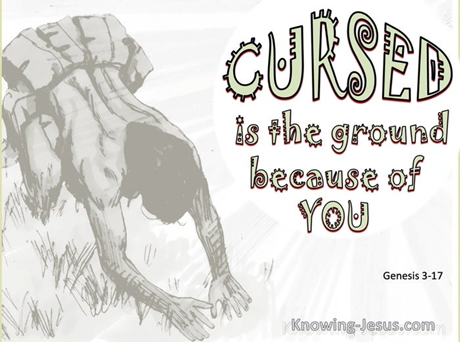
This was not so before.
2. Woman – all the daughters of Eve will suffer increased pain in childbirth and be under the power of the husband.
This was not so before.
Note that these tie in with their original mission – the man to steward the land and woman to be fruitful and be a helpmate.
Sin has entered the world, and our ability to fulfil our roles has been damaged, especially our relationships.
Q: What was the first sin?
Disobedience
Q: What is meant by disobedience besides just to “not eat from the tree of good & evil”?
Lack of trust in God’s goodness, and replacing it with that trust in the serpent and in self desire of all kinds
Q: Was being expelled from Eden punishment?
It was an act of Mercy. Note tree of life – would have immortalized their fallen state.
God knew this before. His plan was not to expel humans forever.
( )"Love" ( ) "Sacrifice" ( )"Life" (x)"Helper" ( )None of the above
Q: Who is called "ezer" most often in Scripture?
( )Eve (x)God ( )Adam ( )Satan ( )None of the above
Q: True or False: Men and women are created equal in their dignity.
(x)True ( )False
Q: True or False: Adam succeeds in his mission to protect the Garden and to protect Eve.
( )True (x)False
Q: True or False: God expelling Adam and Eve from the Garden was an act of mercy.
(x)True ( )False
Q: Who’s fault was the Fall?
A cooperative effort – shared.
Q: Has the curse been lifted?
The Spiritual aspects of the curses have been lifted but not the physical difficulties until this life is completed.
Closing Prayer
Father in Heaven
We thank you for Your presence as we explored the Fall of Man.
We also ask your blessings upon all humans of good will in their search for You.
Finally, we ask that your love and grace follow each of us as we return to our daily lives,
Refreshed and blessed by You.
Hail Mary, full of grace, the Lord is with thee;
blessed are thou amongst women, and blessed is the fruit of thy womb, Jesus.
Holy Mary, Mother of God,
pray for us sinners,
now and at the hour of our death.
Amen.


Comments