10.17.23 Topic Tuesday - Women in the Bible
- tmaley
- Oct 23, 2023
- 15 min read
Northern Virginia Catholic Bible Study & Apologetics
Every Tuesday, 7PM-8PM
This class/meeting is FREE.
House rules/notes…
1. Online via Meetup/Zoom or In Person at St. John Neumann Catholic Church 11900 Lawyers Road, Reston, VA 20191 https://saintjn.org/ (usually held downstairs in Room 5).
2. Meetup is www.meetup.com/catholicbiblestudy Zoom Meeting Logon info is the same every week: Zoom ID: 861 1782 2081 Password: 406952
3. I will send out Meeting Recaps the same night as our sessions – these are unedited versions without pictures. An edited version with pictures will be posted on our website https://catholiccatacombs.wixsite.com/website before the next meeting. Taylor will notify everyone at that time and provide a link.
4. Questions encouraged. If you have questions about anything, you can ask in the chat box, email the Meetup group, or me at ron@hallagan.net.
5. Respectfulness. We will be discussing differences between religions and Christian denominations, and we agree to be respectful at all times. Specifically, Protestants are our friends and brothers in Christ; in fact, I personally owe part of my return to the faith to them!
6. No politics. It would be easy for us to self-destruct, but that’s not our goal. Our goal is to learn/understand/apply the Bible and our Catholic faith.
7. Catholic Prayer & Fellowship. Are you interested in praying with other Catholics during the week? Fellow member Jason Goldberg has started “Catholic Prayer, Fellowship, and Spirituality Meetup.” Sign up at: https://www.meetup.com/online-catholic-prayer-fellowship-and-spirituality/.
8. “The Chosen” TV series. All of us seek a relationship with Jesus Christ, which is not always easy. It can help if we have seen and heard Him. The Chosen captures Jesus better than any show I have ever seen. Highly recommended.
9. RSVP Reminder: Please RSVP whether you are attending the meeting or just reading the Recaps afterwards. The more RSVPs, the more Meetup will give exposure to “Catholic Bible Study” – a good thing!
Catholic Catacombs Website: https://catholiccatacombs.wixsite.com/website
Bible Study Format: Each week of the month has a repeating topic, as noted below.
Each meeting: 5 min greet, prayer, 10-15 min Catholic topic, 40-45 min main topic.
Week 1: Gospel Week:
Week 2: Bible Week (Gen to Rev): We are in EXODUS, the 2nd book of Moses.
Week 3: Survey Topics Voted on by Members:
x 1) Jesus’ Greatest Parables x 2) Hell, Purgatory, Heaven x 3) Comparative Religions
4) Great Women in the Bible 5) Book of Revelation 6) Major Heresies and Church Councils
Week 4: Member Questions:
What does it mean to “put on Christ”?
Why aren't Catholic priests allowed to marry? Wasn't Peter married?
Is “recognition” a good thing? How does pride play into it? Isn’t glorification a type of heavenly recognition?
Can you provide a brief review of the origin/meaning of the (12) statements in the Creed?
Can we do a Christian Meditation one evening?
Angels – who are they, what do they do? Do we really have guardian angels? What about devils/demons?
Please explain exorcisms. Do they happen, are they real?
What should our response be to those who ask us about priestly sex abuse?
What about the atheist who leads a good life?
Miracles since the NT
Opening Prayer
Dear Lord
Thank you for your promise that where two or three of us are gathered in your name, You are there.
Your statement means that You are here with us right now, and for our discussion tonight!
We welcome your guidance as we continue our study of the most influential women in the Bible.
By better understanding their role in Salvation History,
May we better understand ourselves and learn from both their strengths and their weaknesses.
And as You taught us to pray:
Our Father
Who art in Heaven, Hallowed be Thy Name.
Thy Kingdom come, Thy Will be done, on earth as it is in Heaven.
Give us this day our daily Bread;
And forgive us our trespasses as we forgive those who trespass against us.
And lead us not into temptation but deliver us from evil.
Lord Jesus Christ, Son of God, have mercy on us all.
Amen.
“God has made me laugh…” – Sarah, Gen 21:6
We will review a different apologetics or exegesis term each week...
Apologetics and Exegesis Terms
Apologetics – to defend a belief.
Catholic Apologetics– to defend the Catholic faith using reason, tradition, & Scripture.
Exegesis – the study and interpretation of Scripture (it’s what we do here every week; you are all exegetes).
Eschatology (Greek, eschaton=last/end): the study of the End Times – the Second Coming of Christ (also called
Parousia), Judgement Day, Heaven and Hell.
Bible = The OT = The Torah (Pentateuch, Books of Moses), the Prophets, the Writings (Wisdom, Novellas)
The NT = The Gospels and the Epistles (Epistles: New Test Letters [Paul], Catholic Letters, and Revelation).
Church – Greek kyriakon house of the Lord: building for Christian worship; the whole body of Christian believers.
Ark of the Covenant: a) The golden chest holding the 10 Commandments; b) Mary’s womb holding the Word of God
Tabernacle - the portable sanctuary used by the Israelites in the wilderness from the Exodus from Egypt to the building of the Temple in Jerusalem by Solomon. Latin tabernaculum – tent; temporary dwelling place
Temple – Latin templum - space set aside for sacrifice/worship; replaced the Tabernacle; original Temple in Jerusalem
Synagogue – Jewish house of worship oft. w/facilities for religious instruction. Greek synagogue: assembly/gathering
Epiphany/Theophany – Epiphany means a manifestation from above. In Christianity, it is the manifestation of Christ to the gentiles (Magi) 12 days after Christmas. Theophany means a divine appearance, such as to Moses and at the Transfiguration.
Eucharist –the Lord’s Supper. The bread & wine become Jesus’ body/blood. From Greek eucharistia = thanksgiving.
Mass – the celebration of the Last Supper/Eucharist. “Mass” is from the Latin missa meaning “to send (out).”
Evangelize – to make the Kingdom of God present in our world.
God as Father/He/Him – scriptural tradition (God is not a gender); God does set the gold standard for fatherhood.
Man – generic for mankind, humanity.
Deism – belief in a supreme being/creator who does not intervene in the universe, or who is indifferent to it.
Theism – belief in the existence of God or gods, especially the believe in one God who is creator of the universe and is actively engaged in some way, intervening in it and sustaining a personal relationship with his creatures.
Atheism – belief that gods of any kind do not exist.
Agnosticism – belief that God may or may not exist but we cannot know.
Preternatural – means “outside the natural”; refers to the preternatural state of grace Adam & Eve were in before the Fall.
The “World” – as used in the Bible, this term pertains to the material world or our temporary, material lives. The word “secular” means the same thing (Latin seaecularis - worldly/temporal). It is often used with a negative connotation, i.e., “The fall of man resulted from our choosing this world/ourselves over God.”


Major upcoming holy days in the Liturgy of the Church: November 1 – All Saints Day, Nov 2 All Souls Day
Speaking of which, Oct 31 is Halloween!
Q: How do you respond when someone says Christians (Catholics) created and celebrate the pagan holiday, Halloween? You say, “Well, that’s at least half true! Yes, Halloween came into existence in Christian/Catholic communities, but it was not a pagan celebration. The name Halloween comes from “All Hallow’s Eve” because Nov 1 is All Saints Day. Starting in Ireland and Scotland, the evening before All Saints Day was called “All Hallow’s Eve” when Catholics/Christians celebrated “farewell” to all the pagan witches and ghosts (hence, the costumes) because the pagan gods had been officially replaced by the arrival of Christ and his Saints.

The Washington Times, Oct 25, 1896 Los Angeles, CA, October 30, 1910

New Your Tribune, Oct 24, 1915
Other pagan stories eventually found their way into Halloween, but that is to be expected. It’s officially nothing.
Q: Who knows the story of Stingy Jack? (hint: it has to do with Jack-o’-Lanterns)
Jack-o’Lanterns – The tradition of carving Jack-o’-Lanterns originated in Ireland using and is allegedly based on a legend about a man named Stingy Jack who repeatedly trapped the Devil and only let him go on the condition that Jack would never go to Hell. But when Jack died, he learned that Heaven did not want his soul either, so he was forced to wander the Earth as a ghost for eternity. The Devil gave Jack a burning lump of coal in a carved-out gourd to light his way. Locals eventually began carving scary faces into their own gourds to frighten away evil spirits.
Trick or Treat – a German-American tradition where children would dress up in disguises and if their neighbors couldn’t guess what they were, the would win a treat.
Black Cats were considered by some in the Middle ages to be a symbol of the Devil. It didn’t help when witches began to have black cats!
Seeing Ghosts – Celtic pagans often thought spirits walked the earth. This was a hard belief to shake, Christian missionaries introduced All Souls’ Day on Nov 2, so people could truly honor the dead and pray for their souls.
Gospel Reading for this coming Sunday: Mt 22:15-21
Context: Jesus’ last time in Jerusalem. He is preaching in the Temple grounds. The week will end in his arrest. We will discuss the highlighted parts, but no notes (you have to take your own!).
The Pharisees went off and plotted how they might entrap Jesus in speech.
They sent their disciples to him, with the Herodians, saying,
"Teacher, we know that you are a truthful man and that you teach the way of God in accordance with the truth.
And you are not concerned with anyone's opinion, for you do not regard a person's status. Tell us, then, what is your
opinion: Is it lawful to pay the census tax to Caesar or not?"
Knowing their malice, Jesus said, "Why are you testing me, you hypocrites? Show me the coin that pays the census tax."
Then they handed him the Roman coin.
He said to them, "Whose image is this and whose inscription?"
They replied, "Caesar's."
At that he said to them, "Then repay to Caesar what belongs to Caesar and to God what belongs to God.
When they heard this they were amazed and leaving him they went away.

Emperor Tiberius 13-37 AD
"Caesar Augustus Tiberius, son of the Divine Augustus"
My commentary last Tuesday on this reading was only verbal. For an excellent written one, see attached from the pastor at St. James in Falls Church (Fr. Paul Scalia).
https://www.thecatholicthing.org/2023/10/22/being-gods/?utm_source=The+Catholic+Thing+Daily&utm_campaign=320224b320-EMAIL_CAMPAIGN_2018_12_07_01_02_COPY_01&utm_medium=email&utm_term=0_769a14e16a-320224b320-244236729&mc_cid=320224b320&mc_eid=3561a44a62

X Eve (Zoe), Sarah, Rebecca, Rachel, Leah
Most Influential Women in the Bible
Remember what the Bible is and is not…
The Bible is not a history book. It is not a science book. It is not an ethnological guide. It is a book with a religious message. Its purpose is to instruct us about the nature of the relationship between the people of Israel and the God who chose them.
The Old Testament particularly was written using the historical memories and images that were familiar to the people who were its audience. Part of our learning (part of our exegesis) is to discern this before we judge our understanding.
Where we left off…
We recall that after Eve, there is a good line and bad line. Cain, who kills Abel in jealousy, is the bad line and goes off to create great cities, and much evil will spread from this line. Eve and Adam have another child, Seth, who is good. From Seth will come Noah.
Man’s spiritual intellect and free will are powerful forces and we soon find that evil and violence spread quickly over the earth. It is so bad that God sets out to rid the world of them before it goes any further.
Q: Why does evil spread so much easier and faster than good?
Evil seeks control and domination. Good does not.
Remember, evil doesn’t self-exist. It is the perversion good. It will always present itself as good, just like the serpent to Eve in the Garden. But evil is just a wolf dressed up in sheep’s clothing.
Evil can spread fast and violently and snuff out any good in its path. It not only doesn’t care about good, it sees good is a nuisance, because the presence of good exposes evil for the false thing that it is.
Is it any different today?
Fortunately, Cain wasn’t the only descendant. From Seth’s line will come Noah, and God will start over with him.

The Flood
This is when the story of the flood and the ark take place. How literal is this story? We do not know. Recall that the Church refers to everything prior to Gen 11 as “pre-history,” meaning events may have literal components but it is unlikely to line up with historical events as we know them today. Notwithstanding, there is truth to all Scripture, irrespective of what parts are literal. The truth can often be literal, allegorical, or both. As we saw Genesis 1-3, it was both, although all the wisdom was hidden in the allegorical.
The Catholic Church does not prohibit interpretations of Genesis 6-8 that include a worldwide flood, but neither does the Church require there to be a worldwide flood in all interpretations. Instead, according to Pope Pius XII, “in simple and metaphorical language adapted to the mentality of a people but little cultured,” the first eleven chapters of Genesis “both state the principal truths which are fundamental for our salvation, and also give a popular description of the origin of the human race and the chosen people” (Humani Generis 38).
Q: Does the Bible say that the entire world was flooded?
Yes, although “the earth” could mean the “known world” at that time, or the entire planet.
We know that many ancient civilizations record an immense flood in their history, including those around where Noah lived (Mesopotamia). Interestingly, some will say that the fact that other cultures refer to a great flood somehow diminishes the Biblical story. But actually the opposite is true. If everyone experienced the flood, then you would expect to hear about it from elsewhere than just the Bible.
Another reason for considering the regional option is that since the flood was specifically intended to rid the earth of injustice and evil, and only the free-will humans who received a spirit were capable of this, then one could make the argument that just that part of the world where they were living at this time was affected, not the entire earth. That would be the Mesopotamian area.
The regional option is a view which has gained increasing traction in recent centuries because of scientific findings. Below is one of the theories of what might have happened since the effects of an ancient flood were discovered. Called the Black Sea Deluge hypothesis, glacial meltwater caused overflowing of the Caspian Sea into the Black Sea and breaking through the Bosphorus Strait to the Mediterranean Sea. Heavy rains could have added to the triggering of this event, causing catastrophic flooding. But I digress. Although we keep discovering more and more, this is just one theory.

Q: What is the term for the period before and after before the Biblical flood?
Antediluvian is the period before the flood; Postdiluvian is after. (Diluvium is Latin for deluge, flood.)
Postdiluvian (after the flood)…
After the flood, Noah’s family begins again. We might expect all evil would be wiped out, right?
No dice. Fallen man is still fallen man.
Noah has three sons, Shem, Japeth, and Ham. Shem is good, Japeth heads east towards China and we don’t hear from him again, and Ham is bad.
Q: So now we already have Cain’s replacement ready to go. Who is it?
Ham. From Ham will come all the future enemies of Israel, including Nimrod, the Philistines, Assyrians, Canaanites, the Babylonians, and the Egyptians! I.e., two of Ham’s sons were named Egypt and Canaan. Interestingly, Canaan is called “Egypt’s little brother,” which turns out to be true in their respective lands! https://www.thetorah.com/article/who-was-living-in-the-land-when-abraham-arrived.
There is much to these stories but we are focusing on influential women, so let’s not stop here.
Sarah
Finally, from Shem’s line, we get Abram (later Abraham) at the end of Gen 11. Abraham, son of Terah, was living in Ur of the Chaldeans, who were associated with Babylon (Tower of Babel) and had descended into idolatry and violence. Abraham’s family was well-to-do. He married Sarai (later Sarah), who turns out to be barren.
Q: God changed Abram’s name to Abraham. Why? What is the meaning?
Abram means “exalted father.” Abraham means “father of a multitude.”
Q: God changed Sarai’s name to Sarah. Why? What is the meaning?
Sarai means lady or princess within a family. Sarah signifies a lady or princess without any limits.
God calls Abraham to leave his hometown (present day Iraq) and go to a new land in Canaan at the age of 75. Abraham obeys the Lord’s call without hesitation. This is fascinating in itself when you consider Abraham was well off and well- established, to say nothing of his age!

Q: What did God promise Abraham?
Land
Numerous descendants, a nation
Through him, all families/nations of the world will be blessed
As incredible as these promises were, it is still a HUGE leap of faith that Abraham would up and go at the age of 75 when he was already comfortable and established. But it wasn’t only Abraham that had faith in this.
Abraham’s wife, the beautiful Sarah, was considered a strong woman in her own right. She also agreed to go. Perhaps it was the promise of descendants, since having children was a big, big deal. We don’t know. But she also had family, and I suppose if she thought Abraham had lost his mind, she could have stayed behind. But she was willing to go. If she hadn’t, there would be no lineage to Moses, David, or Jesus. Like Mary who said yes, Sarah makes this venture possible.
Even the author of Hebrews (Paul?) points out Sarah’s faith some 2000 years later.
“By faith, Sarah herself received the power to conceive, even when she was past the age, since she considered Him faithful who had promised.” – Hebrews 11:11
As much incredible faith as is credited to Abraham and Sarah, they too have their ups and downs in the years ahead. We will learn that no one in the Bible except for Jesus is without fault or sin. That’s good news for the rest of us :).
Ten years later in Gen 16, we find that Sarah is still without children. Sarah is 77 now and having doubts. She decides they need children so she has her Egyptian servant, Hagar, sleep with Abraham. She conceives and bears a son, Ishmael, although he is not the one to carry on the line of Abraham. The child that can do that must still come from Sarah and Abraham.
In Gen 18, Sarah is now 90 (Abraham is 100). Three mysterious men visit them. Some Fathers of the Church believed this visit was from the Trinity, because the passage literally says,
“The Lord appeared to Abraham by the Oaks of Mamre… He lifted up his eyes and looked, and behold, three men stood in front of him.” (Gen 18:1-2)

Three mysterious men from the LORD visit Abraham and Sarah
Abraham rushes to serve these guests with the finest food he has. They ask about Sarah and then tell Abraham that she will have a child when they return the following year. Sarah was in the tent nearby listening and she laughed out loud when she heard this, saying to herself, “Shall I indeed bear a child, now that I am old?”
The next passage (again pointing to the Trinity) says,
The Lord said to Abraham, “Why did Sarah laugh? …Is there anything too hard for the LORD?” (Gen 18:13-14)
Then the men left.
In Gen 21, The LORD did as he had promised and Sarah conceived and bore Abraham a son the following spring, whom they named Isaac. In fact, Isaac means one who laughs and rejoices.”

In Gen 23, Sarah dies at the age of 127 years in Hebron. Abraham mourns for her bitterly. He also meets with the surrounding tribes of Hittites and they agree to sell him land nearby so he can bury Sarah. The cave Abraham selects will become known as the Cave of the Patriarchs, and Sarah will be the first. You can still visit the “Tomb of the Patriarchs” in Israel today.
Rebekah
Abraham is concerned about Isaac because he will not let Isaac marry a Canaanite woman. He decides Isaac must marry someone from his homeland, but he doesn’t want Isaac to go for fear he may not return. So in Gen 24 he sends his most trusted servant back to his homeland in Mesopotamia to find a wife who is willing to leave the land and come to them.
The trusted servant is given many guides, camels, and gifts and he heads off to Nahor. He is worried about pulling this venture off successfully and he prays about it. When he arrives outside of Nahor, he stops at a spring to water his camels and sees a beautiful woman (Rebekah) at the well. He asks about Abraham’s relatives and Rebekah invites him to her home where he meets her father, Bethuel, and Abraham’s relatives and tells them of his assignment. They are amazed and in general agreement but think he should spend some time with them and give Rebekah some time. However, Rebekah says, “I will go.” (Gen 24:8)
Once again, the trust (faith) stands out in a most stunning way. Like Sarah before her – and Mary after her – she immediately says “yes.”


Rebekah returns with Abraham’s servant. As the get close to Hebron, they see Isaac in the field at a distance. Isaac sees Rebekah as well and comes to her. They immediately fall in love. (Gen 24:67)
Rebekah is barren for a while but finally conceives and bears twins.
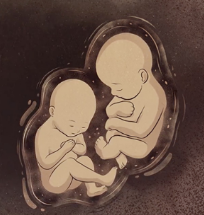
There seemed to be quite a struggle going on in her womb and Rebekah decides to ask God what is going on. God tells Rebekah:
“Two nations are in your womb, and two peoples, born of you, will be divided; the one shall be stronger than the other; the elder will serve the younger.” (Gen 25:23)
In other words, the younger will carry on the line of Isaac and Abraham.
The oldest (because he was delivered first) is Esau, and the younger is Jacob.
Birthright
When the boys grow up, Esau was a skillful hunter, a man of the field, and no interest in God or anything spiritual. Jacob, on the other hand, was more of a quiet, studied man, dwelling in tents. Isaac grew to favor Esau and Rebekah favored Jacob – perhaps because she knew he was the one God said would carry on the line of Abraham.
One day Esau came back from a hunt and is starving, and he asks Jacob for some of the stew he has prepared. Jacob says he will give it to him if he sells him his birthright. Esau recklessly agrees. (Gen 25:27-34)
Q: What is a birthright?
It was the right of the firstborn male to have authority over the other children and to receive a double portion of the inheritance.
Closing Prayer
Father in Heaven
We thank you for Your presence and assistance as we read about the Matriarchs of the Patriarchs!
We also ask your blessings upon all of us and our families as we return to our daily lives.
May we be renewed and blessed by You.
And we pray for Mary’s intercession in strife all around the world, for justice and peace,
and for the protection of life everywhere.
Hail Mary, full of grace, the Lord is with thee;
blessed are thou amongst women, and blessed is the fruit of thy womb, Jesus.
Holy Mary, Mother of God,
pray for us sinners,
now and at the hour of our death. Amen.


Comments