10.28.25 - Halloween | All Saints | All Souls | Fall of Man III
- tmaley
- Nov 1, 2025
- 10 min read
Opening Prayer:
Dear Lord
We know that every discouragement begins with something we don't like or can't control
and then graduates to places we don't want it to be.
Help us remember to give it to the You at the onset, and then walk with You.
May our every moment and every task be unto the Lord.
As you taught us to pray together…
Our Father
Who art in Heaven, Hallowed be Thy Name.
Thy Kingdom come, Thy Will be done, on earth as it is in Heaven.
Give us this day our daily Bread;
And forgive us our trespasses as we forgive those who trespass against us.
And lead us not into temptation but deliver us from evil. Amen.
Upcoming major holy days: November 1: All Saints Day
Today’s Agenda
Reflection: Halloween Oct 31
All Saints Day and All Souls Day
Genesis 3, The Fall of Man III
Quote of the Week:
“The Bible is a smooth deep river in which a lamb may walk and an elephant may swim.”
– Pope St. Gregory the Great
Reflection: Halloween

At times people who know little about Catholicism claim that Halloween is a pagan holiday that Catholics assimilated into Christianity. Is this true?
That is a very humorous claim, so be sure to laugh if you hear it. Nevertheless, the best lies often have some truth to in them, and this one is no different. Let’s look at the historical connection.
Halloween is indeed an old Catholic celebration, similar to Marti Gras before Lent, except more geared towards children. Halloween is Oct 31, the day before “All Saints Day” (Nov 1) which celebrates all the named and unnamed Saints since the time of Christ. After Scotland and Ireland became Catholic, they decided to celebrate a “farewell/good riddance” to all the old pagan gods and priests – which included dressing up as druids, demons, magicians, and witches – the day before All Saints Day. All Saints Day was called, “All Hallow’s Day.” Similarly, the word “Halloween” comes from "All Hallows Eve” which is Scottish for “Eve of All Saints.” So, they were celebrating good overcoming evil.
When the Scottish and Irish brought “All Hallow’s Eve” (Halloween) with them to the United States, America was mostly inhabited by Protestants, who were very anti-Catholic at the time (Catholics were still being persecuted In England). Moreover, the Puritans were here, and remember they came to America because England wasn’t Protestant enough, so you can imagine what they thought about this horrible Catholic custom. Naturally, they accused Catholics of importing their pagan beliefs to America.
Presently… As our society continually seeks to remove God from the public square and paganism is on the rise, Halloween has become a source of worry for some. Some Satanists claim it is their day. Nonsense, every day on the calendar belongs to God. Let’s not forget that its original point was to celebrate “good overcoming evil,” and treat it as a day for community fun.
All Saints Day – Nov 1
Catholics are used to calling only those canonized by the Church as "Saints." However, Scripture also says that everyone who resides in Heaven is called a saint. Since Catholics created a kind of Hall of Fame for the greatest of saints, perhaps the best way to think of it is capitalized Saints and lower-case saints. The “capitalized Saints” are the saintly Hall-of-Famers who gave their whole lives to God, often times literally (martyrs). The rest of us will have to settle for little s “saints.”
That being said, "All Saints Day" on Nov 1 celebrates the large S and small s – every human being who is in Heaven. It is a great feast of the triumph of Easter, for this is what Christ came and died for. The saints are what Rev 7:10 is referring to:
“After this I looked and saw a multitude too great to count, from every nation and tribe and people and tongue, standing before the throne and before the Lamb. They were wearing white robes and holding palm branches in their hands.” – Rev 7:10
What do the palm branches represent?
The victory of Jesus Christ over death. Recall the palm branches laid on the ground as Christ entered Jerusalem on a donkey on Palm Sunday.
Is All Saints Day on Nov 1 a holy day of obligation (to attend Mass)?
Normally, yes; but rather than thinking of it as an obligation, we should think of it is co-celebrating with the entire class of saints that extends back to Adam, many who gave up their lives to defend the faith. We all hope to join this incredible class one day! I said, “normally” because All Saints Day this year falls on a Saturday so the obligation moves to Sunday.

All Souls Day – November 2nd
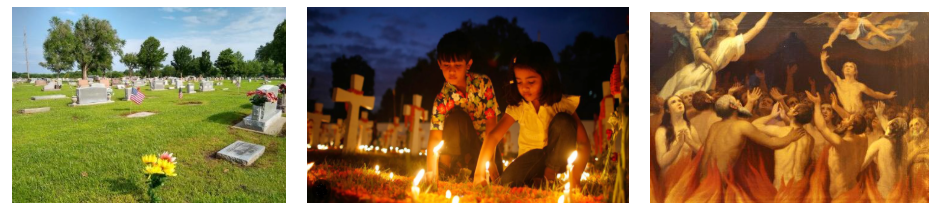
All Souls' Day commemorates all the faithful departed who are not fully cleansed from sin and may require purification before entering the Beatific Vision (presence of God). On this day, the Church and faithful offer Masses for them and intercessory prayers, since we believe that our prayers can assist in the souls' journey towards Heaven. This observance highlights our collective relationship in the Body of Christ, loving and praying for each other, which includes the souls in Purgatory. We will be grateful for such prayers if and when it’s our turn.
Since apostolic times – and for the Old Testament Jews including Jesus (2 Mac 12:43-46, Wisdom 3:1-9) – Christians have been aware that at the moment of death we are not always the kind of persons we need to be for eternity. If we have received forgiveness and satisfied our penances at the time of our death, our sanctification will be complete and we will enter Heaven immediately. Often, however, our souls are still stained with selfishness, resentments, not honoring the Sabbath Day, not loving our neighbor/enemy, etc. Therefore, we need a final purification of our unreconciled sins before entering Heaven.
As it says in the Book of Maccabees (which Jesus read and celebrated), they prayed for the dead “because it is holy and wholesome to pray for the dead that they may be loosed from their sins.” References to purification of souls after death can also be found in the New Testament (Mt 5:26, Mt. 12:32, and 1 Cor 3:11-15).
Apologetic: Protestants have been taught that Jesus' death for us was sufficient to cover all our sins so that we can go straight to heaven. The first part is certainly true – Jesus' death and grace from the cross was absolutely sufficient to wipe out every sin of humanity times infinity. But it isn’t about Jesus’s part; it’s about our part. This offer of grace is not a one-off but rather the beginning of a relationship. We are being called into a life-long journey with Christ where we learn to cooperate with His grace while we continue seeking His forgiveness and council.
Genesis 3 – The Fall of Man
Where we left off… (note: “man” more often than not refers to “human” or mankind).

Genesis 3:6-7
6a The woman saw that the tree was good for food and pleasing to the eyes, and the tree was desirable for gaining wisdom.
The three temptations of Eve that will define humanity’s fallen state thereafter.
Good for food – physical desire/physical gratification.
Delight to the eyes – possessions.
It will make me wise – pride/ego.
6b So she took some of its fruit and ate it; and she also gave some to her husband, who was with her, and he ate it.
Adam was directly made responsible for being the steward of Eden. We can see that he was at Eve’s side while she was engaged with the Serpent. Adam had three options:
Defend the Garden and defend Eve.
Ask God for help.
Go along. ✓
They both ate!
7 Then the eyes of both of them were opened, and they knew that they were naked; so they sewed fig leaves together and made loincloths for themselves.
“Their eyes were opened and they knew they were naked” = “they” both recognized their sin/betrayal.
They indeed received knowledge but it wasn’t the kind they were expecting, or that the Serpent seemed to promise them. Their “increased knowledge” was the experience of guilt when breaking a promise or acting against God.
Unfortunately, guilt by itself doesn’t lead one to truthfulness, but often to covering up the truth, which is what was meant by their covering themselves up with fig leaves.
What is the difference between guilt and shame?
Guilt us usually associated with something you did. It is focused on a specific behavior. Because it is somewhat external, it is easier to repair and/or make amends.
Shame is more intense and internal, focused on the self. If guilt makes you “feel” bad, shame causes you to think you are bad. So they are degrees of each other.
But even within guilt and shame, there are degrees.
Guilt and shame come from our consciences and their purpose is to get our attention in order to hopefully stop our downward descent. Guilt and shame are red flags that tell us we’ve made some serious wrong turns, but God will take us back if we are willing to turn around and walk with Him in the other direction. BTW, that’s the definition of repentance to turn around and walk with God.
Repentance is the process of turning around and walking with God, back towards innocence/truth/improvement. God will take us back anytime and as often as necessary. But if we still don’t trust God, we may end up at self-hatred and despair.

It is easy to see how without God, repentance, and forgiveness, many people could end up in a bad place, and why secular psychology might conclude that “shame” was the problem. That’s a little like shooting the messenger.
In fact, guilt and shame are the very reasons God appears in the following verses (8-13).

8 When they heard the sound of the LORD God walking in the garden in the cool of the day, the man and his wife hid themselves from the LORD God among the trees of the garden.
God isn’t “walking in the garden in the cool of the day” by accident. He feels their/our pain, especially shame. God comes to us always in our sins and beckons us to come back. But the ego does not surrender easily, so our pride can also blind us to God’s presence.
Let’s see how Adam and Eve handle this.
9 The LORD God then called to Adam and asked him: “Where are you?”
Surely God knows where Adam is, so why is He asking this question?
God asking ‘where are they’ isn’t a location question; it is a relationship one. “Where are you” is a spiritual question.
Also, notice how God comes after Adam first even though Eve ate first. Why? (Gen 2:16).
10 Adam answered, “I heard the sound of you in the garden, and I was afraid because I was naked, so I hid myself.”
What on earth does Adam’s response mean?
Adam is afraid of God’s presence but nothing can be hidden from God. He was only hiding because that is what sin does to us – the ego seeks to keeps us out of the light. Recall, Jesus exhorts us to practice radical honesty in this life:
"There is nothing concealed that will not be revealed. What you have said in the dark will be heard in the light, and what you have whispered in the inner rooms will be proclaimed on the rooftops." – Luke 12:2-3
Let’s review again what Adam and Eve’s violation was…
We know that Adam and Eve disobeyed God, but this was not merely some small breach of trust but a complete rupture of the relationship between God and man. They had been given freedom but to retain that freedom and all that came with it, they had to stay connected to the source of that freedom, God. The tree represented a boundary set for them. It represented self-glorification and separation from God. They sought to become “like God but without God.” This was the same choice the fallen angels made.
As we will find out, God knew beforehand that this would happen so He planned to give man another chance and even send us a Redeemer.
11 Then God asked: “Who told you that you were naked? Have you eaten from the tree of which I commanded you not to eat?”
The question, “Who told you were naked?” reveals that something foreign has intruded. It is shame. Guilt and shame are employed by our consciences to convict us when we continue to ignore a problem.
What are our choices when guilt or shame try to enter our consciousness?
Our choices are to deny, blame, pretend it’s not true, or we can humble ourselves by admitting the problem, seek forgiveness, and start over with the grace God gives with forgiveness. The longer we wait to do this, the worse it gets.
Why would God ask Adam if he ate from the tree? Doesn’t God know everything?
God is holding off judgment to give Adam a chance to respond. Perhaps Adam will appeal for mercy.
Again, Adam’s choices are… deny, blame, or seek to restore his relationship with God.
Adam’s response will highlight the immediate shift in human behavior post-fall.
12 The man replied, “The woman whom you put here with me—she gave me fruit from the tree, so I ate it.”
Wait a minute, who is Adam accusing?

If you ever wondered why this is called the Fall of Man, look no further.
Notice how Adam not only throws his wife under the bus and but also manages to blames God at the same time: the woman YOU gave me! That takes some real ... audacity …
to blame God for his disobedience.
Boy, sin doesn’t need much practice, does it? This was Adam’s first time at it and he’s already a pro.
Notice how selfishness/self-protection/self-glorification is the automatic default position humans take when separated from God. This makes sense when you consider that God is not only all good, but the source of all good. The big lesson of this is that once harmony with God breaks down, harmony with each other breaks down.
However, God breathed his spirit into us in the previous chapter, and we didn’t lose that, so we will always recognize and desire good.
In any event, it appears any hope of salvaging the situation is about gone now. Perhaps Eve can save the day?
13a The LORD God then asked the woman: “What is this you have done?”
What is this you have done? God knows what she did. He is now giving her the chance to come clean.
13b The woman answered, “The serpent tricked me, so I ate it.”
At least she didn’t say, “The serpent whom you created tricked me.” Nevertheless, at this point it’s kind of a forced confession, and Eve doesn’t show much regret. She chooses blame.
Next month – judgment pronounced and Eden closes its doors. But God makes a surprise promise of redemption.

Closing Prayer


Comments