11.05.24 Jesus Teaches during Holy Week Scribes & Widows
- tmaley
- Nov 6, 2024
- 8 min read
Opening Prayer
Lord please bless America, her moral-political leadership, the integrity of our elections and of our words, the faith and honesty of the people we elect, the protection of our children, and the moral education of our citizens. Lord, bless those who oppose Your will with roadblocks of truth & wisdom. Bless all the countries of the world and the entire human race; help us learn to choose to become one people in the Holy Spirit, who comes to us for this reason.
As you taught us to pray together…
Our Father…
Upcoming major holy days: The Season of Advent begins Sunday, Dec 1 to Dec 24.
How many holy days of obligation are there per year?
Officially 10 internationally, although that varies slightly by country. Taking out those adjustments, this leaves us with five holy days of obligation in the dioceses of the United States:
1. January 1, Holy Mary the Mother of God
2. August 15, Assumption of Mary
3. November 1, All Saints Day
4. December 8, The Immaculate Conception
5. December 25, Christmas
The first three of these holy days—Jan 1 (Holy Mary the Mother of God), Aug 15 (Mary’s Assumption), and Nov 1 (All Saints)—are not obligatory if they fall on a Saturday or a Monday. They will be celebrated on those Sundays.
Quote of the Week:
Jesus didn't found the Church for those who are perfect and have it all together. Jesus came for sinners and the imperfect. He comes every Mass in the Eucharist for you and for me and for Our Father, to bring us together.
Today’s Agenda
1. Apologetics – Obedience and Commandment
2. Gospel #1: Reading for 32nd Sun in Ord Time, Mark 12:38-40, Condemnation of the Scribes
3. Gospel #2: Mark 12:41-44, The Poor Widow gives Alms
4. Gospel #3: Mark 12:1-2, Prediction of the Temple Destruction
Apologetics Word: Obedience
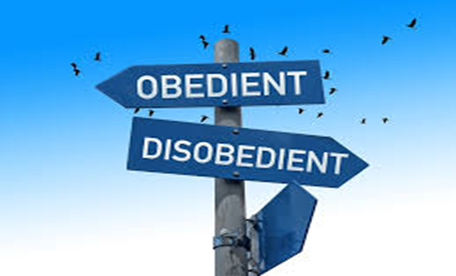
The word “obedience” tends to ruffle the feathers of most human beings, who don’t like being told what to do. Obedience seems to fit this hated category. It almost seems to contradict free will!
Since God gave us free will, how should Christians perceive these oft-used, Biblical words?
Obedience comes from the Latin word obedire, which means “to listen to” or “to pay attention to.” It was used with apprentices who had to pay attention and do exactly what the “master” said and did for them to become proficient in their trade. Obedience involves a willingness to quiet oneself in order to listen to, learn, and then apply what is learned.
Likewise, obedience to God is like being God’s apprentice. He is trying to teach us HOW to use our free will. It involves a willingness to listen to his Word (be it in prayer, spiritual direction, or Bible study), learn what He means and wants, and apply that wisdom to our lives.
Obedience – to listen to God – does not contradict our free will, since we can clearly disobey (not listen to Him) at any time. Like the example with the apprentice, we can choose to be a good apprentice, or a poor one.

Apologetics Word: Commandment
Similar to obedience, the word “commandment” tends to ruffle our feathers, as we don’t like being told what to do. Commandment surely fits this category, and also seems to contradict free will!
In OT Hebrew the word is הַדְּבָרִ֣ים (had·də·ḇā·rîm), which means “thing” (to do) or “word.” Meaning they were things to do from God, or God’s word, it was naturally assumed that it was a command of some kind, but in the same vein as obedience.
Since people have been disobeying God’s “commandments” (words) since the day He gave them to us, clearly the mere act of giving them to us doesn’t contradict our free will.
Other Jewish tradition says that “obligation” or “prescription” could also be used for commandment.
Obligation… for one to become one of God’s people.
Prescription… for a healthy spiritual and physical life.
God also explained what would happen if people followed these “commandments” – excellence, wisdom, protection, and salvation; and what would happen if they didn’t follow them – lying, stealing, murder, disrespect of parents and others, self-indulgence, self-glorification, and alienation from God.

The Ten Prescriptions!
Gospel #1 – The Denunciation of the Scribes, Mark 12:38-44
Context: Jesus is still teaching in the Temple grounds during Holy Week. So far, he has thrown the merchants out of the Temple and has several successful debates with the Pharisees. They are angry and plotting against him. Now Jesus takes aim at the arrogance of the scribes.
Who were the scribes?
In Greek gramateon, meaning writer. In Hebrew, a “teacher of the Law,” referring to the Law of Moses (first five books of the OT). The were highly-educated, highly-revered Biblical scholars, a member of the elite.
Why were the scribes revered in Jewish society?
Because the Temple and God’s word was preeminent to everyone. Similar to how we hold entertainment figures in high esteem, at least they held religion that high. The problem was the scribes abuses of their influence, not their position.

Mark 12:38-40
In the course of his teaching Jesus said to the crowds,"Beware of the scribes, who like to go around in long robes and accept greetings in the marketplaces, seats of honor in synagogues, and places of honor at banquets. They shamelessly cheat widows out of their property and then recite lengthy prayers in public. They will receive a very severe condemnation.”
Jesus mentions widows often, as does God in the OT. Why such a concern about widows?
Widows were especially vulnerable if they didn't have a living son to support them. Jesus' condemnation suggests the scribes in their business dealings confiscate the homes of widows who are unable to support (or defend) themselves and at the same time pretend piety in their prayers and demand the positions of highest honor. A more severe sentence would fall upon them on the day of judgment, because, with false piety, they practiced iniquity and indulged their avarice under the mask of religion. (Recall Jesus’ millstone quote…)
Was Jesus fulfilling an OT prophecy?
“To the shepherds, thus says the Lord GOD: Woe to the shepherds of Israel who have been pasturing themselves! Should shepherds not pasture the flock? … My sheep became plunder… because my shepherds did not look after them but instead pastured themselves. Thus says the Lord GOD: I am coming against these shepherds” – Ezekiel 34:1,2,8,10.
Gospel #2 – The Poor Widow’s Temple Donation, Mark 12:41-44
Context
The 2nd half of the reading changes scenes, but the stories are connected. Here Jesus has us observe the wealthy and a poor widow contribute money to the Temple treasury.
The treasure-chamber of the Temple had trumpet-shaped vessels that stood near the entrance for receive the people’s donations (alms).

Mark 12:41-44
He sat down opposite the treasury and observed how the crowd put money into the treasury.
Many rich people put in large sums. A poor widow also came and put in two small coins worth a few cents.
Calling his disciples to himself, he said to them, "Amen, I say to you, this poor widow put in more than all the other contributors to the treasury.
For they have all contributed from their surplus wealth, but she, from her poverty, has contributed all she had, her whole livelihood."
How is this story connected to the previous story about the scribes?
In Jesus’ condemnation of the scribes, he accuses them of swindling defenseless widows out of their homes. Then he turns the world’s priorities upside down by singling out one of these poor widows to show how God sees things differently .
Here was a widow whose house had been “devoured,” and who yet showed by her act that she kept the two great commandments.
Jesus act/example/lesson was significant. He sought to teach his disciples – and us – to judge acts by other than a quantitative standard. God does not weigh the gift so much as the mind of the giver. The gift that is greater in his sight is not the one of greater value, but which is greater in respect to the giver. This poor widow would likely have to rely on the Lord to help her find enough bread for the next day.
In the above passages, Jesus describes the scribes as the proverbial “wolves in sheep’s clothing.” Where did this originate?
Beware of false prophets, which come to you in sheep's clothing, but inwardly they are ravening wolves (Mt 7:15)
Wolves were known not just as carnivores but as “opportunistic predators.” Most often preying upon their victims in packs, they attack the ill, the injured, the weak, the small, and the old, completely devouring their prey until nothing at all is left. Wolf attacks reveal multiple bite and slash marks on a victim’s body. Attacking them from behind unawares, they have no qualms in consuming their victims while they are still alive. The wolf symbolizes everything distasteful, predatory, and cowardly about those who “devour” the weak.
How did the widow keep the two great commandments?
By her giving alms when she had almost nothing, she showed her love for God and also for her neighbor, since the alms were for the poor. Recall last week’s greatest commandment? To love God with your entire being. This woman qualifies, the scribes don’t.
Gospel #3 – The Destruction of the Temple Foretold, Mark 13:1-2
Context: The preceding passages about the scribes and widows, the shepherds’ failure to take care of God’s sheep, and their refusal to accept the Messiah lead Jesus to this next passage, which is a judgment on the Temple.
After a day of teaching in the Temple, Jesus leaves the city of Jerusalem and crosses the Kidron Valley to the Mount of Olives. Sitting on the Mount of Olives across from the Temple Mount, Jesus responds to the His disciples' admiration of the Jerusalem Temple and shocks them by prophesying its total destruction.

Mark 13:1-2
As he was making his way out of the temple area one of his disciples said to him, “Look, teacher, what stones and what buildings!”
Jesus said to him, “Do you see these great buildings? There will not be one stone left upon another that will not be thrown down.”
This was a stunning statement by Jesus. Herod I began expanding the Temple in 20 BC and it was still being finished years later when Jesus was there. Several of its marble stones were 40 feet in length and weighed 100 tons. The building was some 300 feet high. Yet as Ezekiel prophesied, God would destroy the shepherds of his Temple.

Depiction of Herod’s Temple

Destruction of Jerusalem
When was the Temple destroyed?
70 AD by the Romans.
Why then?
One generation (roughly 40 years) was the “grace period” given to the Jews to accept the Messiah. The number 40 also represents a period of preparation, which was for the development of the new Church. The ending of the Temple signified the official end of the Old Covenant.
Closing Prayer
Prayer of Mother Teresa
People are often unreasonable and self-centered.
Forgive them anyway.
If you are honest, people may cheat you.
Be honest anyway.
The good you do today may be forgotten tomorrow.
Do good anyway.
Give the world the best you have, and it may never be enough.
Give your best anyway.
In the end, it was between you and God, anyway.
Hail Mary
Full of grace, the Lord is with thee,
Blessed art though among women and blessed is the fruit of thy womb, Jesus.
Holy Mary, Mother of God, pray for us sinners
Now, and at the hour of our death.
Amen!


Comments