12.05.23 Joshua & Judges
- tmaley
- Dec 18, 2023
- 16 min read
Northern Virginia Catholic Bible Study & Apologetics

Every Tuesday, 7PM-8PM
This meeting is a lecture/Q&A format. It is free.
House rules/notes…
1. Our meeting/classes are In-Person at St. John Neumann Catholic Church 11900 Lawyers Road, Reston, VA 20191 https://saintjn.org/ (usually held downstairs in Room 5), or ONLINE via Zoom (see #2).
2. To sign up for Zoom notifications and to receive the Meeting Recaps, go to www.meetup.com/catholicbiblestudy and join us! The Zoom Logon is the same every week: Zoom ID: 861 1782 2081 Password: 406952.
3. After each meeting, I send out Meeting Recaps of what we discussed. Please remember these recaps are unedited and without the pictures. The edited version with pictures will be posted on our website before the next class on the Website – https://catholiccatacombs.wixsite.com/website. Taylor will notify everyone at that time and provide a link.
4. Questions encouraged. If you have questions, we ask that you keep them on topic and brief. You can ask in the chat box during the class, or email through Meetup.com, or email me at ron@hallagan.net afterwards.
5. Respectfulness. We will be discussing differences between religions and between Christian denominations, and we agree to be respectful at all times. Protestants especially are our friends and brothers-in-Christ; in fact, I personally owe part of my return to the faith to them!
6. No politics. It would be easy for us to self-destruct, but that’s not our goal. Our goal is to learn/understand/apply the Bible and our Catholic faith.
7. Catholic Prayer & Fellowship. Are you interested in praying the rosary, etc. with other Catholics during the week? Follow fellow member Jason Goldberg at https://www.meetup.com/online-catholic-prayer-fellowship-and-spirituality/.
8. “The Chosen” TV series. All of us seek a relationship with Jesus Christ, which is not always easy. It can help if we have seen and heard Him. The Chosen captures Jesus better than any show I have ever seen. Highly recommended.
9. RSVP Reminder: Please RSVP whether you are attending the meeting or just reading the Recaps afterwards. The more RSVPs, the more Meetup will give exposure to “Catholic Bible Study” – a good thing!
Catholic Catacombs Website: https://catholiccatacombs.wixsite.com/website
Bible Study Format: Each week of the month has a repeating topic, as noted below.
Each meeting: 5 min greet, prayer, 10-15 min Catholic topic, 40-45 min main topic.
Week 1: Gospel Week:
Week 2: Bible Week (Gen to Rev): We are in EXODUS, the 2nd book of Moses.
Week 3: Survey Topics Voted on by Members:
x 1) Jesus’ Greatest Parables x 2) Hell, Purgatory, Heaven x 3) Comparative Religions
4) Great Women in the Bible 5) Book of Revelation 6) Major Heresies and Church Councils
Week 4: Member Questions:
1. Can you provide a brief review of the origin/meaning of the (12) statements in the Creed?
2. How do I live my Christian faith at work when my faith is not accepted there?
3. Angels – who are they, what do they do? Do we really have guardian angels? What about devils/demons?
4. Please explain exorcisms. Do they happen, are they real?
5. What should our response be to those who ask us about priestly sex abuse?
6. What about the atheist who leads a good life? Can I be a person be good apart from God?
7. Miracles since the NT
8. What’s the difference between Charity and Love? What are the highest forms of charity?
9. How can I get more excited by the Mass?
Major Holy Days:
Advent: Dec 3 to Dec 24
Christmas: December 25
Opening Prayer
LORD
As we conclude the book of Joshua tonight,
We thank you for helping us understand he played a role in the unfolding of salvation history,
As your Covenant expands from the tribe of Abraham into the nation of Israel in the Book of Judges next.
And as you taught us to pray…
Our Father
Who art in Heaven, Hallowed be Thy Name.
Thy Kingdom come, Thy Will be done, on earth as it is in Heaven.
Give us this day our daily Bread;
And forgive us our trespasses as we forgive those who trespass against us.
And lead us not into temptation but deliver us from evil.
Lord Jesus Christ, Son of God, have mercy on us all. Amen.
Today
1. Gospel – New Year, Intro to Mark
2. Book of Joshua – Conquest and Land Distribution
3. If we finish in time: Gospel reading for 12/10 (12/17)
Quote of the Week:
“I have told you this so that you might have peace in me. In the world you will have trouble, but take courage, I have conquered the world.” – John 16:33
We will review a different apologetics or exegesis term each week...
Apologetics and Exegesis Terms
Apologetics – to defend a belief.
Catholic Apologetics– to defend the Catholic faith using reason, tradition, & Scripture.
Exegesis – the study and interpretation of Scripture (it’s what we do here every week; you are all exegetes).
Eschatology (Greek, eschaton=last/end): the study of the End Times: the Second Coming of Christ (called Advent in Latin,
Parousia in Greek), Judgement Day, Heaven & Hell. In exegesis, you will hear Parousia (pair-oo-sia) more than Advent.
Bible = The OT = The Torah (Pentateuch, Books of Moses), the Prophets, the Writings (Wisdom, Novellas)
The NT = The Gospels and the Epistles (Epistles: New Test Letters (Paul), Catholic Letters, and Revelation).
Best Bibles – The Didache Bible, Ignatius Edition; Ignatius RSV 2nd Catholic edition; Augustine Bible; Douay Rheims (Jerome). Starters: Bible Basics for Catholics-Ave Maria press.
Church – Greek kyriakon house of the Lord: a) building for Christian worship; b) the whole body of Christian believers.
Ark of the Covenant: a) The golden chest holding the 10 Commandments; b) Mary’s womb holding the Word of God
Tabernacle - the portable sanctuary used by the Israelites in the wilderness during Exodus the from Egypt and then in the Temple in Jerusalem by Solomon (and again later by Herod). Latin tabernaculum – tent; temporary dwelling place.
Temple – Latin templum - space set aside for sacrifice/worship; replaced the Tabernacle; the Temple in Jerusalem.
Synagogue – Jewish house of worship often w/facilities for religious instruction. Greek synagogue: assembly/gathering.
Church Authority – The Church is the only authority given by Jesus Christ to interpret the Word of God: "Whatever you bind on earth will be bound in Heaven" (Mt 18:18-20). Otherwise, there could be a different interpretation for every Scriptural passage for every person who ever read them, resulting in division vs unity (which is why there are 10,000 different Protestant churches and 17+ Eastern Orthodox churches). Catholic Church teachings are nothing more than the Church’s interpretation of that which has already been revealed by God, either through Scripture or what has been handed on from Apostolic Tradition. This body of the Church’s interpretation is called the “Magisterium” and it is not superior to the Word of God, but its servant. The Church cannot make up anything outside what has been handed to it, but rather guards and teaches it (CCC#86, 890). The Church believes that Divine Revelation ended with the Apostles.
Doctrine refers to all of the official teachings of the Church. They fall into three categories:
1)
a. Those that the Church teaches authoritatively but not infallibly. Elements within these can change.
b. Those which the Church teaches infallibly.
c. Dogma: Those teachings which the Church has infallibly taught to be divinely revealed.
“Theological Opinions” are teachings that express a pope’s views in a subject but are not doctrine/not binding. Encyclicals fall into this category.
Heresy is the rejection of dogma. If someone rejects a teaching belonging to the first or second categories of
doctrine, it may be very sinful, but it does not rise to the level of heresy.
Epiphany – Epiphany means a sudden appearance or manifestation from above. In Christianity, it refers to the manifestation of Jesus Christ being the Savior of the World to the gentiles (Magi) 12 days after Christmas. Often applies to knowledge.
Theophany means the appearance of God, such as Yahweh to Moses on Mt. Sinai, or at the Transfiguration. Note “phany” in both words, from the Greek phainein = to appear. [Theo=God + phany=appear]
Eucharist –the Lord’s Supper. The bread & wine become Jesus’ body/blood. From Greek eucharistia = thanksgiving.
Mass – the celebration of the Last Supper/Eucharist. “Mass” is from the Latin missa meaning “to send (out).”
Evangelize – to make the Kingdom of God present in our world.
Forgiveness – letting go of past harm to God or others; it presumes repentance, which presumes changes in behavior.
Mercy – withholding judgment or harsh treatment that is justified.
God as Father/He/Him – scriptural tradition (God is not a gender); God does set the standard for what fatherhood is.
Man – generic for mankind, humanity.
Deism – belief in a supreme being/creator who does not intervene in the universe, or who is indifferent to it.
Theism – belief in the existence of God or gods, especially the believe in one God who is creator of the universe and is actively engaged in some way, intervening in it and sustaining a personal relationship with his creatures.
Atheism – belief that gods of any kind do not exist.
Agnosticism – belief that God may or may not exist, but we cannot know.
Preternatural – means “outside the natural”; refers to the preternatural state of grace Adam & Eve were in before the Fall.
The “World” – as used in the Bible, this term pertains to the material world or our temporary, material lives. The word “secular” means the same thing (Latin seaecularis - worldly/temporal). It is often used with a negative connotation, i.e., “The fall of man resulted from our choosing this world/ourselves over God.”
“A lie travels around the globe while the truth is still putting on its shoes.” – Mark Twain
Add: Concupiscence, Octave, Justice, Mercy, Kingdom
Advent marks the beginning of the 2nd Liturgical Year in the Church’s 3-year cycle of Mass readings.
The Year of MARK
The Church’s Mass readings follow a 3-year cycle: Year A (Matthew), Year B (Mark), and Year C (Luke). These three Gospels are called the “Synoptic Gospels” because they similarly recount the life of Jesus in roughly chronological order. The Gospel of John was the most theological and philosophical of the four and likely written last. John did not see the need to repeat many of the Gospel accounts already in circulation, although some accounts he does repeat, and others are unique to him. John’s Gospel is also used in the Church’s Mass readings, but not in the 3-year rotation like the Synoptics. Instead, John’s accounts are interspersed throughout the year, especially during the Christmas and Easter seasons. All that said, the year of Mark has Gospel accounts from all the other Gospels because it is the shortest Gospel (Mt-28, Mk-16, Lk-24, Jn-21).

St. Ambrose used these depictions for the four Gospel writers, taken from the visions of Ezekiel.
(Matthew-man/angel, Mark-lion, Luke-ox, John-eagle)
Q: We just finished the year of Matthew and are starting the year of Mark. Who is Mark?
Also known as John Mark, he is considered the writer for Peter although he also followed Paul at times also. Let’s review some passages that we have about him.
The first passage occurs not long after Jesus is gone, Peter is arrested and imprisoned by Herod in Jerusalem. An angel appears and leads Peter out of jail to the edge of town and disappears. Peter was like in a dream for this but when the angel disappeared, he realized what had happened and immediately went to a trusted location.
“When this had dawned on him, he went to the house of Mary the mother of John, also called Mark, where many people had gathered and were praying.” – Acts 12:12
This Mary was not the mother of Jesus but likely a cousin of Barnabas. The fact that she had a house in Jerusalem would indicate she was somewhat wealthy. Since John Mark’s father’s name is not mentioned, we could conclude that Mary was likely a widow. One tradition tells us that this “place of prayer” in Jerusalem was also the location of the Upper Room, where the Last Supper was conducted.
Another passage is contained in the first letter of Peter. Babylon was considered to be the code word for Rome…
Your sister church in Babylon, chosen along with you, sends you greetings, as does Mark, whom I regard as a son.
– 1 Peter 5:13
Mark is also mentioned in Philemon 23-24 and Acts 15:36-40. So, Mark is not an apostle or a regular disciple during Jesus’ 3-year ministry, but a disciple of Peter’s and occasionally Paul.
Another interesting passage is found near the end of Mark that is found nowhere else. After the Last Supper – which we think was in the Upper Room at Mary (John Mark’s) house, the apostles when out to the Garden of Gethsemane to pray. Judas leads the soldiers into the Garden Jesus is arrested. The Apostles flee. Then comes this passage:
And a young man followed him, with nothing but a linen cloth about his body; and they seized him, but he left the linen cloth and ran away naked. – Mark 14:51
Q: Why would only Mark note something so strange as this? Who do you think it is?
The general belief is that it was Mark. If you were Mark and the Messiah and his Apostles went to the Garden after the Last Supper, would you not go out and follow them to see what was happening? Furthermore, the Upper Room (John Mark’s house) was in the Essene quarter of Jerusalem, and it was Essene tradition to wear single garments. The fact that it was “linen” indicates it was an expensive garment, which would also make sense.

7:30… Where are we so far in our Biblical Timeline?
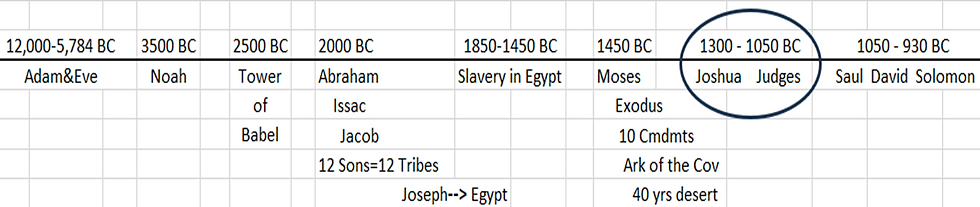
Bible Timeline
Genesis – (12,000-2200 BC) Ch 1-11: Adam to Noah to Nimrod and the Tower of Babel (called pre-“history”)
(2,100-1,800 BC) Ch 11-50: Abraham, Issac, and Jacob, 12 sons/tribes, Joseph into Egypt à slavery
Exodus – (1,400-1300 BC) Moses – out of Egypt/slavery to Mt. Sinai to the promised land/40 years in the wilderness.
(Leviticus, Numbers, Deuteronomy - all take place during the 40 years in the wilderness.)
Joshua – (1350-1250 BC) Conquest of Israel and the division of land among Israel’s twelve tribes.
Judges – (1250-1050 BC) “Israel” ruled by 12 Judges from Joshua to King Saul
Ruth – (1100 BC/during Judges) Ruth the Moabite was the unlikely, great grandmother of King David.


The Book of Joshua
The Book of Joshua may be divided as follows:
I. Ch. 1-5: Preparations to Take the Land
II. Ch. 6-12: Taking the Land
III. Ch. 13-21: Dividing the Land
IV. Ch. 22-24: Keeping the Land (Exhortations by Joshua to the people about remaining faithful to the covenant)
Several other reminders for context:
1) God did not choose the land of Israel because it was especially fertile. The Jordan River is not like the Nile but small and incapable of irrigating the country. The central portion is mountainous, and the southern part is arid desert. The main value of the land was that it was a land bridge between Northern Africa/Egypt to Mesopotamia and the Mediterranean world (via land and sea). Millions of people from myriad countries pass through the land (exposing them to Yahweh!) and many will want to own this land. Israel will need God’s protection to keep it.
2) The Canaanites are not a foreign people. Canaan was the cursed son of Ham, the cursed son of Noah. The Israelites are descended from Shem, the good son of Noah, so that makes them distant relatives. That said, by the time of Joshua, Canaan no longer referred to one specific people but became a general term used for this area, which included many different, distantly related tribes.
3) History tells us that the people of Canaan were wicked and unjust, even with their own people, worshiping fertility gods and goddesses that involved human/child sacrifice. The Israelites were the instrument of judgment against the Canaanite peoples for their crimes against the innocent that cried out to God for justice.
4) The conquests often use rhetorical, hyperbolic, symbolic, or other figures of speech that were common to the cultures and times that we are studying. Consequently, battles may sound greater than they were. For example, entire cities and whole peoples that the book suggests were wiped out were actually quite alive and well just a few decades later in the Book of Judges.
The theological message of the book is that God is faithful to His promise to Abraham to give him descendants, land, and a nation. However, Moses’ final message to the Israelites about keeping the land stands for the rest of Israel’s future. As we shall see, Israel fails to keep their end of the agreement, time and time again. Israel may keep the land…
IF Israel relies completely on the Lord for victory, and
IF Israel stays united as a people, and
IF no one grows rich from victory in war, and
IF God remains their one and only God.
Joshua sends spies before crossing into the land. Rahab the prostitute.
Joshua 2:1-15
Then Joshua, son of Nun, secretly sent out two spies from Shittim, saying, “Go, reconnoiter the land and Jericho.” When the two reached Jericho, they went into the house of a prostitute named Rahab, where they lodged.
But a report was brought to the king of Jericho: “Some men came here last night, Israelites, to spy out the land.” So the king of Jericho sent Rahab the order, “Bring out the men who have come to you and entered your house, for they have come to spy out the entire land.”
The woman had taken the two men and hidden them, so she said, “True, the men you speak of came to me, but I did not know where they came from. At dark, when it was time to close the gate, they left, and I do not know where they went. You will have to pursue them quickly to overtake them.”
Now, she had led them to the roof, and hidden them among her stalks of flax spread out there. But the pursuers set out along the way to the fords of the Jordan. As soon as they had left to pursue them, the gate was shut.
Before the spies lay down, Rahab went up to them on the roof 9and said: “I know that the LORD has given you the land, that a dread of you has come upon us, and that all the inhabitants of the land tremble with fear because of you. For we have heard how the LORD dried up the waters of the Red Sea before you when you came out of Egypt, and what you did to Sihon and Og, the two kings of the Amorites beyond the Jordan, whom you destroyed under the ban. We heard, and our hearts melted within us; everyone is utterly dispirited because of you, since the LORD, your God, is God in heaven above and on earth below.
Now then, swear to me by the LORD that, since I am showing kindness to you, you in turn will show kindness to my family. Give me a reliable sign that you will allow my father and mother, brothers and sisters, and my whole family to live, and that you will deliver us from death.”
“We pledge our lives for yours,” they answered her. “If you do not betray our mission, we will be faithful in showing kindness to you when the LORD gives us the land.”
Then she let them down through the window with a rope; for she lived in a house built into the city wall.*
They told Rahab to tie a scarlet ribbon or chord onto her window, and she would be protected when the Israelites returned to take the city.
Q: Why is Rahab important?
Rahab ended up marrying Salmon whose child was Boaz. Boaz married Ruth (Book of Ruth) who became the great, great grandparents of King David, whose lineage led to JESUS!
This is another example of things that no one would put in the history of their religion, let alone their savior. Jesus not only came for all people; his lineage was from all people.
Crossing from the Desert Wilderness over the Jordan River
There are many parallels to Exodus. Sending spies to reconnoiter the land was the first one. Now they must cross the Jordan River during the spring flooding season. As Joshua says in Ch 3, the waters were over the banks. The Jordan is no Nile River, to be sure, but at the point of crossing it is figured to be at least 100 feet across and 10 feet deep; but the real problem crossing at this time was the current. From the Sea of Galilee 60 miles north to the Dead Sea (the lowest place on earth) is a drop of around 700 feet in elevation. In the last decade, an expert swimmer apparently tried to swim across the Jordan at this point and time of year and was unable to because of the current.
Q: What were God’s instructions for being able to cross the river?
The river waters were halted by the presence of God in the Ark of the Covenant. As soon as the priests carrying the Ark stepped into the water, the waters rushed backwards and the ground beneath them dried. After the entire nation had crossed, priests gathered stones from the riverbed and built an alter to give thanks to God. In 3:14-17, it says that when news of Israel’s miraculous river crossing spread, fear of them spread throughout all the cities of Canaan.


The Israelites cross over the Jordan River

Same location today but not flooding season.
The Capture of Jericho
Jericho was a well-fortified city which controlled the hill country near the Jordan River on the north end of the Dead Sea. God instructed Joshua to circle the city. Each day for 6 days the Israelite soldiers were to march around the city with the Ark followed by 7 priests blowing ram’s horns (“Shofars”). On the 7th day, they were to circle the city 7 times and then all the Israelites were to begin shouting. They did this and the walls of Jericho came tumbling down, which allowed the army to enter and capture the city. Joshua puts the city under the ban, which means it is supposedly completely destroyed. Nonetheless, at the beginning of the next book of Judges, we see that Jericho is still standing and still a city much in use.
Whatever actually happened, Joshua conquers the land. The message is that the power of God, the Ark, and the use of the perfect 7s were greater than any walls built by man. As long as Joshua sticks close to God and follows his instructions, he will take the Promised Land.
Israel has a difficult time with a small city named Ai, because one of Joshua’s soldiers named Achan secretly took some gold and silver from Jericho for himself. The army didn’t know it and were ambushed. Thirty-six of Joshua’s men were killed. When Joshua found out what happened, the man and his family were put to death for violating God’s instructions and getting 36 men killed.
Except for the Gibeonites, who heard about the power of Yahweh and quickly made a pact to serve Israel, the five kings of the southern lands – the Amorites, Hittites, Perizzites, Hivites, and Jebusites – get word about Joshua coming and head out to attack Israel. They suffer humiliating defeats, and in the end the 5 kings are found hiding in a cave. Things did not go well for them.
Next, the kings of the northern lands get word and decide to attack Israel together. Joshua puts all his trust in the Lord. By the end of chapter 11, he has victoriously led Israel against this coalition in the north. Although only half the land has actually been taken, the powerful pagan kings in the North and South have been overcome. Joshua declares the land at rest, echoing the rest in Genesis 1 after God’s creation overcomes chaos. Actually, we will find the land not at rest so much, as small pockets of resistance exist in many places in the years ahead.
In chapters 13-20, we enter the next phase, which is the distribution of the land to the 12 tribes of Israel, except for the priestly tribe of Levi, who are given cities throughout the kingdom. As we view the map, we will see that 10 tribes have settled in the northern part of Israel, and 2 tribes in the southern part – Judah and Benjamin.

Joshua’s Final Advice
In Chapter 23, Joshua gives his final speech to the Israelites, much like Moses’ final speeches in Deuteronomy before he died. He warns them that although Israel now dwells in the land, they still live with the remnants of nations they defeated. Their fidelity to God will be the key to their security, just like God was responsible for their victories. If they abandon God, He will no longer protect them, and they will fall into the hands of their enemies. He emphasizes the word “serve”; they are to serve the Lord, which also translates as both “work hard” and “worship.”
Joshua’s final speech was given in Shechem, which is no accident, since it was here that Abraham built an altar for sacrifice and where Jacob lived some 500 years earlier.

There is an offering at Shechem and, at the end of his life, in the final chapter (24), Joshua again renews the covenant and initiates the next generation into the covenant life of Israel.
Next month: The Book of Judges

Famous quote from Joshua (24:15)
Next week 12/19, we will discussing the Great Women in the Bible – in particular the Exodus period – as we move on the Prophetess Miriam and the Prostitute Rahab, both who help bring about the Kingdom of David.
Tues., Dec 26 is Christmas Week, no class.
4300
Closing Prayer
LORD
As we return to our lives, please bless everyone in this Bible Study group –
Our faith, our families, our work, and how we involve you in all of these.
Accompany us in our understanding and living out your Word, and may Your will be done.
Hail Mary, full of grace, the Lord is with thee.
Blessed art thou among women, and blessed is the fruit of thy womb, Jesus.
Holy Mary, Mother of God, pray for us sinners,
now and at the hour of our death.
Amen.


Comments