12.09.25 - John the Baptist and the Immaculate Conception
- tmaley
- Dec 16, 2025
- 17 min read
Catholic Understanding & Biblical Defense Class 12/9/25
Every Tuesday, 7PM-8PM (EST). This meeting is a lecture/Q&A format. It is free.
Meetings on Meetup: www.meetup.com/catholicbiblestudy
Past classes are posted on our Catholic Catacombs Website: www.CatholicCatacombs.org
House rules/notes…
Our meetings/classes are on ZOOM every Tuesday, 7-8 PM. Sign up on Meetup at www.meetup.com/catholicbiblestudy
to receive Zoom reminders and meeting recaps afterwards. Zoom ID: 829 7355 9896 Password: 358319.
RSVP Reminder: Please RSVP whether you are attending the meeting or just reading the Recaps afterwards. The more RSVPs, the more Meetup will give exposure to “Catholic Bible Study” – a good thing!
Questions. We encourage questions although we ask that you keep them on topic and brief. You can ask during the meeting, or in the chat box, or if you prefer you can email us through Meetup.com, or Ron directly: ron@hallagan.net.
Recaps. Within a day or two after each meeting, we will post the edited meeting notes of our discussions on our website, www.catholiccatacombs.org. Taylor will notify everyone when this is posted and provide you with a link.
Respectfulness. We will be discussing differences between Christian denominations and religions in general, and we seek to be respectful at all times. Protestants especially are our friends and brothers-in-Christ; in fact, I personally owe much of my return to the faith to them!
No politics. It would be easy for us to self-destruct, but that’s not our goal :). Our goal is to learn, understand, and apply the Bible and our Catholic faith to our everyday lives.
“The Chosen” TV series. All of us seek a relationship with Jesus Christ and it can help if we have seen and heard Him. The Chosen series captures Jesus better than any show I have ever seen. Season 4 is underway. Highly recommended.
Catholic Prayer & Fellowship. Are you interested in praying the rosary, etc. with other Catholics during the week? Follow fellow member Jason Goldberg at https://www.meetup.com/online-catholic-prayer-fellowship-and-spirituality/.
Cursillo. Interested in meeting weekly over coffee to discuss how God is involved in your personal and professional life? Join Cursillo (cur-see-yo). Initiation involves a 3-day retreat at Mission Hurst in Arlington. For men’s groups, contact Ron (ron@hallagan.net) and Jennifer Pence (Jennifer.pence@gmail.com) for women’s groups.
Format: Each week of the month has a repeating theme, as shown below.
Wk 1: Gospel Week – we study several Gospel stories, especially the tough ones.
Wk 2: Bible Week – we are working our way through the Bible. We are studying the Prophets.
Wk 3: Questions and Survey Topics chosen by Members:
1) Apparitions and modern miracles 2) What happens to pets after they die? 3) Prison ministry stories 4) Could you review of Plenary and Partial Indulgences again?
Wk 4: Apologetics:
Gen 1-3 (Creation Story, Adam & Eve, the Fall of Man, The Meaning of the Trees)
Faith and Doubt
Deeper meanings of the Mass
Each meeting is (roughly) as follows:
15 min Apologetics/Catholic Reflection
15 min Upcoming Gospel reading
30 min Weekly topic/theme
1 hour
Our Bible Study is a combination of Biblical Exegesis and Apologetics.
Study and interpretation of Scripture A reasoned defense of the faith
Taylor will send a link to everyone with today’s notes.
The class is also recorded if you want to listen to it anytime.
Reader for the day…
Opening Prayer:
O LORD
Thank you for your promise that where two or three of us are gathered in your name, You are there.
We ask for Your help to open our minds and hearts tonight so that Your Word will change our lives.
And as you taught us to pray together…
Our Father, who art in heaven, hallowed be your name.
Your kingdom come, your will be done, on earth as it is in heaven.
Give us this day our daily bread,
And forgive us our trespasses as we forgive those who have trespassed against us.
And lead us not into temptation, but deliver us from evil. Amen!
Major holy days: Advent Sun Nov 30 to Christmas Eve
Dec 8 – The Immaculate Conception
Dec 25 – The Nativity of our Lord, Jesus Christ (Christmas)
Jan 1 – Holy Mary the Mother of God
Jan 6 – The Epiphany
Mass or Confession anywhere/anytime: www.masstimes.org
TODAY:
Reflection – Advent
Gospel Reading for 3rd Sunday of Advent, 12/14: Messengers from John the Baptist– Matthew 11:2-11
The Immaculate Conception – what is it, how and when it came about, apologetics.
Quote of the Week:
"No one has access to the Almighty as His Mother has; none has merit such as hers. Her Son will deny her nothing that she asks; and herein lies her power" – St. John Henry Newman, Anglican convert, Cardinal, Theologian.
Advent Reflection

Daily Mass
Have you ever considered going to daily Mass? I do most of the time, and I wanted to share a couple of things about it.
First, it’s only a half hour, sometimes less.
Second, it’s peaceful. Talk about starting your day peacefully, this is it.
Third, the people you see at daily mass are very prayerful, faithful people who are either there because they prize their relationship with God, or they are in need of His intervention in their lives. These are the kind of people you might have met secretly attending Mass in the Catacombs when Christianity was being persecuted in the Roman Empire in 200s.
Fourth, people are deep into communion with God, not judging or even noticing anyone else. You can come and go with no attention, if you like.
Fifth, you get forgiveness and Communion – and the grace that pours out from both of these. What a way to start your day.
Just a thought.
Daily reflections with Johnathan Roumie, Sr. Miriam, etc. on Hallow.com. hallow.com/collections/2688/
Mass anywhere/anytime: www.masstimes.org
Gospel Reading for 3rd Sunday of Advent: Matthew 11:2-11
Mt. 11:2-6 – Messengers from John the Baptist
Mt. 11:7-11 – Jesus praises John the Baptist

Context
There are three sets of statements made in today’s reading that have often troubled many a Christian reader.
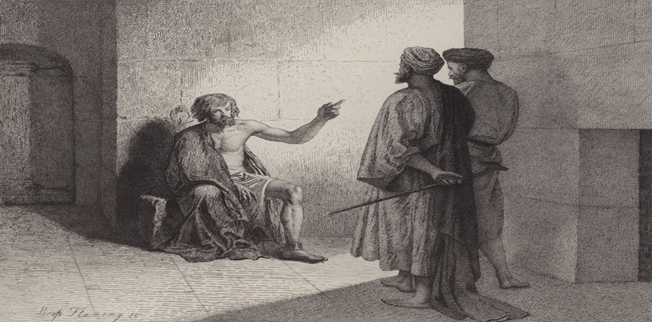
While John was in jail, he sent his disciples to ask Jesus if he was the one to come. Why, we wonder, would John ask such a thing? He knew who Jesus was and, in fact, already baptized him, right?
Then when Jesus answer John’s messengers, he does so indirectly. Why? Why doesn’t he just come out and tell them?
Third, Jesus then praises John by saying that John was not only more than a prophet but also the greatest born of a woman (this just speaks to the universality of his statement, going back to Adam & Eve!)– but then he adds that the least in the Kingdom of Heaven is greater than John.
Aside from answering these questions, please take note of two other things:
1. That John is one of the humblest people who ever lived. Like Mary, everything he said or did pointed to the Christ.
2. For much of Jesus’ ministry, his identity continues to unfold, for he too is more than a prophet, and more than even a Messiah. He is God come down to save us. This was not known to John or anyone else. The primary prophecies had to do with a Messiah, but there were also numerous passages in Scripture where God said He would come and save his people. People thought this would be some separate event and time – perhaps at the end of time – or maybe just allegorical.
They were wrong.

Today’s reading has two distinct messages, so the passages are separated into two below, accordingly.
Messengers from John the Baptist, Mt 11:2-6
When John the Baptist heard in prison of the works of the Christ, he sent his disciples to Jesus with this question, "Are you the one who is to come, or should we look for another?"
Jesus said to them in reply, "Go and tell John what you hear and see: the blind regain their sight, the lame walk, lepers are cleansed, the deaf hear, the dead are raised, and the poor have the good news proclaimed to them. And blessed is he who does not fall away because of me."
Jesus Praises John the Baptist, Mt 11:7-11
As they were going off, Jesus began to speak to the crowds about John, "What did you go out to the desert to see? A reed swayed by the wind? Then what did you go out to see? Someone dressed in fine clothing? Those who wear fine clothing are in royal palaces. Then why did you go out? To see a prophet?
Yes, I tell you, and more than a prophet. This is the one about whom it is written: Behold, I am sending my messenger ahead of you; he will prepare your way before you.
Amen, I say to you, among those born of women there has been none greater than John the Baptist; yet the least in the kingdom of heaven is greater than he."
Exegesis (Investigation/Interpretation/Explanation)
Now let’s tackle each of the issues mentioned above:
After John was arrested by Herod and put in jail, he sent his disciples to ask Jesus, “if he is the one to come.” Why?
Some think that John was having doubts, but how could that be after the Baptism, the dove coming down on Jesus as foretold, and God speaking?
However, John didn’t ask if Jesus was the Messiah. He asked if he was the “one to come.” He is combining a Messianic prophecy with God’s own statements that He will come, such as in Isaiah chps. 26, 35, and 61. Tell me, who is being prophesied in this passage from Isaiah?
Say to those who are of a fearful heart, “Be strong, fear not! Behold, your God will come with a vengeance, with the recompense of God. He will come and save you. Then the eyes of the blind shall be opened, and the ears of the deaf unstopped; then shall the lame man leap like a deer, and the tongue of the mute sing for joy.” – Isaiah 35:4-6
When Jesus answers John’s messengers, why does he do so indirectly? Why doesn’t he just come out and tell them?
Notice Jesus’ answers exactly what John is asking by restating the same miraculous acts that are stated in Isaiah 35. Remember, if Jesus makes an explicit proclamation that he is God this early in his ministry, he will never be able to finish the task. He will die in his own time, after the 3rd year of his ministry.
Jesus praises John saying he was not only more than a prophet but also the greatest born of a woman.
John the Baptist is acknowledged as the greatest signifying his unique role as the forerunner of Christ. The others pointed to this day, but John participated in this day.
John’s greatness is not only attributed to his prophetic office and his mission to prepare the way for Jesus, but the humility in which he did it. Rather than take on his rightful priestly role in the Temple, he went to live alone in the desert and prepare for the Lord. He declined to take any credit for his blood relations with Jesus (which would have added bias in people’s minds) and instead relied on the promised dove that would descend on Jesus for all to see. When asked if he was the great prophet Elijah, he declined and replied that the one coming was the important one, for whom he was unqualified to carry his sandals. He was also not afraid to speak authoritatively and directly to the hypocrisy of the Pharisees and Scribes who seemed to pretend they had come to repent. Finally, when John was asked by his disciples if they should follow him or Jesus, he said, “He must increase and I must decrease.” Notice the humility surrounding Mary, Jesus, and John. There’s a salvation theme here, and humility is the doorway to it all.

John knows his calling and purpose is coming to its finish.
Jesus then adds that the least in the Kingdom of Heaven is greater than John.
This phrase introduces a breathtaking contrast, or paradox, contrasting earthly greatness with spiritual greatness – those standing on either side of the cross. On the other side of the cross is forgiveness and Heaven. It tells us that the New Covenant, inaugurated by Jesus, offers a greater spiritual reality than the Old Covenant.
Once again, Jesus’ identity is still unfolding. He is not only the new Adam, the new Moses, and the promised Messiah, he is God come down to save us. The Pharisees and Scribes had a hard time putting this together – and decided it was impossible, so Jesus had to be put to death to calm people down.
Interestingly, Satan probably thought he had won the battle with God, or at least Round 2, when Jesus was put to death. He knew he couldn’t win by himself – the only way was if people, by their own free will, rejected Jesus and killed him; so, no doubt he did his best to encourage this. When Jesus died, perhaps he thought, shaking his fist at Heaven, “Haha, go back where you came from, God. Better luck next time!”
He was wrong.

Apologetics: The Immaculate Conception is probably the most misunderstood – and most rejected – doctrine of the Catholic Church.
Misunderstood: What is the Immaculate Conception?
Many think the Immaculate Conception has to do with Jesus’ conception, but it doesn’t (that is the “Virgin Birth of Christ”). The Immaculate Conception has to do with the conception of Mary without Original Sin in the womb of her mother, Anna. This means Mary was born without sin, was sinless when she conceived Jesus, and the Church has always held that she remained sinless the rest of her life. Yes, yes, I know that seems impossible, so we will dig in!
Most rejected: Why is it rejected?
Because they will say, “Where is it in the Bible?” “Catholics are so unbiblical!”
First, there are many terms that all Christians believe that aren’t spelled out in Scripture. We use terms that have developed over time, such as The Trinity, Easter, Christmas, and even the word Bible, none of which are in Scripture. Catholic terms like Purgatory and the Immaculate Conception fit into this category, which Protestants didn’t reject until some years after Luther. BTW, Protestants believe in “Sola Fides” (faith alone) and “Sola Scriptura” (Bible alone), although neither of these terms are in the Bible.
For what it’s worth, there was no written records at all for the first 20 years after Jesus died – just oral teachings (which is the origin of “tradition”), and the was no “Bible” until the Catholics formalized one – with the same 73 books we have today – in the late 4th century at the Synod of Hippo, 393 AD. All Christians in the world followed this Bible until Protestants removed 7 OT books in the 16th century.
But I digress. Back to the Immaculate Conception.
Some will say that Pope Pius IX created the Immaculate Conception of Mary in his dogmatic proclamation in 1854. How do we respond to that?
It is true that Pope Pius IX formalized this doctrine in 1854 but note the word “formalized.” The Church will sometimes do this when it feels clarity of Church teaching is needed. It doesn’t mean the doctrine was invented then. For example, the Church didn’t formally establish the doctrine of the Trinity until the Council of Nicaea in 325 AD. Does that mean the Trinity was invented then? Of course, not.
As for the Immaculate Conception, you can take your pick among early Church fathers who support this doctrine. I will use one saint that the Protestant’s love and respect – St. Augustine – in the 5th century:
All the just have truly known of sin except the Holy Virgin Mary, of whom, for the honor of the Lord, I will have no question whatever where sin is concerned. – St. Augustine, De natura et gratin, c. xxxvi
Clearly, the Church didn’t make this up in 1854. Augustine’s comment that Mary has not known sin refers to her entire life, the same position the Church holds today.
As we have said, many doctrinal proclamations happen because the Church decides it needs to be put a doctrinal belief to rest for one reason or another. In the case of the Immaculate Conception, it was because of Protestant Reformation attacks on Mary and the Immaculate Conception. The pope decided to remove all questions about the Church’s doctrine.
If there is nothing in Scripture about the Immaculate Conception, how did we get this belief?
It is correct there is nothing explicit about the Immaculate Conception, just like there is nothing explicit about Trinity. However, we will show that the Immaculate Conception is indeed based on Scripture.
First, you might find it interesting what ancient tradition gives us regarding Mary’s early life…
Joachim and Anna, Mary’s parents, were older and childless. Anna prays that if she is allowed to have a child, she will dedicate his/her life to the service of the Lord (the Temple). Anna becomes pregnant and they have Mary. They deliver Mary to the Temple when she is barely old enough. There she serves as a ‘Virgin of the Temple” learning Jewish scriptures and traditions and growing to love God so much that when it was time for her to leave the temple to be married, she refused. The priests finally convinced her she must go and they offered to help her find a husband. They called all the eligible bachelors in the village and gave them each a rod from which to draw lots. A dove flew down and landed on Joseph’s rod, making it clear that he was God’s choice. Joseph was older than Mary and feared taking her as she had committed her virginity to the Lord, but the priests confirmed that he was chosen and must take his responsibility with great honor.
Interestingly, another tradition shared in a Marian vision said that Joseph was nearly as religiously committed as Mary and desired to commit his life to the Lord, including his chastity. He was worried about taking Mary because of his commitment. When he met her and they both realized they had the same goals, they were both relieved and ecstatic.
When would the Immaculate Conception have occurred?
Mary is born around 18-20 BC without Original Sin (full of Sanctifying Grace).
It is true that there are not many references to Mary in the Bible, but the Gospels were about Jesus, not Mary or anyone else. Example:
Simon Peter: about 40 times, all four Gospels.
James and John (Jesus’ inner circle): about 21 times, all four Gospels.
Mary, Mother of Jesus: About 20 times; mentioned in all four Gospels.
Mary Magdalene: Around 14 times; mentioned in all four Gospels.
Joseph (Jesus' earthly father): Mentioned in Matthew, Luke, and John; 10 times (e.g., Matt 1:16, Luke 2:4, John 6:42).
Elizabeth (mother of John the Baptist): Around 9 mentions, primarily in Luke's Gospel (e.g., Luke 1:5-40).
Matthew (1st Gospel writer): 6 times, mostly when the list of Apostles are named.
Mark (2nd Gospel writer): 2 times.
Luke (3rd Gospel writer): 3 times.
By contrast, how many times Jesus is mentioned in the Gospels?
Over 1,000 times, depending slightly on which Bible you read, because that’s who the Gospels are written for and about. Also, Mary’s 20 times doesn’t count unnamed references to her in Genesis (“The seed of the woman will crush the head of the serpent” – Gen 3:15) and Revelation as Queen of Heaven (“The woman clothed in the sun” – Rev 12:1).

As mentioned above, the Incarnation of Mary via Joachim and Anne are not in the Gospels. The Church picks the reading on the Annunciation (Gabriel’s visit to Mary) for the Gospel reading on this celebration because it gives us many clues.

Gospel Reading, The Annunciation, Luke 1-26-38
In the sixth month, the angel Gabriel was sent from God to a town of Galilee called Nazareth, to a virgin betrothed to a man named Joseph, of the house of David; and the virgin’s name was Mary.
And coming to her, he said, “Hail, full of grace! The Lord is with you!”
But she was greatly troubled at the saying and considered in her mind what sort of greeting this might be.
Then the angel said to her, “Do not be afraid, Mary, for you have found favor with God. And behold, you will conceive in your womb and bear a son, and you shall name him Jesus. He will be great and will be called Son of the Most High, and the Lord God will give him the throne of David his father, and he will rule over the house of Jacob forever, and of his kingdom there will be no end.”
But Mary said to the angel, “How can this be, since I have no relations with a man?”
And the angel said to her, “The holy Spirit will come upon you, and the power of the Most High will overshadow you; therefore, the child to be born will be called holy, the Son of God. And behold your kinswoman, Elizabeth in her old age has also conceived a son; and this is the sixth month for her who was called barren. For with God nothing is impossible.”
And Mary said, “Behold, I am the handmaid of the Lord. Let it be to me according to your word.”
The Archangel Gabriel says, “Hail, full of grace! The Lord is with you!” What word seems to be missing?
“Mary” seems to be missing, but it isn’t.
“Full of grace” is spoken by Gabriel as a title, as in when they mocked Jesus, “Hail, King of the Jews,” or even “Hail Caesar!”
This is very unusual and significant. Nothing from God or sent by God is said by accident. Nothing. (Note: “Mary” was added later to the prayer Hail Mary just for clarity’s sake.)
Mary is rightly troubled at this greeting? Why?
Wouldn’t you be? A high-level Archangel sent from God is addressing you, “Hail, Full of Grace!” Of course, that would be unsettling, especially to someone of such lowly status as Mary.
Exegeses: It is important to understand that in the original Greek, the Angel Gabriel uses the past-perfect tense when he greets Mary, “Hail, Full of Grace.” It means he is describing a state of grace that was already in existence, not something he was bestowing on her at the greeting. So this “grace” Mary had was already there. There is no other time in her life before this that such gift would have been given except at her birth. This makes sense since God knew for all eternity that Mary would say yes, and that it would be through her that He (God) would be entering into His creation.
What grace did Mary receive? Recall the grace that Adam and Eve lost in the Fall…
Sanctifying Grace. The grace of relationship with God that is required to enter Heaven. When we say that Mary was born without Original Sin, what we mean is that she was born in a state of Sanctifying Grace.
Adam and Even lose Sanctifying Grace, their relationship with God and access to Heaven
What happens next?
Gabriel sees Mary’s anxiety over his words to her so he repeats (exegesis: repetition in Scripture is no accident, but an intended emphasis):

“Do not fear, Mary, for God had found favor with you.”
This time Gabriel uses Mary’s name, but he also repeats himself because “favor” and “grace” come from the same root word – “chaire” in Greek and “gratia” in Latin. They both mean grace = “divine favor.” Favor implies a “free gift.”
We are not reviewing the rest of the passage because that has to do with the birth of Jesus and her cousin, Elizabeth, and this class is on the Immaculate Conception. But there is usually one more pressing question that people will ask…
Isn’t it inexplicable that someone not have sin? The Church teaches that Mary was without sin for her entire life? How is that possible?
Believe it or not, there are several easy explanations:
Answer this question: “There is no sin in Heaven, right? Will we still have free will?
We have to have free will. Love requires the free giving and receiving of it. But there is no sin in Heaven, so it seems they can co-exist.
How? In Heaven we have become perfectly wise and filled with love, so why would we choose sin?
Another thought exercise: if you have a baby in your arms that you love so much you would give up your life for it, what are the chances you throw this baby off a balcony? Zero? But you still have free will, don’t you? Having perfect wisdom is like that. You wouldn’t even conceive of being selfish or harmful or… sinful.
Another: Is anyone sinning on this Bible Study call right now? You don’t have to raise your hands, but the chance are most of you are not. You have lots of time you are already not sinning. Remember, temptation is not a sin – it is feeding that temptation and acting on it that makes it a sin. So, sinlessness isn’t impossible at all.
Last fact: Were not Adam and Eve without sin before the Fall? Indeed. So sinlessness has already existed. And Mary is put into the same position as they were BEFORE the Fall.
Adam and Eve fell, two of them. Jesus is the new Adam, ushering in a New Creation so we could start over. Who was his partner? Mary, the New Eve, who said Yes to reverse Eve’s no. She was part of the new creation. She was actually the first Christian. When Jesus said to Mary on the cross, “Woman, behold your son,” and to John, “Behold your mother,” he was introducing the New Eve. “Woman” is the exact term used in Genesis for Eve.

The First Eve and The New Eve
Closing Prayer
Hail Mary
Full of grace, the Lord is with thee.
Blessed are thou among women, and blessed is the fruit of thy womb, Jesus.
Holy Mary, Mother of God,
pray for us sinners now and at the hour of our death.
Amen.


Comments