5.14.24 - Bible Timeline Tuesday
- tmaley
- May 20, 2024
- 15 min read
House rules/notes…
1. Our meeting/classes are In-Person at St. John Neumann Catholic Church 11900 Lawyers Road, Reston, VA 20191 https://saintjn.org/ (usually held downstairs in Room 5), or ONLINE via Zoom (see #2).
2. To sign up for Zoom notifications and to receive the Meeting Recaps, go to www.meetup.com/catholicbiblestudy and join us! The Zoom Logon is the same every week: Zoom ID: 861 1782 2081 Password: 406952.
3. After each meeting, I send out Meeting Recaps of what we discussed. Please remember these recaps are unedited and without the pictures. The edited version with pictures will be posted before the next class on the Website – www.CatholicCatacombs.org. Taylor will notify everyone at that time and provide a link.
4. Questions encouraged. If you have questions, we ask that you keep them on topic and brief. You can ask in the chat box during the class, or email through Meetup.com, or email me at ron@hallagan.net afterwards.
5. Respectfulness. We will be discussing differences between religions and between Christian denominations, and we agree to be respectful at all times. Protestants especially are our friends and brothers-in-Christ; in fact, I personally owe part of my return to the faith to them!
6. No politics. It would be easy for us to self-destruct, but that’s not our goal. Our goal is to learn/understand/apply the Bible and our Catholic faith.
7. Catholic Prayer & Fellowship. Are you interested in praying the rosary, etc. with other Catholics during the week? Follow fellow member Jason Goldberg at https://www.meetup.com/online-catholic-prayer-fellowship-and-spirituality/. Daily/weekly prayer is saintly!
8. “The Chosen” TV series. All of us seek a relationship with Jesus Christ, which is not always easy. It can help if we have seen and heard Him. The Chosen captures Jesus better than any show I have ever seen. Highly recommended.
9. RSVP Reminder: Please RSVP whether you are attending the meeting or just reading the Recaps afterwards. The more RSVPs, the more Meetup will give exposure to “Catholic Bible Study” – a good thing!
Bible Study Format:
Each week of the month has a repeating topic, as noted below.
Each meeting: 5 min greet, prayer, 10-15 min Catholic topic, 40-45 min main topic.
Week 1: Gospel Week
Week 2: Bible Week (Gen to Rev): We are in the book of 1 SAMUEL
Week 3: Survey Topics Voted on by Members:
x 1) Jesus’ Greatest Parables x 2) Hell, Purgatory, Heaven x 3) Comparative Religions
4) Great Women in the Bible 5) Book of Revelation 6) Fathers, Heresies, and Church Councils
Week 4: Member Questions:
1. What is “conscience?” To answer this we must also define our soul, free will, and our passions, and how these relate to each other.
2. Purgatory. How do I live my Christian faith at work when my faith is not accepted there?
3. How do I live my Christian faith at work when my faith is not accepted there?
4. What should our response be to those who ask us about priestly sex abuse?
5. What about the atheist who leads a good life? Can I be a person be good apart from God?
6. Miracles since the NT
7. Was King David good or bad? Was Emperor Constantine good or bad? Was he a Christian? What is a prophet?
8. Why does God allow suffering?
9. What is Tradition? Is Tradition equal to Scripture in importance? (2Thes2:15)
Opening Prayer:
O LORD
We ask you to bless everyone who has come here tonight to immerse ourselves in the study of your Word.
Give us the light of your wisdom and we celebrate your Holy Spirit and early life of your servant, King David.
May your blessings extend beyond this night into our lives and to our families and friends.
And as you taught us to pray together:
Our Father, Who art in Heaven, Hallowed be Thy Name.
Thy Kingdom come, Thy Will be done, on earth as it is in Heaven.
Give us this day our daily Bread
And forgive us our trespasses as we forgive those who trespass against us.
And lead us not into temptation but deliver us from evil. Amen.
Today
1. Apologetics: The Holy Spirit
2. Reading for next Sunday, The Pentecost, John 15:26-27, 16:12-15, Acts 2:1-11
3. Bible Timeline: 1Samuel, chapters 8-31
Quote of the Week:
It is not what we believe but how regularly we are reminded of our beliefs that most determines our behavior and the people we become. This is why we are a religion of reminders, from weekly Mass to holy days, solemnities, feast days, memorials, Advent, and Lent.
Upcoming major holy days in the Liturgy of the Church:
May 19 – Pentecost, The Solemnity of the Descent of the Holy Spirit

Apologetics and Exegesis Terms
“I do not seek to understand in order that I may believe, but rather, I believe in order that I may understand.”
Exegesis is the study/interpretation of the Word of God. If Jesus IS the Word of God, then you might also say that exegesis is the study/interpretation of Jesus. In a way, then, Jesus is also the exegesis of the Father! A more down to earth definition: exegesis is the study and interpretation of the Word of God (Scripture). It is what we do every week. You are all exegetes.
Catholic Apologetics– apologetics means to defend a belief, so Catholic Apologetics is the art of defending the Catholic faith using reason, tradition, and Scripture.
Today: The Holy Spirit
Although the Holy Spirit does not show up as clearly distinct from the Father and Son until the New Testament, He was clearly present from the beginning and throughout the Old Testament. Part of His elusiveness is because man had lost his intimate connection with the Holy Spirit at the Fall of Man. Jesus came to return the Holy Spirit to us, which happens at Pentecost, which is also called the Age of the Holy Spirit and of the Church.
For our Apologetics topic, I will cite a few OT and NT passages just to show the change in Holy Spirit vernacular.

The Holy Spirit
Old Testament
“The earth was without form and void, and darkness was upon the face of the deep, and the Spirit of God moved upon the face of the waters.” – Creation, Genesis 1:2
“The Spirit of the Lord came upon him, and he judged Israel.” – Judges 3:10 (Othneil)
“The Spirit of the Lord speaks through me; His words are upon my tongue.” – David in 2 Sam 23:2
“The Spirit came to me as He spoke, and He set me on my feet.” – Ezekiel 2:2
“The palace and the city will be deserted… until the Spirit is poured out on us from Heaven.” – Isaiah 32:15
“The Spirit of the Lord God is upon me, because the LORD has anointed me to preach good tidings to the poor. He has sent me to heal the brokenhearted, to proclaim freedom to the captives and the release from darkness for the prisoners. – Isaiah 61:1
New Testament (The Holy Spirit is mentioned 98 times in the OT and 250 times in the NT)
Jesus said, "When the Advocate comes, whom I will send you from the Father – the Spirit of truth that proceeds from the Father – He will testify about me. – John 15:27
Peter replied, “Repent and be baptized, every one of you, in the name of Jesus Christ for the forgiveness of your sins. And you will receive the gift of the Holy Spirit. – Acts 2:38
Then Peter said, “Ananias, how is it that Satan has filled your heart to lie to the Holy Spirit and withhold some of the proceeds from the land? – Acts 5:3
When they came up out of the water, the Holy Spirit suddenly took Philip away, and the eunuch did not see him again, but went on his way rejoicing. – Acts 8:39
While Peter was puzzling over the vision, the Holy Spirit said to him, “Simon, three men are looking for you. -Acts 10:19
Peter: Now the Spirit told me to go with them, not having discriminated. Now these six brothers also went with me, and we entered into the man's house… - Acts 11:12
May the grace of the Lord Jesus Christ, and the love of God, and the fellowship of the Holy Spirit be with you all. – 2 Cor 13:14
Readings for PENTECOST (May 19), John 15:26-27, 16:12-15, Acts 2:1-11 7:20

Last Supper Discourse in John (Ch. 13-17)
Context: The Gospel of John that you will hear this Sunday would take 30 minutes of exegesis to explain, so I will leave that for Gospel Week. This is especially true in what is called Jesus’ “Last Supper Discourse” in chapters 13-17. John is written after the three synoptic Gospels, and he saw no need to repeat most of what they wrote, so he decided to go deeper into Jesus’ words. John is by far the most philosophical Gospel, containing many theological discussions by Jesus. This is true of such subjects as God is love (Agape) and our call to love like Him; Jesus as the Logos (Word) of God; Jesus in the Bread & Wine at the Last Supper & Mass (the “Eucharist”); and Jesus’ introducing us to the person of the Holy Spirit.
The Holy Spirit is referred to by many names: the Spirit of Truth, Wisdom, Understanding, Paraclete (Greek for Advocate), Advisor, Counsellor, and Comforter. If you were to combine our earthly terms for best friend, favorite teacher, personal lawyer, protector, and advisor, that is how Jesus is telling us to view the Holy Spirit. As in all relationships, though, it takes two to dance, and so we must reach out and invite the Holy Spirit into our minds and hearts, because He cannot participate in our lives uninvited. Also true of any relationship, our relationship with the Holy Spirit grows with time and trust. The good news is that this spiritual, Trinitarian “friend” will never leave us or betray us, is forever patient with us, and will do everything possible to bring us into Heaven.
The Jewish Feast of Pentecost was one of the 3 required, annual pilgrimages calling all devout Jews to come to Jerusalem to celebrate their birth as God’s chosen people into the covenant law given to Moses at Sinai (Lev 23:15-21; Deut 16:9-11). These mysteries prefigured their ultimate fulfillment in the pouring out of the Holy Spirit on Mary and the Apostles (Acts 1:14) in the New Covenant law that was the start of the Church (vs. the Temple), the Body of Christ on earth.
PENTECOST…According to the CCC, Pentecost is the fulfillment of Jesus’ life, death, and resurrection. That’s a pretty big fulfillment!
This takes place 10 days after Jesus ascended and instructed the disciples to go to Jerusalem and await the HS. About 120 disciples were waiting in prayer when the HS arrived. It was on a Sunday, the 1st day of the week! This was the Jewish feast of Pentecost (Weeks/Shavuot), at 9am. This time of day is when the gates to the Temple would be opened, and large groups of people would be flowing in. The Jewish Pentecost celebrates 50 days after Passover, when the Torah (Ten Commandments) were given to Moses. Just as the first Passover to the Torah represented the Old (Mosaic) Covenant, the Last Supper, Resurrection, Ascension, and Pentecost completes the New Covenant. The New Pentecost is often referred to as the birthday of the Church, although at that time, it was thought to be the fulfillment of the promises to the Jews.
The Holy Spirit coming to man represents the complete reversal of the Fall of Man, where God (HS) returns to humans. This fulfills the prophecy where instead of God’s law being written on tablets like the Ten Commandments, they will be written in the hearts of man.
Q: Which Old Testament prophet prophesied that God would put his laws in our hearts?
Ezekiel (580 BC): “I will give you a new heart and place my spirit within you, taking from your bodies your stony hearts and giving you natural hearts. (Ez 36:26-27).

Acts 2:1-11
When the time for Pentecost was fulfilled, they were all in one place together. And suddenly there came from the sky a noise like a strong driving wind, and it filled the entire house in which they were.
Then there appeared to them tongues as of fire, which parted and came to rest on each one of them.
And they were all filled with the Holy Spirit and began to speak in different tongues, as the Spirit enabled them to proclaim.
Now there were devout Jews from every nation under heaven staying in Jerusalem. At this sound, they gathered in a large crowd, but they were confused because each one heard them speaking in his own language.
They were astounded, and in amazement they asked, "Are not all these people who are speaking Galileans? Then how does each of us hear them in his native language? We are Parthians, Medes, and Elamites, inhabitants of Mesopotamia, Judea and Cappadocia, Pontus and Asia, Phrygia and Pamphylia, Egypt and the districts of Libya near Cyrene, as well as travelers from Rome, both Jews and converts to Judaism, Cretans and Arabs, yet we hear them speaking in our own tongues of the mighty acts of God."
Q: What Old Testament connection might there be to this passage: “There came from the sky a noise like a strong driving wind, and it filled the entire house in which they were.”
There were also loud sounds and fire when God came to Moses on Mt. Sinai (Ex 19:16-19) causing all the Israelites to tremble.
Q: “…there appeared to them tongues as of fire, which parted and came to rest on each one of them. And they were all filled with the Holy Spirit…” Who prophesied this just 3 years before?
John the Baptist: “I am baptizing you with water for repentance; but the one who is coming after me is mightier than I. I am not worthy to carry his sandals. He will baptize you with the Holy Spirit and fire.” (Mt 3:11)
Q: Is there a meaning to the reference to “tongues of fire”?
The “tongues as of fire” are distributed to, and rest on, the disciples, thus empowering them to miraculously speak in “other tongues” (i.e., languages). This also symbolized the beginning of the reversal of the Tower of Babel.
Q: The Holy Spirit not only came to reunify man with God, but also man with man. The Holy Spirit is also called the author of Baptism. What is the connection?
We are baptized into the Body of Christ. The Body of Christ is the key to human unity and the portal to Heaven.
Bible Timeline 7:35

Bible Timeline
Genesis – Ch 1-11: (15,000?-2100 BC) Adam to Noah to Nimrod and the Tower of Babel (called pre-“history”)
Ch 11-50: (2,100-1,800 BC) Abraham, Issac, and Jacob, 12 sons/tribes, Joseph into Egypt à slavery
Exodus – (1,450-1350 BC) Moses – out of Egypt/slavery to Mt. Sinai to the promised land/40 years in the wilderness.
Leviticus, Numbers, Deuteronomy - all take place during the 40 years in the wilderness.)
Joshua – (1350-1250 BC) Conquest of Israel and the division of land among Israel’s twelve tribes.
Judges – (1250-1050 BC) “Israel” ruled by 12 Judges from Joshua to King Saul
1 & 2 Samuel (1050BC- 980 BC) King Saul and King David
1& 2 Kings (980 BC – 597 BC) King Solomon to the Babylonian Exile

As we said last month, the contents of the two Books of Samuel may be subdivided as follows:
I. The Last Judges, Eli and Samuel
II. Establishment of the Monarchy, King Saul
III. The Reign of King David
1st Samuel, Chapters 7-8
Where we left off: After the Philistines return the troublesome Ark to Israel, Samuel leads the people in worship and sacrifice – a priestly leadership never displayed by his horrible predecessor Eli – and God delivers Israel from her enemies.

“So the Philistines were subdued and did not again enter the territory of Israel.” – 1 Sam 7:13.
Israel Asks for a King (Ch 8)
In Samuel’s old age, his sons succeed him as judges over Israel, but they are nothing like their great father and in fact are nearly as disrespectful and corrupt as Eli’s sons. The people envision a return to Eli’s horrible rule and come to Samuel and demand a king so they can be like the other nations. But they aren’t like other nations. They are the chosen people, and they have a king – the Lord – who they only listen to after they are captured or enslaved, and then only for a little while.
Samuel warns them that getting a king may not be all that it is cracked up to be. The king will conscript their sons into his army, he will tax them to pay for the kings life, the army, and whatever else he wants. But the people are relentless and, because of the “hardness of their hearts,” the Lord tells Samuel to let them have their king.
King Saul
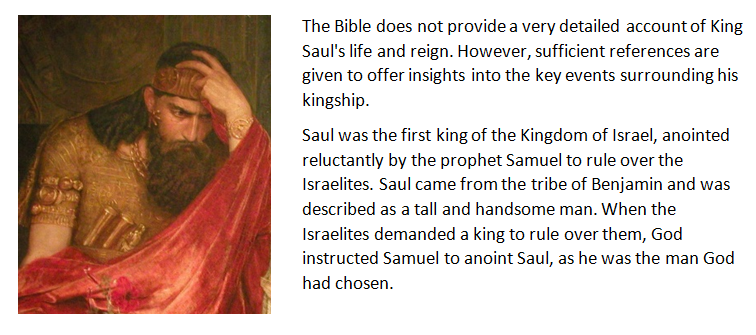
Q: Why would God have Saul anointed as their king if He knew Saul would eventually turn bad and fail?
There are many possibilities, but some things we won’t know for sure until we see God.
1) Saul was good in the beginning, but he has free will. Saul may have been the best man for the job at that time.
2) Even though God knows the future, he also knows the “chosen people” have much to learn.
3) God knew Saul would lead to David, one of the great figures in all of Israel’s history.
Initially, Saul's reign was marked by success, as he led the Israelites in battles against their enemies, particularly the Philistines. However, Saul's relationship with God and Samuel soon became strained. Saul disobeyed God's commands on several occasions, including offering a sacrifice himself instead of waiting for Samuel, and sparing the life of the unrepentant, wicked Amalekite king Agag against God's instructions. (Nor was Saul sparing Agag’s life out of a sense of mercy, but for his own purposes.) As a result, God rejected Saul as king and instructed Samuel to anoint David, a young shepherd, as the next king of Israel.
David – Shepherd in Bethlehem, Son of Jessi.
David's journey from shepherd to king is a remarkable story of divine providence and the unfolding of God's plan. The Biblical accounts provide a detailed narrative of this transformation.
Despite his lowly origins, David was chosen by God to be the future king of Israel. David was the youngest of the eight sons of Jesse, a small landowner in Bethlehem. As a shepherd boy, David spent his days tending his father's flocks, finding solace in playing his harp and communing with God through prayer and song.
When the prophet Samuel was sent by God to anoint the next king, he initially overlooked the young David, focusing instead on his older and more experienced brothers. However, the Lord saw the heart of David and chose him, the youngest and least likely of Jesse's sons, to be anointed as the new king. Samuel then took David to Ramallah.
David's rise to prominence began when King Saul was troubled by an evil spirit. David was summoned to Saul's court to play the harp and soothe the king's troubled soul. It was Saul’s first encounter with David, though the king did not know who he was.
The pivotal moment came when the Philistines challenged the Israelites to single combat – their giant Goliath against anyone the Israelites would like to send. There was a tense standoff for 40 days as no Israelite had the size or courage to face Goliath, until the young David heard about the confrontation and came to Saul to volunteer. Saul was incredulous and told him to forget it, but David told him that as a shepherd he had killed wolves and lions before to protect his sheep. He said the Lord protected him all those times, and He would protect him again. Saul relented and had armor put on him, but David could not move in the armor, took it off, and went to face Goliath with no armor. Goliath was insulted at the sight and went to cut the boy into pieces, but David hit him with one stone from his slingshot right on the forehead and it knocked Goliath out cold. David ran over and took Goliath’s sword and cut off his head. When the Philistines saw their big man dead, they ran.

Q: How tall was Goliath?
There are three theories:
1) Scripture says, “6 cubits and a span,” which comes out to 9’9.”
2) Ancient cubits are known to have a couple different measurements, the smaller one indicating only 7’10.”
3) A Greek translation 800 years later says 4 cubits and a span, which would be just short of 7 feet tall.
Regardless, any of these would be considered “giant,” especially 3,000 years ago when men were less tall than now.
This victory over the Philistine champion earned David great acclaim and the lasting friendship of Saul's son, Jonathan, who was likewise a man of God. Saul took David in and then put him in charge of his army. David was successful in many battles. However, one day when they were returning from battle in a victory parade, the people sang out:
“Saul has slain his thousands, and David his ten thousands!” (1Sam 18:7)
Saul was suddenly very angry as his pride was hurt. Saul's jealousy of David's growing popularity eventually led him to want David dead. David was forced to run away, and Saul pursued him. Saul’s son, Jonathan, was loyal to David and helped him avoid capture. Twice David had a chance to kill Saul, yet he showed him mercy instead.
Saul and his sons later died in another battle with the Philistines. The story of King Saul serves as a cautionary tale about the dangers of disobedience and the importance of submitting to God's will. Saul's downfall was ultimately a result of his own pride and failure to follow God's commands, despite being chosen by God to lead the Israelites. The narrative highlights the consequences of straying from the path of righteousness and the importance of maintaining a right relationship with God.
Upon the death of Saul, the men of Judah were quick to anoint David as king in Hebron, Judah’s capital at the time.
Eventually, David's power and influence grew, and he was recognized as the king of all Israel, after which he established his capital in Jerusalem (approximately 1000 BC). David's journey from shepherd to king was marked by divine providence, courage, and a deep faith in God. Despite his flaws and sins, he was a man after God's own heart, and his reign laid the foundation for the messianic tradition that would culminate in the coming of Jesus Christ, the Son of David.
Next: The reign of King David.

Closing Prayer
Psalm of David – 18:1-3
I love you, O Lord, my strength.
The Lord is my rock, and my fortress, and my deliverer…
My God, my rock, in whom I take refuge, my shield, and the horn of my salvation, my stronghold.
I call upon the Lord, who is worthy to be praised, and I am saved from my enemies!
Hail Mary, full of grace, the Lord is with thee.
Blessed art thou among women, and blessed is the fruit of thy womb, Jesus.
Holy Mary, Mother of God, pray for us sinners,
now and at the hour of our death.
Amen.


Comments