7.15.25 - Martha & Mary | Books of Judith & Esther
- tmaley
- Jul 17, 2025
- 11 min read
Opening Prayer:
O LORD
Thank you for your promise that where two or three of us are gathered in your name
You are there. We welcome You among us today!
We thank you for the gift of life that you have lavished upon each of us.
We ask that You open our ears so that we hear your voice, our minds that we may receive your wisdom,
And our spirits so You might change our lives.
And as you taught us to pray together…
Our Father
Who art in heaven, hallowed be your name.
Your kingdom come, your will be done, on earth as it is in heaven.
Give us this day our daily bread,
And forgive us our trespasses as we forgive those who have trespassed against us.
And lead us not into temptation, but deliver us from evil. Amen!
Upcoming major holy days: August 15: Solemnity of the Assumption of the Blessed Virgin Mary.
TODAY:
· Reflection: The Term “Catholic”
· Gospel reading for 16th Sun in Ordinary Time (7/20), Jesus visits Martha & Mary, Luke 10:38-42
· Bible Timeline: The Books of Judith and Esther
Quote of the Week:
“God loves each one of us as if there were only one of us.” - St. Augustine
Augustine is describing what perfect love looks like. Remember Jesus’ parable of the 99 sheep and 1 missing – God goes after the one? That means if you were the only person who ever lived, Jesus would still have come to die for you.
The Term “Catholic”
What does the term Catholic mean?
The word catholic itself comes from the Greek katholikos, meaning “universal” or “throughout the whole.” From the beginning, this Church wasn’t local or tribal—it was for everyone from every nation, offering the fullness of truth handed down by Christ Himself. The use of the term increased in frequency after this.
When was the term Catholic first used?
The first recorded use of Catholic to describe the Church came from St. Ignatius of Antioch, bishop, martyr, and disciple of the Apostle John, around the year 107 A.D. As he was being transported to Rome for execution, Ignatius wrote several letters to Christian communities along the way. In his letter to the Smyrnaeans, he wrote:
“Wherever the bishop appears, there let the people be; as wherever Jesus Christ is, there is the catholic church.”
Ignatius’ use of the word shows us something important and powerful: the Church understood itself as one, holy, catholic, and apostolic from the earliest days. It’s not just a line in the Creed—it’s a historical reality.
When did the term Catholic take on more formal role in the Church’s identity?
By the fifth century – particularly with St. Augustine – the term “Catholic” was well established. In response to the various heresies, Augustine informed everyone to make sure the speaker clarified if they were from the “Catholic” Church before wasting any further time listening.

Jesus visits Martha & Mary, Luke 10:38-42
Hospitality/Service vs Word of God/Discipleship?
Context:
The Gospels, particularly the Gospel of John, provide several references to Martha, Mary, and Lazarus being long-time friends of Jesus. They lived in Bethany, about 2 miles from Jerusalem, so it is likely Jesus stopped there often when visiting Jerusalem.

Bethany is about 2 miles from Jerusalem
Today’s oft-debated reading usually boils down to hospitality (or service) vs contemplation of the Word of God.
And although we will settle this question, as usual, there is another issue Jesus is addressing.
It says in the beginning of the passage that Jesus’ visit occurs at Martha's house. Once again, Jesus' stories are counter-cultural when it comes to women. That this is a story about women is surprising in and of itself. Women in those days or were not generally decision-makers or principal characters, or even spoken to. Yet Jesus engages women routinely and treats them no different than men. Many women were followers of Jesus and some wealthier ones offer financial support for the mission, especially after Pentecost.
In today’s story, Martha is doing all the serving and Mary is listening at the feet of Jesus. We find that Martha is not happy, for not only is Mary not helping her, but she had the chutzpah to sit with the men. She is upset enough that takes her complaint to Jesus. Jesus’s response is kind but he is not receptive to her request.

What is unusual about Mary sitting at the Lord’s feet?
Sitting at the feet of teachers/rabbis was how students became disciples. For instance, listen to what Paul says in Acts 22:3:
“I am a Jew, born in Tarsus… and I learned at the feet of Gamaliel.”
Gamaliel was one of the greatest rabbis of the first century. As mentioned earlier, it is remarkable in 1st century Judaism that a woman would assume the posture of a disciple at the master’s feet, and that the Apostles would write about it shows that Jesus was changing the culture of the future.

Luke 10:38-42
As they continued their journey, he entered a village where a woman whose name was Martha welcomed him into her home.
She had a sister named Mary who sat beside the Lord at his feet listening to him speak. But Martha, who was distracted about much serving, came to him and said, “Lord, do you not care that my sister has left me by myself to do the serving? Tell her to help me.”
The Jesus said to her in reply, “Martha, Martha, you are anxious and worried about many things. There is need of only one thing. Mary has chosen the better part and it will not be taken from her.”
Was it reasonable for Martha to ask Jesus to tell Mary to help her?
Ha, yes and no. It was probably a little bold of her to interrupt Jesus to complain, but then on the other hand, the Torah is very clear that Jews are to be hospitable to everyone, even strangers, reminding them that they, too, were strangers in Egypt. Martha was doing her duty by focusing on hospitality.
Do you think Jesus’ response to Martha was unkind?
It was kind. Jesus repeating of her name – “Martha, Martha” – suggests a loving tenderness, which Jesus had done elsewhere (“Simon, Simon…” (Luke 12:31) and “Saul, Saul…” Acts 9:4).
Jesus replied that Mary has chosen ‘the better portion.’ What does that actually mean?
“Portion” is not an “either-or” response. The “better portion” means the more important of the two.
The two primary aspects of spiritual life is faith and service, both connected by love. Acts of service are acts of love are critically important; however, they must be in based in faith, which can only be enriched by prayer, His Word, and the Sacraments. These are what keep us from veering off the right path.
In other words, it is God who informs our thinking, decisions, and actions – and, ultimately, it determines the persons we are becoming. To think we can act successfully without God is how the Fall of Man happened.
We can view our faith (i.e., prayer and study) and our actions (service, etc.) as two sides of the same coin; they must remain together. But communication with God must be the foundation of our behavior. If we could have a three-sided coin, we would add “reviewing our actions afterwards with God” to review how it went, discuss what we learned, and see what feedback we get in how we might improve. That is relationship!
Is Martha’s priority of providing hospitality (at the expense of listening) the only issue Jesus raises?
Martha, Martha, you are anxious and worried about many things
Anxious and worried. In the prior verse, Jesus also says Martha was "distracted," by which he means being pulled away by earthly things from more important things around her – in this case, everything Jesus was saying.
If the devil could keep us distracted from God for most of our life, would you consider that to be a successful strategy?
It is already a winning strategy with many humans. The more advanced our society gets, the more we must learn to reduce distractions. Uncontrolled distractions lead to lack of focus. Lack of focus leads to lack of commitment and purpose. Lack of purpose and commitment lead to a life of quiet desperation. (Or maybe not so quiet.)
Why is being attentive in the present so important?
First, the present is eternal. The past and future don’t exist – these are just tools for our minds to learn and plan. Second, God is only in the present. We should talk to Him about the past and future, but the present is the only reality.
Other examples: we can only love in the present; we can only forgive in the present; we can only pray in the present; we can only be attentive to the needs of others in the present; and we can only change ourselves – or the world – in the present. Just remember to keep God with you!
What can we do to reduce distractions?
Discussion. This exercise challenges us to identify what matters most. We seek to gives ourselves the clarity to focus on the important few instead of chasing the trivial many.
Bible Timeline

How many books in the Bible and how are they usually arranged?
73 books in the Bible (46 in the OT + 27 in the NT).
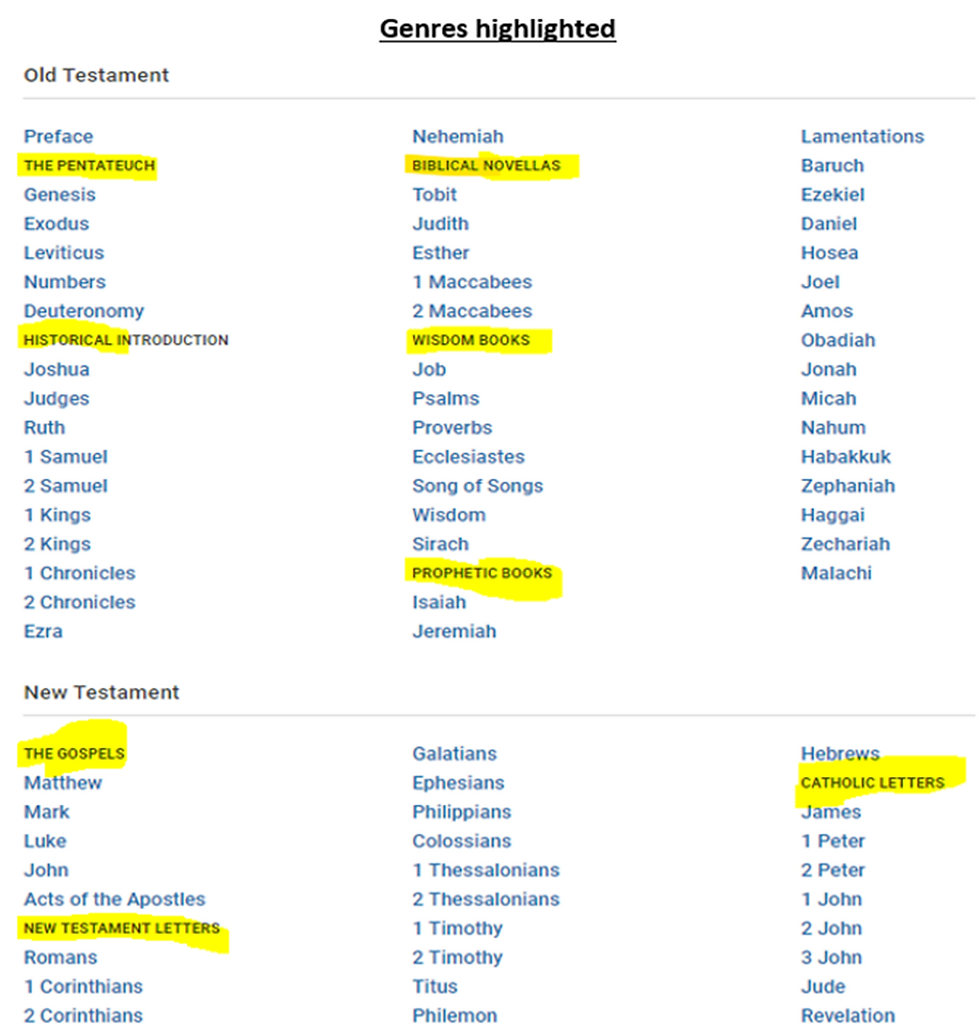
They are typically listed in “Canonical Order,” as opposed to chronologically. Canonical order means the Church has grouped them by genre/type.
Below is a list as you will usually find them, and below that I have provided another list that highlights the genres more clearly.

Old Testament – 46 books New Testament – 27 books Total Bible– 73 books
The Prophets

These biblical prophets are classified into “major” and “minor” prophets, which is not based on their significance but on the length of their writings.
Major Prophets: There are four major prophets in the Old Testament:
1. Isaiah
2. Jeremiah
3. Ezekiel
4. Daniel
Minor Prophets: The minor prophets consist of twelve individuals, whose writings are shorter. They are:

Next: Tobit, Judith, Esther, Maccabees, Greeks, Romans, Herod, End of Old Testament
The Books of Judith and Esther are classified as Novellas. Judith is what we is called inspired historical fiction. Inspired because the lessons taught are inspired truths for one’s salvation; historical fictional because it blends fictional narratives within a historical context and true cultural norms of the time. Esther is a novella that is more historically accurate.
The Book of Judith
The Book of Judith recounts a thrilling tale of courage and faith in the face of overwhelming odds. The story unfolds as the formidable King of Nineveh dispatches his general, Holofernes, to conquer the Jewish people. Holofernes lays siege to the city of Bethulia, cutting off their water supply and driving the inhabitants to the brink of surrender. Despair grips the city, and their trust in God wavers.
Amidst this crisis, a devout and beautiful widow named Judith emerges as an unlikely hero. Reproaching the people for their lack of faith, she devises a daring plan to save her city. Adorning herself, Judith, accompanied by her maid, ventures into the heart of the Assyrian camp. Her striking beauty and clever words captivate Holofernes. Gaining his trust, Judith waits for the opportune moment.
After a banquet where Holofernes becomes heavily intoxicated, Judith returns with Holofernes to his private tent. Holofernes passes out, and Judith seizes her chance. In a stunning act of bravery, she takes his sword and beheads the fearsome general in his own tent.
Returning to Bethulia with Holofernes’ head as a gruesome trophy, Judith rallies her people. The sight of their leader’s severed head throws the Assyrian army into chaos. Emboldened, the Israelites launch an attack, routing the disoriented enemy and securing a miraculous victory. Judith is hailed as a hero, and her bravery and faith are celebrated in a triumphant hymn. She lives out her days in honor, a testament to how one woman’s courage, guided by God, can deliver a nation from destruction


The Book of Esther takes place around 475 BC (after the Persians conquered the Babylonians) and tells a dramatic story of courage, intrigue, and divine providence in the Persian empire.
Esther is a beautiful young Jewish woman who becomes queen to King Ahasuerus (often identified with Xerxes). Her cousin and guardian, Mordecai, is also an official in the king’s court. Mordecai uncovers a plot against the king, earning a place in the royal chronicles, but no reward.
The plot thickens with the rise of a high-ranking official, Haman, who is both jealous of and angry with Mordecai; angry because Mordecai does not bow down in his presence. Haman gets the king’s approval to demand religious subservience of everyone in the kingdom. Mordecai refuses and Haman determines to have him killed, even though he had been praised for stopping an attack on the king.
Haman is consumed by pride and hatred. Haman eventually manipulates the king into issuing a decree for the extermination of all Jews throughout the kingdom on a day chosen by lot. The king still does not realize that Mordecai and Esther are jews.
Mordecai implores Queen Esther to intervene, even though approaching the king uninvited could mean her death. Esther begins fasting and prayer, after which she summons the courage to go before King Ahasuerus. The king receives her favorably and Esther cleverly invites the king and Haman to two banquets.
A series of pivotal events unfolds: the king, unable to sleep, has the chronicles read to him and discovers Mordecai’s unrewarded loyalty. When Haman arrives to the first banquet, he plans to ask for Mordecai’s execution. However, first the king asks Haman how to honor a man that the king delights in. Haman thinks the king is thinking about him, so he recommends a lavish public honor. The king agrees, and then orders Haman to bestow this public honor upon Mordecai. Haman is outraged, but his order to kill the Jews has already gone out. Haman does not stop the order.

At the second banquet, Esther reveals her Jewish identity to the king and Haman’s wicked plot to kill Mordecai and annihilate her people. Furious, the king orders Haman to be hanged on the very gallows Haman had prepared for Mordecai. The king then empowers Esther and Mordecai to issue a new decree, and allowing the Jews to defend themselves against anyone who attacks them.
On the appointed day, the Jews are ready and triumph over those who still sought to destroy them.

To commemorate this miraculous deliverance, Mordecai and Esther establish the joyous festival of Purim, a lasting celebration of how sorrow was turned into gladness. To this day, the Jews celebrate feast of Purim (mid-March).
Closing Prayer
From the Prayer of Esther (14:3-19)
O my Lord, who alone are our king, help me a desolate woman, who has no other helper but thee.
Give me a well ordered speech in my mouth in the presence of the lion
And turn his heart to the hatred of our enemy, that both he himself may perish.
Deliver us by thy hand, O Lord, and help me who have no other helper but you,
Who have the knowledge of all things.
O God, who are mighty above all, hear the voice of our fathers,
And deliver us from the hand of the wicked, and deliver me from my fear.
Hail Mary
Full of grace, the Lord is with thee.
Blessed are thou among women, and blessed is the fruit of thy womb, Jesus.
Holy Mary, Mother of God,
pray for us sinners now and at the hour of our death.
Amen.


Comments