4.14.26 - Road to Emmaus and Intro to New Testament
- tmaley
- Apr 16
- 15 min read
Catholic Understanding & Biblical Defense Class 4/14/26
Every Tuesday, 7PM-8PM (EST), on Meetup: www.meetup.com/catholicbiblestudy
Past classes are posted on our Catholic Catacombs Website: www.CatholicCatacombs.org
House rules, Catholic resources…
RSVP Reminder: Please RSVP whether you are attending the meeting or just reading the Recaps afterwards. The more RSVPs, the more Meetup will give exposure to “Catholic Bible Study” – a good thing!
Questions. We encourage questions although we ask that you keep them on topic and brief. You can ask during the meeting, or in the chat box, or if you prefer you can email us through Meetup.com, or Ron directly: ron@hallagan.net.
Respectfulness. We will be discussing differences between Christian denominations and religions in general, and we seek to be respectful at all times. Protestants especially are our friends and brothers/sisters-in-Christ; in fact, I owe much of my return to Christianity to them. Therefore, any critique of our brethren is in loving pursuit of apostolic truth.
No politics. It would be easy for us to self-destruct, but that’s not our goal :). Our goal is to learn, understand, and apply the Bible and our Catholic faith to our everyday lives.
Dynamic Catholic. Interested in receiving daily inspirations to grow closer to God and the Catholic Church, not to speak of the many educational resources? Visit and sign up for Matthew Kelly’s powerful insights, quotes, and reflections at www.dynamiccatholic.com.
Word on Fire. Bishop Robert Barron has reached millions through his 10 min Sunday homilies, podcasts, educational series and certifications, bibles, and other lectures and apologetics. www.wordonfire.org
Catholic Answers – www.catholic.com. Best site for Catholic Apologetics there is.
“The Chosen” TV series. All of us seek a relationship with Jesus Christ, which is not always easy. It can help if we have seen and heard Him. The Chosen series captures Jesus better than any show I have ever seen. Highly recommended.
Cursillo. Interested in meeting weekly over coffee to discuss how God is involved in your personal and professional life? Join Cursillo (cur-see-yo). Initiation involves a 3-day retreat at Mission Hurst in Arlington. For men’s groups, contact Ron (ron@hallagan.net) and Jennifer Pence (Jennifer.pence@gmail.com) for women’s groups.
Online- Catholic Prayer & Fellowship. Are you interested in praying the rosary, etc. with other Catholics during the week? Follow fellow member Jason Goldberg. Link: https://www.meetup.com/online-catholic-prayer-and-fellowship/
Our Bible Study is a combination of Biblical Exegesis and Apologetics.
Study and interpretation of Scripture A reasoned defense of the faith
Each meeting is a Speaker/Q&A format, roughly as follows:
min Apologetic Reflection
min Upcoming Gospel Reading
30 min Weekly topic/theme
1 hour
Week 1: Gospel Week – we study several Gospel stories, especially the tough ones.
Week 2: Bible Week – we are working our way through the Bible. We just began the New Testament.
Week 3: Questions and Survey Topics chosen by Members:
1. Explanation of the Mass and Eucharist 2. The Dead Sea Scrolls 3. Catholicism related to modern cosmology? 4. The 7 Gifts/Fruits of the HS & 7 Deadly Sins 5. Does doubting one’s faith mean we are failing God? 6. How do we experience the Love of God? 7. The Communion of Saints 8. Comparative Religions 9. Catholic vs Protestant beliefs
Week 4: Apologetics:
Gen 1-3 (Creation Story, Adam & Eve, the Fall of Man, The Meaning of Eve/the Trees/Summary)
Faith and Doubt
Deeper meanings of the Mass
Please RSVP to these classes, it boosts Catholic Bible Study visibility on MeetUp.
Taylor will send a link to everyone with today’s notes.
The class is recorded if you want to listen to it anytime.
I will occasionally ask for volunteer readers…
Opening Prayer:
O LORD
Thank you for your promise that where two or three of us are gathered in your name, You are there!
We ask for Your help to open our minds and hearts tonight so that Your Word breaks through and changes our lives.
And as you taught us to pray together…
Our Father, who art in heaven, hallowed be your name.
Your kingdom come, your will be done, on earth as it is in heaven.
Give us this day our daily bread,
And forgive us our trespasses as we forgive those who have trespassed against us.
And lead us not into temptation, but deliver us from evil. Amen!
Major holy days: The Lord is Risen!
The Ascension of the Lord – Thurs, May 14 and Sun, May 17
Pentecost – Sunday, May 24
Mass or Confession anywhere/anytime: www.masstimes.org
TODAY:
Reflection – The Season of Redemption isn’t Over!
Gospel Reading for 3rd Sun of Easter (4/19): The Road to Emmaus – Luke 24:13-35
Bible Timeline, New Testament – Act I: A King is Born
Term of the Week: Beatific
Last week we discussed happiness and joy. Secularly speaking, they are interchangeable, though we have culturally diluted ‘happiness’ over time. “Biblical joy” has retained its loftiness and is considered a profound satisfaction in God that transcends our temporal circumstances. Now we will take things up a notch – beatific.
Beatific – a kind of happiness that feels serene and radiant; bliss; rapture; exalted joy; profound peace (recall Jesus’ comment on peace, “My peace I give you, but the peace I give is not as the world gives it.” (Jn 14:27) Beatific is all these descriptions rolled into one. It is how we describe being in the presence of God, the beginning/ground of Heaven.

Reflection: The Season of Redemption isn’t Over
I hope you had a meaningful and joyful time celebrating Easter! And of course, the Easter Season is not over – it is with us through the Ascension and to the Pentecost.
Why is the Ascension 40 days after Easter (Passover) and Pentecost 50 days after Easter (Passover)?
The final “40” days of preparation for the Apostles/the Church 50 days fulfills the Jewish Pentecost.
Why do we call it “Easter”? TayQuiz
It is supposed to mean Passover. In other languages, it’s either Passover or Paschal (Jesus was the Paschal Lamb), i.e., Pasqua-Italian, Pascha-Greek). When it was translated to English, it was given the name Easter, which meant Spring/ new beginnings. That’s reasonable, since in God’s calendar, it is a new beginning for humans, a new day, a new creation.
The Jewish Passover celebration isn’t over, either. It extends for 7 days, called the Feast of Unleavened Bread, as tradition has that it took 7 days for them to reach the Red Sea. It was a total of 50 days after the Passover that they reached Mt. Sinai and Moses received the Ten Commandments from the Lord, which the Jews call Pentecost, or Shavuot.
The Ten Commandments represent the Old Covenant, a down-payment on the true Word of God – Jesus – whom we receive in the New Covenant, beginning with the Last Supper and culminating with receiving the Holy Spirit on the new Pentecost, 50 days after Easter.
This is why this season matters so much. It is an invitation not just to remember what God has done, but to prepare for what He wants to do in us next. When the words “He is Risen!” truly begins to sink in with believers, it becomes a personal epiphany, for nothing is the same after that: this world is only a stepping stone, and nothing can get in our way but ourselves.
As Jesus said, “Behold, I make all things new.” – Rev 21:5. He is referring to us.
Gospel Reading: The Road to Emmaus – Luke 24:13-35
Context
Last week, we discussed Jesus’ visit to the Apostles hiding in the Upper Room where he breathed the Holy Spirit on them and issued two commissions to them: to preach the Good News and to forgive sins. The power to forgive in Jesus’ name was now underway and their priestly duty to preach the Gospel would be confirmed on Pentecost.
There was one other key event that also took place on Easter Sunday just before this: the Story of the Road to Emmaus. As critically important as preaching the Gospel and forgiving sins is to the very existence of Christianity, there is one thing that precedes those, and that what the Emmaus story is about.
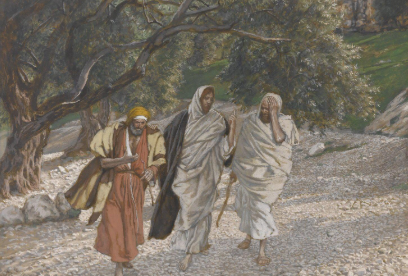
The first thing we will note in our reading is that two disciples are leaving Jerusalem. In spite of the Jesus’ resurrection prediction, and in spite of the women who reported that the angel said Jesus had risen, they are still leaving Jerusalem disbelieving and discouraged. This is a reminder to us of the human condition. Although we have the hindsight of knowing the ending, they didn’t. We could easily have been them. And it could be many people today.
The story is for all of us.
The Road to Emmaus… Luke 24:13-35
That very day, the first day of the week, two of Jesus' disciples were going to a village seven miles from Jerusalem called Emmaus, and they were conversing about all the things that had occurred.
And it happened that while they were conversing and debating, Jesus himself drew near and walked with them, but their eyes were prevented from recognizing him.
He asked them, "What are you discussing as you walk along?"
They stopped, looking downcast. One of them, named Cleopas, said to him in reply, "Are you the only visitor to Jerusalem who does not know of the things that have taken place there in these days?"
And he replied to them, "What sort of things?"
They said to him, "The things that happened to Jesus the Nazarene, who was a prophet mighty in deed and word before God and all the people, how our chief priests and rulers both handed him over to a sentence of death and crucified him. But we were hoping that he would be the one to redeem Israel; and besides all this, it is now the third day since this took place. Some women from our group, however, have astounded us: they were at the tomb early in the morning and did not find his body; they came back and reported that they had indeed seen a vision of angels who announced that he was alive. Then some of those with us went to the tomb and found things just as the women had described, but him they did not see."
And he said to them, "Oh, how foolish you are! How slow of heart to believe all that the prophets spoke! Was it not necessary that the Christ should suffer these things and enter into his glory?"
Then beginning with Moses and all the prophets, he interpreted to them what referred to him in all the Scriptures.
As they approached the village to which they were going, he gave the impression that he was going on farther. But they urged him, "Stay with us, for it is nearly evening and the day is almost over." So he went in to stay with them.
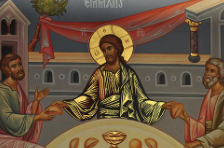
And it happened that, while he was with them at table, he took bread, said the blessing, broke it, and gave it to them. With that their eyes were opened and they recognized him, but he vanished from their sight.

Then they said to each other, "Were not our hearts burning within us while he spoke to us on the way and opened the Scriptures to us?"
So they set out at once and returned to Jerusalem where they found gathered together the eleven and those with them who were saying, "The Lord has truly been raised and has appeared to Simon!"
Then the two recounted what had taken place on the way and how he was made known to them in the breaking of bread.
Exegesis
And it happened that while they were conversing and debating, Jesus himself drew near and walked with them, but their eyes were prevented from recognizing him.
Was Jesus already unrecognizable only two days after they saw him last?
The key words are “kept from.” Some say they were kept from recognizing Jesus due to their lack of faith; others say Jesus simply did not allow them to recognize him; but in fact, these are one and the same. Faith in Jesus is necessary to experience Jesus; but also, if Jesus had kept them from recognizing him, it was because of their lack of faith.
Cleopas said to him in reply, "Are you the only visitor to Jerusalem who does not know of the things that have taken place there in these days?"
What is humorous about this statement?
Jesus happens to be the only person in Jerusalem (or in the world) who actually knows what happened!
Who is Cleopas?
We have a clue in the Gospel of John 19:25 where it says…
“Near the cross of Jesus stood his mother, his mother’s sister, Mary the wife of Cleopas, and Mary Magdalene.”
Mary’s sister is also Mary, and her husband is Cleopas. That would make him Jesus’ uncle. And if he was Jesus’ uncle, he was also probably a fairly prominent disciple. All the more surprising he would be leaving Jerusalem.
They said to him, "The things that happened to Jesus the Nazarene, who was a prophet mighty in deed…
Notice how much their view of Jesus had fallen already. Instead of the Messiah or Son of God, Jesus was now just another prophet. They had such high expectations and hopes and, even though the women had reported that angels had told them Jesus was alive, they were still leaving Jerusalem.
At this point, Jesus calls them out, saying how foolish they were being, “slow of heart to believe all the prophets spoke!” But then Jesus doesn’t leave them there; rather, he meets them exactly where they are – broken, sad, and doubting – and begins to take them forward. This is what God does. If we are willing to walk with Him, he will gladly take us by the hand, even if we are full of doubts.
Then beginning with Moses and all the prophets, he interpreted to them what referred to him in all the Scriptures.
Jesus is doing a Bible Study! This is where we learned how! Notice how he connects the Old Testament to the New Testament to connect the works of God from the beginning all the way to Jesus. I would give anything to have been walking along with those guys just to hear what he said.
But they urged him, "Stay with us, for… the day is almost over."
They were so spellbound, they didn’t want Jesus to leave them. As it should be.
When Jesus is “at table” with them, he takes the bread, blesses it, breaks it, and gives it to them.
Let’s look at what Jesus said earlier at the Last Supper in Luke 22:19…
He took the bread… he blessed the bread… he broke the bread… he gave it to them.
What was Jesus doing?
Jesus was focusing their attention on the way he was going to be with them from now on.
Back in Jerusalem – in the Upper Room – they told the other disciples what had happened…
“… how Jesus was made known to them in the breaking of the bread.”
In the first century, before it was called the Mass, it was called, “The Breaking of the Bread.”
It is true that Jesus in his glorified body could appear wherever and whenever he wanted – even in multiple places at once. And that is exactly what Jesus has been doing since then – in the Breaking of the Bread – in the Eucharist.
Let’s think about what took place. First, Jesus expounded on the Old Testament and connected it to him (the New Testament). Next they are at table for the “Breaking of the Bread.” It’s no accident that this is exactly how our Mass is structured today – the first part of the Mass is the Liturgy of the Word, and the second part the Liturgy of the Eucharist.
CCC #1346-1347
The liturgy of the Eucharist unfolds according to a fundamental structure which has been preserved throughout the centuries down to our own day. It displays two great parts that form a fundamental unity:
The gathering, the liturgy of the Word, with readings, homily and general intercessions;
The liturgy of the Eucharist, with the presentation of the bread and wine, the consecratory thanksgiving, and communion.
The liturgy of the Word and liturgy of the Eucharist together form "one single act of worship"; the Eucharistic table set for us is the table of both the Word of God and the Body of the Lord.
Is this not the same movement as the Breaking of the Bread the risen Jesus shared with his disciples? Walking with them he explained the Scriptures to them; sitting with them at table "he took bread, blessed, broke it, and gave it to them."
Bible Timeline/Covenants
Although we generally discuss 2 primary covenants – the Old Covenant and the New Covenant – the Bible can also be broken down into 6 family covenants for the human race.

Where we left off…
Introduction to The New Testament
How many books in the OT?
46
How many books in the NT?
27
Total in Bible: 46 + 27 = 73
As we move into the New Testament, we will not read all 27 books, but will continue the “Biblical Timeline Narrative,” which will primarily be the Gospel of Luke and the Acts of the Apostles, although other books will be referenced throughout. Much of today’s content was taken from the “Bible In A Year,” which does an excellent job at the Timeline Narrative.

New Testament Timeline
Roman Empire 63 BC to 476AD (539 years)

* For our studying of the New Testament, I will be following along Jeff Cavins’ “Bible in a Year” course, which I highly recommend.
The New Testament can be divided into two parts:
Part I – The Gospels: The Life of Christ
Part II – The Church: Acts of the Apostles, Letters, Revelation

Part I – The Gospels: The Life of Christ
Overview of the Life of Christ
After the Wise Men from the east visit Jerusalem and inform King Herod of the Star of Bethlehem and the prophecy of the new king, Herod dispatches his soldiers to Bethlehem to kill all the children under the age of two (recall the same thing with Moses). Warned in a dream, Joseph takes Mary and Jesus to Egypt. After another dream, the holy Family returns and settles in Nazareth. Thirty years later, Jesus public ministry begins with his Baptism in the Jordan. Jesus then spends 3½ years teaching, preaching, healing, and performing miracles in Judea and Galilee. However, his message of repentance and the arrival of the Kingdom of God threatens Jewish authorities who, rather than rejoicing at the coming of the long-awaited Davidic king and Messiah, pressure Pilate to condemn Jesus to death. Jesus offers his life as a willing sacrifice, atoning for sin, redeeming humans, and opening the gates of Heaven for everyone who wishes to follow him.
To simplify our exegesis of the Gospels, we will divide the life of Christ into four parts, like 4 Acts in a play.
Act 1 the historical setting into which the new Davidic king is born.
Act 2 Jesus’ public ministry and key aspects of his teaching throughout Judea and Galilee.
Act 3 Jesus’ passion and death, which climaxes and completes the story of Israel.
Act 4 Jesus resurrection, his encounter with the two disciples on the road to Emmaus, and his Ascension.
Act 1: A King is Born
The Roman Republic and Caesar Augustus
Herod the Great
Jesus’ Birth
The Ark of the New Covenant
Bible History Recap: In our Old Testament studies, we first saw Northern Israel fall to the Assyrian Empire 721 BC, then Southern Israel (Judah) fell to the Babylonian Empire in 597 BC, then in 539 BC the Persian Empire conquered the Babylonians, and then about 330 BC the Greeks conquered the Persians. Now come the Romans in the 2nd century BC who begin conquering Greek territories. Finally, in 63 BC, the Roman Republic, under Pompey the Great, conquered Israel (Judea) and took Jerusalem. This brings us to our present studies.
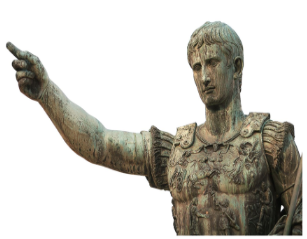
Caesar Augustus
44 BC: Julius Caesar is murdered on the Ides of March and his adopted son, Augustus, rises to power and ushers in the “Pax Romana,” an age of peace and prosperity that lasted roughly 200 years.
Augustus has Julius Ceaser proclaimed a god, which by default makes Augustus the “son of god.” This will cause problems later for Christians who call Jesus, “Son of God.”

2) Herod the Great, 71 BC – 4 BC
40 BC: Herod the Great – through marriage and manipulation – seeks to take over Judea and Samaria but is threatened by the Parthians, flees to Rome for help. He wins the support of Augustus and returns to Judea with Roman soldiers. In 37 BC, he conquered Jerusalem and assumes his responsibilities as the ruler of Judea, a ‘client-king’ of Rome.

This is not a flattering picture of Herod, but Herod hardly deserves one. For the Jews, the only thing worse than Augustus’ claim to divinity was the tyrant he set over them to keep them at peace by the point of the sword while taxing them into poverty. From Judea in the south to Galilee in the north, Herod ruled with an iron fist.
No one but the emperor possessed more wealth and engendered more fear than Herod, who was also perhaps the greatest builder and businessman in the first century. He built and dedicated three cities to Caesar Augustus, where he also built pagan temples for the imperial religions – Caesarea Maritime, Caesarea Philippi, and Caesarea - the capital of Samaria. He also greatly expanded the Temple in Jerusalem to win favor among the Jews. Herod was half-Jew, but he failed to meet any of the requirements for a Jewish king, principally to be of the line of David.
Herod had luxury palaces of unrivaled beauty throughout Israel. On his coins, Herod not only depicted himself as a priest-like king like Solomon, but it also included the Greek letter X (pronounced “chi,” signifying the Greek word Christos, meaning “Messiah.”
The one thing Herod did not possess was mercy. He was so ruthless that Augustus once quipped that it was safer to be Herod’s pig than his son. Examples: Herod had two of his most beloved sons and his favorite wife killed out of envy and paranoia, and he killed many who questioned his leadership or appeared to be a potential threat to his rule.
Once one understands Herod’s dangerous combination of ruthless power and boundless paranoia, it is not difficult to comprehend the Gospel of Matthew’s account of Herod slaughtering the innocent children of Bethlehem after the Magi informed him about the prophecy of the “new king” being born there.
Next month:
Act 1: A King is Born
The Roman Republic and Caesar Augustus
Herod the Great
Jesus’ Birth
The Ark of the New Covenant
Closing Prayer
Come, Holy Spirit
Fill the hearts of your faithful; kindle in them the fire of your love.
Send forth your Spirit and they shall be created.
And You will renew the face of the earth.
Hail Mary
Full of grace, the Lord is with thee.
Blessed are thou among women, and blessed is the fruit of thy womb, Jesus.
Holy Mary, Mother of God,
pray for us sinners now and at the hour of our death.
Amen.


Comments