9.15.26 | Gratitude | Laborers in the Vineyard | Evolution
Catholic Understanding & Biblical Defense Class 9/15/26
Every Tuesday, 7PM-8PM (EST), 🖥️Zoom ID: 861 1782 2081 🗝️Passcode: 406952
Join to receive notifications and study notes on Meetup: www.meetup.com/catholicbiblestudy
Past classes are posted on our Catholic Catacombs Website: www.CatholicCatacombs.org
House Rules and Catholic Resources…
1. RSVP Reminder: Please RSVP whether you are attending the meeting or just reading the Recaps afterwards. The more RSVPs, the more Meetup will give exposure to “Catholic Bible Study” – a good thing!
2. Questions. We encourage questions although we ask that you keep them on topic and brief. You can ask during the meeting, or in the chat box, or if you prefer you can email us through Meetup.com, or Ron directly: ron@hallagan.net.
3. Respectfulness. We will be discussing differences between Christian denominations and religions in general, and we seek to be respectful at all times. Protestants especially are our friends and brothers/sisters-in-Christ; in fact, I owe much of my return to Christianity to them. Therefore, any critique of our brethren is in loving pursuit of apostolic truth.
4. No politics. It would be easy for us to self-destruct, but that’s not our goal :). Our goal is to learn, understand, and apply the Bible and our faith to our everyday lives.
5. Word on Fire. Bishop Robert Barron has reached millions through his 10 min Sunday homilies, podcasts, educational series and certifications, bibles, and other lectures and apologetics. www.wordonfire.org
6. Hallow App. Daily prayers and reflections, especially for the high holyday seasons. www.alex@mail.hallow.com
7. Catholic Answers – www.catholic.com. Best site for Catholic Apologetics there is.
8. Dynamic Catholic. Interested in daily inspirations to grow closer to God and the Church, not to speak of the many educational resources? Sign up for Matthew Kelly’s powerful insights, quotes, and reflections at www.dynamiccatholic.com.
9. “The Chosen” TV series. All of us seek a relationship with Jesus Christ, which is not always easy. It can help if we have seen and heard Him. The Chosen series captures Jesus better than any show I have ever seen. Highly recommended.
10.Cursillo. Interested in meeting with other men or women weekly over coffee to discuss God in your personal and professional life? Join Cursillo (cur-see-yo). Contact Jennifer Pence (Jennifer.pence@gmail.com) for more information.
Bible Study Format

Each meeting is (roughly) as follows:
15 min Apologetic Reflection
15 min Upcoming Gospel Reading
30 min Weekly topic/theme
1 hour
Week 1: Gospel Week – we study several Gospel stories, especially the tough ones.
Week 2: Bible Week – we are working our way through the Bible. We are studying the New Testament.
Weeks 3 & 4: Survey Topics chosen by Members (explanations of our faith & apologetics):
1. Prison Ministry Stories 2. Plenary Indulgences 3. Gen 1-3 (Creation Story, Adam & Eve, the Fall of Man)
4. Faith vs Doubts – does having doubts make us bad Christians? 5. Explanation of the Mass & Eucharist
6. Dead Sea Scrolls 7. Catholicism vs modern cosmology and Evolution 8. Fruits of the HS, 7 Deadly Sins
9. How to experience the Love of God 10. The Communion of Saints
11. Comparative Religions 12. Catholic vs Protestant beliefs
· Don’t forget to RSVP.
· Taylor will send a link to everyone with today’s notes.
· The class is recorded if you want to listen to it anytime.
· I will occasionally ask for volunteer readers…
Opening Prayer
LORD, thank you for your promise that where two or three of us are gathered in your name, You are there.
We welcome You among us today!
We ask that You open our ears so that we hear your voice and receive your wisdom.
And as Jesus taught us to pray …
Our Father
Who art in Heaven, Hallowed be Thy Name.
Thy Kingdom come, Thy Will be done, on earth as it is in Heaven.
Give us this day our daily Bread;
And forgive us our trespasses as we forgive those who trespass against us.
And lead us not into temptation but deliver us from evil. Amen.
Major holy days: All Saints Day (Nov 1)
Memorials – September: Archangels Michael, Gabriel, Raphael-29
Memorials – October: Our Guardian Angels-2, Feast of Apostles/Saints Simon and Jude-28
www.masstimes.org: Mass or Confession anywhere/anytime in the world!
Today’s Agenda…
Reflection: The Virtue of Gratitude and the Vice of Ingratitude
Gospel Reading for 25th Sun in Ord Time 9/20: The Laborers in the Vineyard, Matthew 20:1-16
Topic: Catholicism vs Modern Cosmology and Evolution
Quote of the Week:
We must try to converse with God in little ways while we do our work; not necessarily in memorized prayer or trying to recite previously formed thoughts. Rather, try to purely and simply reveal our hearts as the words come to us. – Brother Lawrence, The Practice of the Presence of God, 1692.
Reflection: Gratitude and Ingratitude
As virtues go, gratitude is our unsung hero. The Roman philosopher Cicero called gratitude not only the greatest of all the virtues but the parent of all the others.
Gratitude is the beginning of humility, and we all know how big Jesus was on humility. Without humility, there can be no love. To truly love (agape love) is to desire the good of another – the opposite of selfishness, which is humility.
So, without humility there can be no love, and without love we cannot receive forgiveness; and without forgiveness we cannot enter Heaven. Alternatively, self-centeredness has no space or tolerance for gratitude. The “vice of ingratitude” is actually at the core of narcissism and stems from a deep sense of entitlement and a lack of empathy.
“Ingratitude has never entered Heaven.” – St. Margaret Mary
What about wisdom? Are wisdom and intelligence related?
Intelligence is nice, but intelligence can be used for good or evil. Hitler was intelligent. What turns our intelligence into wisdom is when by also possessing gratitude and humility, since both these characteristics express love of neighbor. When intelligence is grounded in gratitude, humility, and love of neighbor, it elevates into wisdom.
How do we increase our humility?
By learning to become grateful, for gratitude requires that we look outside our own egos to acknowledge and appreciate people and circumstances in our lives that we would otherwise take for granted.
Gratitude also leads us to happiness. An old proverb goes like this:
I never knew a person who was grateful and unhappy, or a person who was ungrateful and happy. Grateful people take little for granted and always feel blessed. Ungrateful people take everything for granted and feel resentment for those things which they believe they deserved but did not get.
Remember we said gratitude was our unsung hero? It’s the secret sauce! It is so important that many people keep a gratitude list, and they review it and update it nightly, often sharing it with others who are keeping their own gratitude lists. This is a great habit to practice because gratitude doesn’t happen by itself. Gratitude requires intentionality.
So, keeping a list and continually reminding yourself of what you have to be grateful for slowly changes your heart and your world view, so that you are able to start receiving all these other qualities: humility, wisdom, happiness, and Heaven.
Matthew 20:1-16
The Laborers in the Vineyard

Context:
The chapter previous to this had the story of the Rich Young Man. When Jesus told him to sell all his riches, give it to the poor, and follow him, he “went away saddened, for he had many riches.” Then Jesus told his disciples it was harder for a rich man to enter heaven than for a camel to pass through the eye of a needle. This stunned everyone, because at the time Jews presumed financial success was from God. As we know, money, like power, fame, and everything else, can be used for good or evil; Jesus’ point is about priorities: if you are attached to your riches more than you are attached to God, then you won’t make it.
Anyway, after Jesus’ comment, Peter speaks up and says, ‘What about us? We gave up everything for you.’
Although Peter’s question sounds a little reward-focused, his question was not an unfair one. Jewish tradition had always taught that God had especially blessed rich men and that was why they were rich. In their way of thinking, if a wealthy man could not receive salvation, then how could a poor man have any hope? That is the context of Peter’s question.
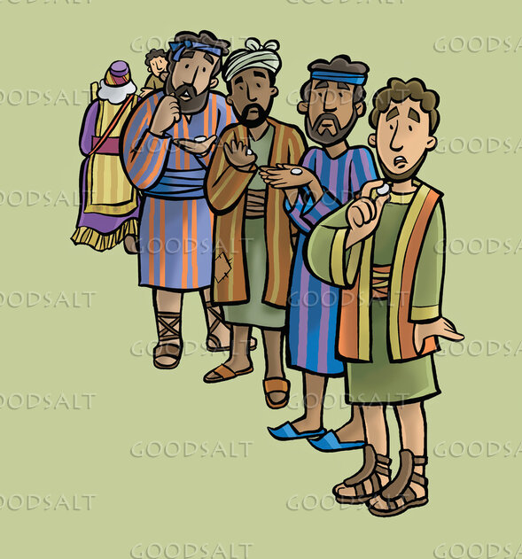
In response, Jesus tells another “Kingdom Parable.” It’s about a landowner who hires workers for his vineyard at different times of the day—some early in the morning, others at nine, noon, three, and even five o’clock. However, at the end of the day, he gives every worker the same wage! As you can imagine, this caused a lot of negative reactions.
For this story, it’s helpful to know something about Jewish law and daily labor in Jesus’ time. Many poor people survived as day laborers. They would gather early in the marketplace hoping someone would hire them. If they were not hired, their families might have little or nothing to eat that evening.
The Law of Moses specifically protected such workers. Leviticus 19:13 commands that the wages of a hired worker should not be held overnight. Deuteronomy 24:14–15 goes even further: a poor laborer must be paid before sunset because he depends on that wage for his daily needs. Thus, paying a worker at the end of the day was not merely good business practice; it was also a religious obligation rooted in justice.
The landowner in Jesus’ parable fulfills that obligation, but then he does something surprising: he gives the workers hired at the last hour the same amount as those who worked all day. Remember, when Jesus puts an unusual or strange twist in a story, that’s key to a hidden message; so is his very last statement:
“Many who are first shall be last, and the last shall be first.”

Matthew 20:1-16
Jesus told his disciples this parable:
"The kingdom of heaven is like a landowner who went out at dawn to hire laborers for his vineyard.
After agreeing with them for the usual daily wage, he sent them into his vineyard.
Going out about nine o'clock, the landowner saw others standing idle in the marketplace, and he said to them, 'You too go into my vineyard, and I will give you what is just.' So they went off.
And he went out again around noon, and around three o'clock, and did likewise.
Going out about five o'clock, the landowner found others standing around, and said to them, 'Why do you stand here idle all day?'
They answered, 'Because no one has hired us.' He said to them, 'You too go into my vineyard.'
When it was evening the owner of the vineyard said to his foreman, 'Summon the laborers and give them their pay, beginning with the last and ending with the first.'
When those who had started about five o'clock came, each received the usual daily wage. So when the first came, they thought that they would receive more, but each of them also got the usual wage. And on receiving it they grumbled against the landowner, saying, 'These last ones worked only one hour,and you have made them equal to us, who bore the day's burden and the heat.'
He said to one of them in reply, 'My friend, I am not cheating you. Did you not agree with me for the usual daily wage? Take what is yours and go. What if I wish to give this last one the same as you? Or am I not free to do as I wish with my own money? Are you envious because I am generous?'
Thus, the last will be first, and the first will be last."

Exegesis (Investigation/Interpretation)
They didn’t have exterior lighting in those days so work usually ended at sundown, which is 6:00 pm in our story. That would mean the last laborers that were hired only worked for one hour.
What does the vineyard represent?
In Old Covenant language, the vineyard symbolically referred to God’s chosen people of Israel. However, since Jesus is speaking about the Kingdom of Heaven (which he came to bring about), it also represents the New Covenant people – the apostles, the Gentiles, and all of us here tonight.
Said differently, the laborers in the vineyard are the people whom God has called to help save humanity. Not just priests, prophets, and saints, but all of us in whatever our walk of life happens to be. We all have a role in this.
Who is the landowner (also called the master of the house and Lord of the vineyard)?
God…
What is the wage being paid?
The wage is salvation.
Who is the foreman who pays the promised wage for their service?
Jesus. He actually already paid for the wage (salvation) on the cross, so that the Father could give it away freely.
As St. Paul said:
There is no salvation through anyone else, nor is there any other name under heaven given to the human race by which we are to be saved. – Acts 4:12
What do the different hours of the day that the laborers enter the vineyard represent?
Two things (kind of one):
1) The people of God entering into His service throughout Salvation history.
2) Each of us entering into relationship with God at different times of our lives, right up to the last moment.
Who do the grumbling workers who were in the vineyard longer represent?
Initially, it would represent Israel's view of the Gentiles being let in after all their years of service. However, it now also applies to any Christian who feels they deserve more than others who seemed less holy, etc.
It is to all the grumblers that Jesus addresses his quote:
“Thus, the last will be first, and the first will be last.”
As soon as we feel we are better than others, we spiritually move down a notch.

Interestingly, this last statement of Jesus’ seems to suggest the grumblers can still make it into Heaven; just that they will be last instead of first.
What might it mean to be first or last in Heaven? For example, Mother Teresa and the thief on the cross both went to Heaven, which perfectly fits the earliest and latest laborers in the parable. Do they receive the same?
They receive the same wage of salvation, which is what truly matters. However, Jesus alludes to greater and lesser rewards in Heaven elsewhere. Thomas Aquinas said that while all those who receive salvation are saved, there will also be a diversity of enjoyment. In other words, heaven is granted to everyone who is in Christ, but the more virtuous will derive greater pleasure from it.
In Dante’s Divine Comedy, when Dante is touring Heaven, he asks this very question of his lady tour guide. It is explained to him via an analogy: everyone has a different sized vase of grace/joy within them. Some vases are larger than others, some are only the size of thimbles. But every one of them is overflowing with joy. You can’t fit any more happiness and joy in any of them if you tried, because they are already overflowing.
Dante asks, “But won’t those with the smaller vases wish they could have the same vases as the those with larger ones?
His tour guide looks at Dante and then responds, “Dante, there is no envy in Heaven.”
Here’s a brief recap of the parable meanings for those interested:

Catholicism and Evolution
Evolution and Genesis 1–3: A Catholic Understanding
The Catholic Church teaches that faith in God as Creator is compatible with the scientific theory of evolution, provided evolution is not understood as excluding God or reducing human beings to merely material organisms. Genesis 1–3 and evolutionary science answer different kinds of questions. Science investigates processes within the natural world; Genesis reveals the world’s origin, meaning, goodness, and relationship to God.
Genesis begins by proclaiming that God created “the heavens and the earth.” Its central message is 1) that everything ultimately depends upon God and 2) that all creation is good. The repeated statement that “God saw that it was good” throughout Genesis 1 tells us that the universe is not divine, not accidental in its origin, and not morally evil. Pope John Paul II reiterates this, calling Genesis 1 a hymn of religious significance that points to God as the only Lord and celebrates the goodness of everything he has made.
Evolution describes how living things may develop through natural processes over immense periods of time. It does not, by itself, answer why anything exists, why the universe is intelligible, or why creation possesses value. A Catholic may therefore accept evolutionary explanations while affirming that God creates and sustains the universe. God can work through secondary causes – natural processes that themselves depend upon him.
Human beings require particular care in this discussion, especially our spirituality. Catholic teaching allows the possibility that the human body developed from pre-existing living matter, but insists that each human’s spiritual soul is created by God. The “human person” is not just an advanced animal or some temporary arrangement of matter. We are created in God’s image and we are given a unique dignity, a spiritual soul, a spiritual intellect, and free-will.
Genesis also teaches truths that evolutionary biology cannot establish or disprove. The Catechism identifies Genesis 1–3 as expressing the origin and goodness of creation, the vocation of humanity, friendship with God, the drama of sin, and the hope of salvation. Consequently, these chapters cannot be reduced to merely a scientific account. They communicate real theological truths about creation, humanity, the Fall, and our need for redemption.
In summary, evolution can describe a natural process; Genesis reveals the Creator, the purpose of creation, and the dignity and fallen condition of the human person. Properly understood, science and faith never contradict one another, because truth cannot ultimately contradict truth.
Are there scenarios that could explain or connect Genesis to the current evolutionary timeline?
Sure. We should start with Genesis 2:7 that says two things of note:
1) God formed man from the dust of the earth. This would refer to the fact that man comes from the earth. In fact, “Adam” means earth/ground/soil. That we evolved on this planet fits this statement.
2) Secondly, God breathed life into man, which nearly all theologians (Jewish and Christian) have held to mean eternal life (an immortal soul). This is when we gained a spiritual nature, making us in the image of God. It is not our earthly/animal nature (#1) that makes us in God’s image, but our spiritual nature.
What did our spiritual natures give us?
Characteristics of God. Usually, they are categorized as a spiritual soul, intellect, and free-will. However, these have subcategories, such as:
- An immortal soul, which makes this life temporal. We will live beyond this life and even get our bodies back at judgment day.
- Our higher intellect gives us a grasp of abstraction, which includes math, theorizing (“what ifs?”), and thinking in terms of time (past, present, future).
- The ability to create.
- The ability to grasp/appreciate beauty.
- Understanding right and wrong/good and evil, and the free-will to make (moral) choices between them.
- The ability to choose to override our lower animal instincts.
When would these events likely to have happened?
According to evolutionary theory, modern humans have been evolving/developing for about 300,000 years. If this is accurate, then that would be the answer to the development of our lower/animal natures.
As for when God breathed a spiritual nature into us, the general consensus would be the Upper Paleolithic period, which started about 50,000-65,000 years ago. The reason for this is that this period showed the most amazing visible leaps in human thinking; so much so that this time period is referred to as the “Great Leap Forward.”
During this era, human behavior and innovation changed faster than at any previous time in history. Homo sapiens transitioned to higher behavioral complexity and developed advanced survival and artistic tools.

Examples of Key Advancements during the Great Leap Forward
Advanced Weaponry: Humans invented complex projectile tools like bows, spear-throwers, and multi-piece weapons that allowed hunting from a safe distance.
Fine Crafting and Clothing: The invention of sewing needles enabled the creation of fitted, sewn clothing for better climate adaptation, alongside the use of ceramics and fishhooks.
Art and Expression: Early humans produced striking representational art, including cave paintings, ivory statues, lion-headed idols, and preserved jewelry.
Early Music: The creation of bird-bone flutes provided some of the earliest evidence of musical expression.
Seafaring and Migration: Humans built early watercraft and seafaring vessels, allowing them to successfully cross open water and colonize Australia and New Guinea.
Standardized Tools: Toolmaking shifted from simple, rough stones to standardized, multi-purpose bone and stone artifacts.
Was there enough time for the human population that ultimately developed to derive from single ensouled parents from 50-65,000 BC?
Yes, easily, and it has been mathematically proven.
Closing Prayer
Lord Jesus
We thank you for the blessing of reading your word together.
We ask that these words of life, truth and hope enlighten our minds and strengthen our faith.
May your love and grace follow each of us as we return to our daily lives, refreshed and blessed by you.
We ask all this in your name.
Hail Mary, full of grace,
the Lord is with thee.
Blessed are thou among women,
and blessed is the fruit of thy womb, Jesus.
Holy Mary, Mother of God,
pray for us sinners,
now and at the our of our death.
Amen


Comments