4.21.26 - The Good Shepherd and The Mass Explained
- tmaley
- Apr 24
- 14 min read
Catholic Understanding & Biblical Defense Class 4/21/26
Every Tuesday, 7PM-8PM (EST), on Meetup: www.meetup.com/catholicbiblestudy
Past classes are posted on our Catholic Catacombs Website: www.CatholicCatacombs.org
House Rules and Catholic Resources…
RSVP Reminder: Please RSVP whether you are attending the meeting or just reading the Recaps afterwards. The more RSVPs, the more Meetup will give exposure to “Catholic Bible Study” – a good thing!
Questions. We encourage questions although we ask that you keep them on topic and brief. You can ask during the meeting, or in the chat box, or if you prefer you can email us through Meetup.com, or Ron directly: ron@hallagan.net.
Respectfulness. We will be discussing differences between Christian denominations and religions in general, and we seek to be respectful at all times. Protestants especially are our friends and brothers/sisters-in-Christ; in fact, I owe much of my return to Christianity to them. Therefore, any critique of our brethren is in loving pursuit of apostolic truth.
No politics. It would be easy for us to self-destruct, but that’s not our goal :). Our goal is to learn, understand, and apply the Bible and our Catholic faith to our everyday lives.
Word on Fire. Bishop Robert Barron has reached millions through his 10 min Sunday homilies, podcasts, educational series and certifications, bibles, and other lectures and apologetics. www.wordonfire.org
Hallow App. Daily prayers and reflections, especially for the high holyday seasons. www.alex@mail.hallow.com
Catholic Answers – www.catholic.com. Best site for Catholic Apologetics there is.
Dynamic Catholic. Interested in daily inspirations to grow closer to God and the Church, not to speak of the many educational resources? Sign up for Matthew Kelly’s powerful insights, quotes, and reflections at www.dynamiccatholic.com.
“The Chosen” TV series. All of us seek a relationship with Jesus Christ, which is not always easy. It can help if we have seen and heard Him. The Chosen series captures Jesus better than any show I have ever seen. Highly recommended.
Cursillo. Interested in meeting weekly over coffee to discuss how God is involved in your personal and professional life? Join Cursillo (cur-see-yo). Initiation involves a 3-day retreat at Mission Hurst in Arlington. For men’s groups, contact Ron (ron@hallagan.net) and Jennifer Pence (Jennifer.pence@gmail.com) for women’s groups.
Online- Catholic Prayer & Fellowship. Are you interested in praying the rosary, etc. with other Catholics during the week? Follow fellow member Jason Goldberg. Link: https://www.meetup.com/online-catholic-prayer-and-fellowship/
Our Bible Study is a combination of Exegesis and Apologetics.
Study and interpretation of Scripture A reasoned defense of the faith
Each meeting is (roughly) as follows:
min Apologetic Reflection
min Upcoming Gospel Reading
30 min Weekly topic/theme
1 hour
Week 1: Gospel Week – we study several Gospel stories, especially the tough ones.
Week 2: Bible Week – we are working our way through the Bible. We are studying the New Testament.
Week 3: Questions and Survey Topics chosen by Members:
1. Prison Ministry Stories 2. Plenary Indulgences 3. Explanation of the Mass and Eucharist 4. Dead Sea Scrolls 5. Catholicism vs modern cosmology? 6. The 7 Gifts/Fruits of the HS, 7 Deadly Sins 7. How to experience the Love of God 8. The Communion of Saints 9. Comparative Religions 10. Catholic vs Protestant beliefs
Week 4: Apologetics:
Gen 1-3 (Creation Story, Adam & Eve, the Fall of Man, The Meaning of Eve/the Trees/Summary)
Faith vs Doubt – is having doubts bad?
Don’t forget to RSVP.
Taylor will send a link to everyone with today’s notes.
The class is recorded if you want to listen to it anytime.
I will ask for volunteer readers… Mo-puppy mascot
Opening Prayer
Lord, in your great generosity, heal our spiritual and physical sickness so we can serve you better.
May we receive the Bread of angels, the King of kings and Lord of lords, with the purity and faith …
That will bring us to salvation.
As Jesus taught us to pray… together
Our Father Who art in Heaven, Hallowed be Thy Name.
Thy Kingdom come, Thy Will be done, on earth as it is in Heaven.
Give us this day our daily Bread;
And forgive us our trespasses as we forgive those who trespass against us.
And lead us not into temptation but deliver us from evil. Amen.
Major holy days: The Lord is Risen! We are in the Easter Season.
The Ascension of the Lord – Thurs, May 14 and Sun, May 17
Pentecost – Sunday, May 24
Mass or Confession anywhere/anytime: www.masstimes.org
TODAY:
Reflection: Humility: Jesus’ log hyperbole
Reading for The 4h Sun of Easter (4/26), Jesus the Good Shepherd, John 10:1-10
Member Topic: The Mass and Eucharist
Quote/Prayer of the Week
Metanoia – to turn around internally, towards God. It means to repent.
To repent is not to look down at my own shortcomings, but upwards at God’s love; it is not to look backwards with self-reproach but forward with trustfulness; it is to see not what I have failed to be, but what by the grace of God I might yet become. – St. John Climacus

Reflection: Jesus uses the LOG hyperbole to expertly make a point, so that his hearers wouldn’t forget:
How can you say to your brother, ‘Brother, let me remove that splinter in your eye,’ when you do not even notice the wooden beam in your own eye? You hypocrite! Remove the wooden beam from your eye first; then you will see clearly to remove the splinter in your brother’s eye.’ – Matthew 7:3-5
As usual, Jesus is talking about the ever-important virtue of humility vs the human tendency to self-importance. Practicing humility isn’t easy but it’s the one of the most important things you can do in your spiritual life. The last thing Jesus did at the Last Supper before he died was wash his disciple’s feet. That was a servant’s job. If God can be humble, we need to try.
In a room full of people there is one person who is arrogant and condescending. Who is usually the last person to know?
The person who is condescending or arrogant is always the last to know. That’s how self-blinding pride is.
Pride – the highest of the 7 Deadly Sins and the root cause of most others. It means failing in self-criticism and abounding in self-praise.
How can we know if it is us that has a log in our eye?
Humility takes intention and practice. You might start by asking yourself who is sitting on your inner throne, your ego or the Lord? Then bring the same question to the Lord. You will usually get your answer. You can also ask a friend or spouse.
Perceptions – when we communicate, we usually think that our message is clear and correct, even when it is not. I also learned this the hard way. As time when on, I learned to change the way I managed people. I began to teach my managers that their employees’ perceptions of them were often more accurate than their perceptions of themselves. When coaching employees, I had them ask their employees to repeat what they had just been coached on. Every manager was stunned to learn that what the employees repeated was seldom what they said, or what they thought they said. I explained how critical this was since what the employee understood when they walked out that door immediately became reality in the workplace. We then began to use this as a tool to improve communications. When their perception and the employee’s perception matched, it was success! Suddenly, the managers were 5X more effective in their jobs, and their jobs got easier, due to more unified teamwork and less unintended mistakes.
Conclusion: We own the perceptions we create. It’s a humbling responsibility to accept, but very rewarding in the long run.
Jesus the Good Shepherd or The Shepherd and the Gate, John 10:1-10

Context
At first reading of today’s passage, one might ask, “What the heck is Jesus talking about?” We can kind of get it, but is there really more to what he is saying?
Yes, there is. Let’s set the stage…
Jesus talks about a “sheepfold.” What is that?
In the first century AD, a sheepfold was a stone enclosure to keep sheep safe, particularly in villages or towns where shepherds were visiting or passing through; it was a place they could keep their sheep overnight. Sheepfolds typically had 1 gate and 1 gatekeeper (see picture above). Sheepfolds were necessary because sheep were a valuable commodity in those days; one always had to be on the lookout for thieves.
Sheepfolds were also communal as more than one shepherd might be passing through; in these cases, the sheep were comingled for the night. This comingling was possible because sheep knew their shepherds. Sometimes shepherds gave names to their sheep, but regardless the sheep recognized their voices when they called out to them.
Was there a historical-biblical connection to Jesus’ sheep story?
Indeed, there was a plethora of key players in the Bible who were shepherds, such as Abel, Abraham, Jacob, Moses, David, and the prophet Amos. But more to the point are the many references connecting the LORD himself to sheep and shepherding, such as in Psalm 23 (The LORD is my Shepherd), Isaiah 40 (the LORD carrying lambs close to his heart), Ezekiel 34 (God promises to seek out his scattered flock), and others. We will read the passage from Ezekiel since it ties in directly with our Gospel reading.
Once again, we find Jesus connecting dots and fulfilling, completing, and elevating everything that came before.
Jesus the Good Shepherd/The Shepherd and the Gate
John 10:1-10
Jesus said:
"Amen, amen, I say to you, whoever does not enter a sheepfold through the gate but climbs over elsewhere is a thief and a robber.
But whoever enters through the gate is the shepherd of the sheep. The gatekeeper opens it for him, and the sheep hear his voice, as the shepherd calls his own sheep by name and leads them out. When he has driven out all his own, he walks ahead of them, and the sheep follow him, because they recognize his voice. But they will not follow a stranger; they will run away from him, because they do not recognize the voice of strangers."
Although Jesus used this figure of speech, the Pharisees did not understand what he was trying to tell them. So Jesus said again,
"Amen, amen, I say to you, I am the gate for the sheep. All who came before me are thieves and robbers, but the sheep did not listen to them. I am the gate. Whoever enters through me will be saved, and will come in and go out and find pasture. A thief comes only to steal and slaughter and destroy; I came so that they might have life and have it more abundantly."

Exegesis (Study/Interpretation/Explanation)
What does the sheepfold represent?
The world.
Jesus says the true shepherd leads the sheep out to pasture. What does the pasture represent?
Heaven. Salvation.
I’m confused. Is Jesus the true shepherd or is Jesus the gate?
Both. He came to shepherd (lead) us back to Heaven. And it is through Jesus (the gate) that we can enter Heaven.
Jesus also says whoever enters the sheepfold through the gate is the true shepherd (v.2). Jesus enters through the gate because he is from Heaven.
Jesus references thieves and robbers (bad shepherds). Let’s see if Ezekiel 34 can help us decipher this.
Ezekiel 34:2-7,112
Prophesy against the shepherds of Israel and say to them:
Thus says the Lord GOD: Woe to the shepherds of Israel who have been pasturing themselves! Should not the shepherds pasture the flock? You eat the curds, clothe yourselves with the wool, and slaughtered the fattened sheep, but you do not feed the flock.
You did not strengthen the weak, nor heal the sick, nor bind up the injured. You did not bring back the strays, or search for the lost. Instead, you have ruled them with violence and cruelty. So they were scattered for lack of a shepherd, and when they were scattered they became food for the wild beasts. My flock went astray on all the mountains and every high hill.
As I live—oracle of the Lord GOD—hear the word of the LORD:
Behold, I am coming after these shepherds. I will take my sheep out of their hand and put a stop to their shepherding my flock, so that these shepherds will no longer pasture them. I will deliver my flock from their mouths so that they may no longer be food for them… I will rescue them from all the places to which they were scattered on a day of clouds and darkness.
Two points from this Ezekiel passage:
1) God is talking about the bad temple priests and bad leaders in Jerusalem, not only in Jesus’ time but for the last 900 years since Solomon. If you remember our chart of Northern and Southern kings, 75% of them were bad. Now Jesus is talking directly to the Pharisees and Sadducees! No wonder they feel threatened and want to get rid of him.
2) In this Messianic prophesy, the passage is saying that God Himself is coming! Perhaps the Jews thought this meant God would be acting through the Messiah, but nobody figured that the Messiah would be God Himself. That’s why Jesus was such an enigma. Many thought there would be a Kingly Messiah, a Priestly Messiah, even a Suffering Messiah based on the prophesies, but Jesus turned out to be all of these. Not only that, but he was also God, satisfying prophesies like this one in Ezekiel! This was the second reason to get rid of Jesus – blasphemy: he was claiming to be God.
Note the last verse from Ezekiel says God will rescue them “on a day of clouds and darkness”? What does this mean?
Good Friday, the moment that Jesus died. His mission is accomplished.

The Mass Explained
Sources: “The Mass Explained” (Dr. Brant Petri), “Catholic Mass 101” (Fr. Mike Schmitz), “Rediscover Catholicism” (Matt Kelly)

The Mass can be broken down into FOUR parts:
Introductory Rites: Entrance, Procession, Penitential Rite, Gloria, Opening Prayer
Liturgy of the Word: Scripture Readings, Homily, Profession of Faith, General Intercessions, The Collection
Liturgy of the Eucharist: Offertory, Eucharistic Prayer, Consecration, Lord’s Prayer, Sign of Peace, Communion
Closing Rites: Final Blessing, The Dismissal
Entrance
Holy Water at the entrance is a sign of baptism renewal. Baptism is the entry into the family of God. Baptism comes with Sanctifying Grace, which is access to Heaven. The blessing with holy water is our reminder of that grace that sanctifies us and stays with us.
Tabernacle – where the Bread of Life – Jesus – is. We look for that as we genuflect and enter our pews. To genuflect means to bend the knee to God (Romans 14:11). It is saying, “Lord, you are God, and I’m not. I am at your service.” Just as a man bends the knee to his bride in offering his life to her, we do this for God as the staple of our lives.
Sign of the cross – the sign of the Trinity. When we sign the cross, we invite the Trinity to be with us. It has other meanings (below).
The sign of the cross is sometimes called a “Catholic” thing – something unbiblical that Catholics just made up. Is this true?
No.
How did the sign of the cross begin?
During the first 3 centuries after Christ, Christians were severely persecuted in the Roman Empire. The mark of the cross on the forehead with the thumb was a signal of belonging to Christ. After the legalization of Christianity in the 4th century, if developed in to the larger gesture it is today.
It also has Scriptural support. For example, in the Gospel of Mark, Jesus referred to his baptism as his death on the cross:
Jesus asked the disciples, "Can you drink the cup I drink or be baptized with the baptism I am baptized with?" referring to his forthcoming suffering and crucifixion. (Mk 10:38-38)
Jesus says, "I have a baptism to undergo, and what constraint I am under until it is completed!"—a clear reference to the constraint to reach the cross. (Luke 12:50)
Paul explains that believers are "baptized into his death," connecting the act of baptism directly with being united in Christ’s death and resurrection. (Romans 6:3-4)
The cross is what made our Baptism real; not just symbolic, but sacramental. So the cross is closely connected to Baptism.
Then, just before Jesus ascended back to Heaven, he instructed the Apostles to baptize everyone “in the name of the Father, and of the Son, and of the Holy Spirit” (Mt 28:19). So Baptism is connected to the Trinity.
The Sign of the Cross, then, connects us to Jesus death on the cross, our baptism into the family of God, and the Blessed Trinity. If the first-century persecuted Christians had to come up with a way to communicate without attracting a Roman death squad, I think the sign of the cross on the forehead was absolutely brilliant.
We come to our pews, genuflect (bow), kneel, and pray. Genuflecting and kneeling are an expression of worship, which comes from the word “worth-ship,” meaning that which we value the highest in life. At the same time, worship means we seek to be “worthy” of God’s friendship.
As Christians we are baptized into the “lay-priesthood,” which means we join the priest at Mass in offering God our worship, ourselves, and, most of all, attaching ourselves, our lives, our successes, and our failures to Jesus’ sacrifice on the cross. When we kneel and pray, we are saying, “Lord, prepare my heart to be worthy of Your praise and sacrifice! I come in need of Your grace. Fill me with Your presence today!”
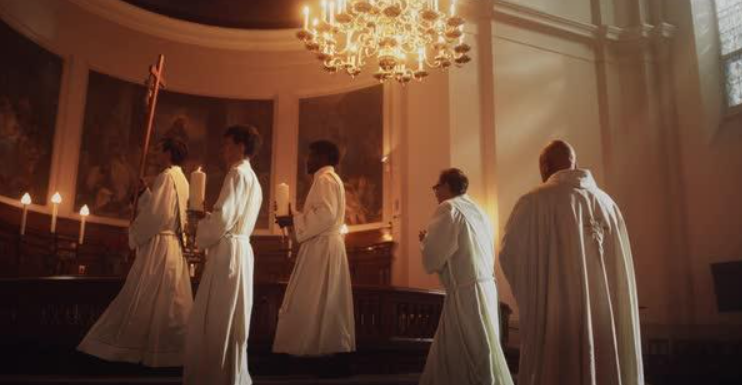
The Procession. “Procession” represents a pilgrimage, because every Christian life is a pilgrimage. We are going from somewhere to somewhere. Outside is the world we leave behind. Ahead of us is the altar, the source and summit of our existence: our forgiveness, our hope, our love, our guide, our grace, and our peace.
Priest arrives at the altar. The altar is both the place of Jesus’ sacrifice – the cross – and Last Supper, and therefore the altar represents Jesus himself. That’s the reason the priest kisses the altar.

The priest and congregation make the sign of the cross together. The sign of the cross has three meanings.
The primary and obvious meeting is the Trinity. When we make the sign of the cross, we are both blessing ourselves and inviting the Trinity to be part of our journey.
The second meaning is that when we trace the cross on ourselves, we are acknowledging the price God paid to win us back. Each one of us. He laid down his earthly life to win YOU and ME back. That makes the sign of the cross and a sign of love.
Third, making the sign of the cross restates our purpose in life, which is to know Him (when we touch our foreheads), to love Him (when we touch our hearts), and to serve Him in this life (which takes both our arms and hands) so that we can live with Him forever in the next.

Priest: “The Lord be with you”… a greeting repeated in the OT and NT, often one from a messenger of the Lord – an angel or prophet – who has come to someone with some calling that was bigger than them.
Us: “And with your spirit.” … speaking to someone’s spirit points to the most personal level of the person’s being and, in this case, to the gift of the Holy Spirit that is connected with the priesthood, especially in saying the Mass, since the priest is standing in for Jesus Christ. This is an ancient response to “The Lord be with you” and it recognizes that the greeting is not self-originating, but comes from the Lord and is carried to the people in the Spirit. We are linking in communion to one another!
Penitential Rite… The Church calls us to take off the mask and acknowledge that we may be wounded, we are not perfect. But we are not just standing there saying I am a sinner, but that I have a Savior, Jesus Christ, who both forgives and binds wounds. I am wounded but I am forever loved. So in this prayer, we are asking God to meet us in our brokenness and give us His mercy.
Lord have mercy, Christ have mercy, Lord have mercy…
Gloria – remember, Mass is primarily our opportunity to focus on God more than ourselves. That’s because God is our highest reality and our highest goal. Our target is not ourselves, our target is God, so we want to raise our minds, our hearts, our souls, and our lives to Him. The Gloria does just this. Immerse yourself into it:
Glory to God in the highest and on earth peace to people of good will!
Where does this opening line from the Gloria come from in Scripture?
It was what the host of angels sang out when they appeared to the nearby shepherds on Christmas Day.
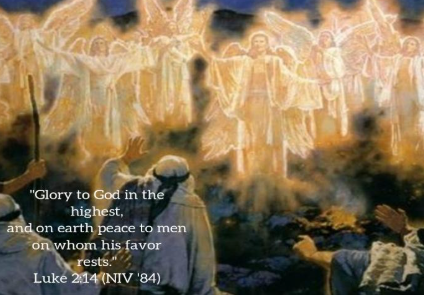
Opening Prayer said by the priest – these prayers are not randomly chosen. They are carefully selected to let us know what we are about to do. Think about this when you hear these words as it helps prepare your mind and heart for the rest of the Mass.
Together we say “Amen” at the end of the prayer.
“Amen” is not just a cute little finish. What does Amen mean?
It means, “So be it!” It is our affirmation and commitment to all that was just said.
The Liturgy of the WORD is about to begin.
If your pew doesn’t have the monthly mass booklet, bring your own missal and pray along with the Mass.

Next Month: Mass Part II – The Liturgy of the Word
Scripture Readings
Homily
Profession of Faith
General Intercessions
The Collection
Closing Prayer
Psalm 23
The LORD is my shepherd; there is nothing I lack.
In green pastures he makes me lie down;
to still waters he leads me; he restores my soul.
He guides me along right paths for the sake of his name.
Even though I walk through the valley of the shadow of death,
I will fear no evil, for you are with me;
your rod and your staff comfort me.
You set a table before me in front of my enemies;
You anoint my head with oil; my cup overflows.
Indeed, goodness and mercy will pursue me all the days of my life;
I will dwell in the house of the LORD for endless days.
Maranatha – Come Lord Jesus, enter, and make your home in me.


Comments