4.1.25 | Gospel Night | Woman Caught in Adultery
- tmaley
- Apr 1, 2025
- 11 min read
Opening Prayer
Lord Jesus Christ, Logos, 2nd Person of the Trinity, and Son of the Father
Teach us today the way you taught your first disciples
Such as you did with the woman caught in adultery.
Enlighten us with your wisdom and truth so that we may understand
and live according to Your holy, perfect, and loving will.
And as you taught us to pray together…
Our Father who art in heaven, hallowed be your name.
Your kingdom come, your will be done, on earth as it is in heaven.
Give us this day our daily bread,
And forgive us our trespasses as we forgive those who have trespassed against us.
And lead us not into temptation, but deliver us from evil.
Upcoming major holy days: Lent Wednesday, March 5 – Thursday, April 17
Paschal Triduum (Last Supper to Easter Vespers) April 17-20
Today’s Agenda
1. Lent reflection – Managing our “Second” Thoughts
2. Gospel Reading for 5th Sun in Lent (Apr 6): The Authorities and the Woman Caught in Adultery, John 8:1-11
Quote of the Week:
Like God, Heaven is pure love and therefore all self-giving. Everyone receives everything but at the same time we lovingly will give it all away. Outside of this reality is Hell – the exact opposite, no giving away – where we are prisoners of the self. – from C.S. Lewis
What is humility?
Dictionary – Courteously respectful. Not proud or arrogant. Humble.
C.S. Lewis – “It’s not thinking less of yourself but thinking of yourself less often.”
Jesus – Wherever you go, take the least seat in the house… (internally and externally; metaphorically and literally).
LENT = New Beginnings

Lent is living out Jesus’ 40 days of worldly subjugation in our own lives.
Lenten Reflection: Managing our “Second” Thoughts
Lent is about practicing and mastering new behavior. In this regard, I once read where we must learn to take responsibility for our second thoughts before we speak or act.
What the heck does “second thoughts” mean?
We all have our initial reactions to things, and they are not always good, whether they are from our own brokenness or preconceived notions – or from the devil feeding us bad information. Our first thoughts could be “I want to pop that man or woman in the nose,” or “That was the stupidest thing I ever heard,” or, or, or…. But then comes a second thought from our consciences that seeks to withhold or replace that first thought. Usually, it is some form of correction to the initial thought. Now, we are forced to choose which thought to run with – which one will become real?
God gives us all consciences, which serve as intellectual-spiritual filters that jump in between our first thoughts and our actions – if we pause long enough to let it – so that we won’t rush to judgment or some other unChrist-like action.
However, our consciences are like every gift from God in that we must use our will to develop it. If we don’t, we will be left with our lower-animal instincts, which usually means following our worst impulses, otherwise known as “ready, shoot, aim!”
As we learn to pause and welcome our second thoughts, they begin to become part of us. We begin to develop our spiritual instincts so that instead of “ready, shoot, aim,” we can “ready….aim...shoot.”
Ready-Aim-Shoot can also be translated as “Lower instinct – Higher/love instinct – Act.”
---------------
No matter how many times we fall off the Lenten wagon, remember that the Lenten Train comes for us every morning. Just get up and get on again. If we only succeed one day out of 40, God will take it! Once we have 1, then try for 2!
The Authorities and the Woman Caught in Adultery, John 8:1-11

Context: There are 21 Chapters in John’s Gospel. This reading is the beginning of Chapter 8, so we are in the second year of Jesus’ ministry on the last day of the Feast of Tabernacles (which is in the Fall) and Jesus is teaching in the Temple courtyard.
Jerusalem was celebrating the Feast of Tabernacles? Anyone remember what that is?
It is a 7-day celebration every Fall. “Tabernacles” is another name for tent, or booth. Today, the Jews celebrate it by its Hebrew name, Sukkot, and it recalls the 40 years they spent in the desert (Exodus) when they lived in small tents (booths).
The day before our reading, the people in Jerusalem were amazed at Jesus’ teachings and many were beginning to call him the Messiah. The chief priests and Pharisees sent guards to bring Jesus to them. The guards returned without him. When questioned, the guards said, “No man has ever spoken like this man!” Then the elders argued amongst themselves about how to have Jesus arrested. This is when Nicodemus spoke up and defended Jesus: “Does our law judge a man without first giving him a hearing?” They replied to him, “Are you from Galilee, too? Search and you will see that no prophet is to rise from Galilee.” Then each went to their own house, but Jesus went to the Mount of Olives (John 7:45-53). This is where our reading in Chapter 8:1 picks up.
Jerusalem in the time of Jesus.

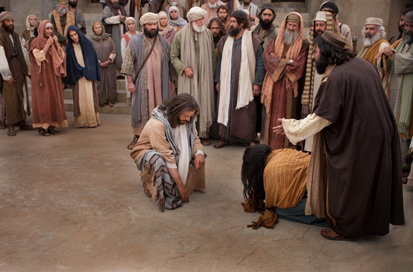
The Woman Caught in Adultery, John 8:1-11
They each went to their own house53, but Jesus went to the Mount of Olives1. Early the next morning, Jesus returned to the temple area, and all the people started coming to him, and he sat down and taught them.
Then the scribes and the Pharisees brought a woman who had been caught in adultery and made her stand in the middle. They said to him, “Teacher, this woman was caught in the very act of committing adultery. Now in the law, Moses commanded us to stone such women. So what do you say?” They said this to test him, so that they could have some charge to bring against him.
Jesus bent down and began to write on the ground with his finger.
But when they continued asking him, he straightened up and said to them, “Let the one among you who is without sin be the first to throw a stone at her.” Again he bent down and wrote on the ground.
And in response, they went away one by one, beginning with the elders. So he was left alone with the woman before him.
Then Jesus straightened up and said to her, “Woman, where are they? Has no one condemned you?”
She replied, “No one, sir.”
Then Jesus said, “Neither do I condemn you. Go, and from now on sin no more.”
Exegesis (Study and Interpretation)

Why did the Pharisees bring this woman to Jesus?
To trap Him and thereby to discredit Him as a false Messiah.
What exactly was the trap?
If Jesus fails to condemn this woman to death under Mosaic Law, the Pharisees will claim to the people that Jesus is a false Messiah who does not support Mosaic Law. However, if He condemns her to death, they can report Him to the Roman authorities as a traitor to Rome because He is fostering rebellion by taking Roman powers unto Himself. When the Romans took over Israel, they took away the Jews right to execution, which had to be approved by the Romans. Treason against Rome was a capital crime punishable by death (usually crucifixion).
The Pharisees had been setting traps for Jesus for months, so this would not be a big surprise to Jesus. However, Jesus had thwarted their traps every time, so you would think they would learn! It seems the reason for this is they considered Jesus a “lowly commoner,” and arrogance sees through the glass darkly. That said, this was probably their best trap yet, because either choice Jesus makes would mean they’ve got him.
What was the law regarding adultery?
In Leviticus 20:10 and Deuteronomy 22:20, it says the man and the woman found guilty of adultery (a violation of the 6th commandment) must be put to death. Stoning isn’t mentioned specifically in these verses but shows up later.
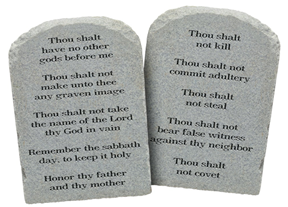
How can we explain the harshness of this law? Why would God allow such a thing as stoning for adultery?
We have to be careful not to project our present environment and assumptions onto cultures 2-4,000 years ago; but that being said, we must also be aware that the Ten Commandments were a brand-new moral way of living for humanity that focused love of neighbor. The 10 Commandments may seem like a bunch of DO NOTS, but each one is for the protection/love of neighbor and training of the self. We also tend to see things from an individual-rights standpoint, but that is also flawed, for love of others is supposed to come first. This was especially unheard of in 1400 BC when the Ten Commandments were received by Moses. These laws needed to transform the world, starting with the Jews, and therefore were so important that to violate them meant death. That was the only way a primitive people would pay attention, and even then they at times they disregarded it. What we need to remember is that God’s goal was the “love of other” over the individual’s love of self. The individual knew the consequences and had free will, so the choice was the individual’s. The message of love of neighbor had to be understood by every individual person and by the community as a whole.
What if a guilty person repented before or during being stoned to death? Would they go to Hell?
No, that individual would go to Sheol (the place of the dead) or the Bosom of Abraham (if innocent) and await Jesus’ death & resurrection to be raised again. If they had Purgatory coming, the pain/anguish of the stoning might offset that. Remember, this life is one tick on the clock of eternity and is not nearly as important as our next lives.
Okay, back to Jesus. Isn’t the man supposed to be stoned to death also? Where is he?
The story doesn’t say, so we don’t know, although it does seem suspicious. Was this a set up? We know she had guilt in the matter because Jesus tells her to sin no more, but was she lured or pressured into a situation so that she could be caught? Again, we don’t know, but we can hardly be surprised if the Jewish leaders did something like this to get rid of Jesus.

What is Jesus’ response to the question the Pharisees put to him?
He writes in the dirt.
Why? What does this mean?
No one knows what Jesus was writing. As we look at Bible history prior to Jesus for clues, we find three fascinating possibilities:
1. "When the Lord finished speaking to Moses on Mount Sinai, He gave him the two tablets of the Testimony, the tablets of stone inscribed by the finger of God" (Deut 9:10). As we know from the Sermon on the Mount, Jesus brought us new commandments that “fulfill” and “complete” the laws of Moses. Like God, Jesus is writing with his finger!
2. “Suddenly the fingers of a human hand appeared and wrote on the plaster of the wall, near the lampstand in the royal palace. The king watched the hand as it wrote; his face turned pale and he was so frightened that his legs became weak and his knees were knocking…” – Daniel 5-6. This finger was from God and the words on the wall pronounced judgment on the king. “You have been weighed on the scales and found deficient... Your days are numbered.” (Dan 5:26-27)
3. “O Lord the Hope of Israel, all who abandon you shall be put to shame; and all who turn away will be written in the earth. – Jeremiah 17:13. Could Jesus be fulfilling this prophecy!?
The Pharisees and scribes, experts in the scriptures, would have known about these passages so seeing Jesus write in the dirt with his finger and say to them, “Let the one among you who is without sin be the first to throw a stone at her” must have spooked them, or else the Holy Spirit sent them an unmistakable message.
A smaller point but worth mentioning: The suggestion was made that this was a Sabbath day, and writing was forbidden on the Sabbath unless it did not leave a lasting mark. For instance, writing with fruit juice or in sand or dirt was permitted. So although we do not know for sure what he was writing, at least they couldn’t arrest him for violating the Sabbath!
Once again, the trap set for Jesus was sprung back on his accusers. How so?
Because Jesus placed the decision of stoning the woman back in their hands. The oldest and wisest Pharisees would have been the first to understand the trap, realizing, "If we stone her the Romans will ask why we took her death sentence upon ourselves.” Jesus neither authorized the stoning nor contradicted the Law. There is no way for the elders to recover from Jesus' trap except to walk away as sinners discredited in the eyes of the people.
Then Jesus straightened up and said to her, “Woman, where are they? Has no one condemned you?” She replied, “No one, sir.”
The Mosaic Law required two witnesses to convict someone. This requirement was not taken lightly because if you got caught “bearing false witness against your neighbor” (8th Commandment), you could die for that, too. Regardless, after the crowd left, there were NO witnesses left!
Then Jesus said, “Neither do I condemn you. Go, and from now on sin no more.”
Does the fact that Jesus does let her go without punishment mean that he failed to uphold Mosaic Law?
Let’s remember that the Mosaic Law is the first deposit on the “Word of God.” Jesus IS the Word of God, so then he had to participate in the giving the Mosaic law. If the Mosaic Law came from Jesus, he must know what he’s doing and, besides, the truth cannot contradict itself, and so we need to dig deeper for our answer.
The first thing is to recognize that the changes to, or fulfillment of, the Mosaic Laws that Jesus came to inaugurate were significant – just as significant as his coming here to reverse the Fall of Man and reopen the gates of Heaven. Consider:
1) Jesus took the Mosaic Laws from mostly external behaviors to both internal and external (i.e., if you lust for a women in your heart, you are already sinning). He raised the bar by saying we can also violate God’s laws in our hearts and in our intentions, even if we don’t carry them out. By raising the bar he is calling us to a higher place – more like God.
2) But Jesus doesn’t leave us hanging. Along with this higher bar, he gives us the Holy Spirit for strength and grace and forgiveness so we can try and try again; and this will replace the punishments in the Old Law. With this assistance – and with forgiveness as often as we ask for it – we have the tools to truly become children of God.
What Jesus brings to the forefront is the emphasis on God’s love and mercy (recall the Prodigal Son). Mercy does not mean lack of accountability or that a person doesn’t need to amend his/her ways. But taking responsibility for one’s actions, seeking forgiveness, and amending one’s life is deserving of God’s endless mercy. The adulterous woman may still have difficulties ahead (especially if she was married), but her life was spared so she can now begin to lead a new one.

Closing Prayer
Eternal God, in whom mercy is endless and the treasury of compassion inexhaustible,
Look kindly upon us and increase Your mercy in us,
That in difficult moments we might not despair nor become despondent,
But with great confidence submit ourselves to Your holy will,
Which is Love and Mercy itself.
Deliver us, O Lord.
Hail Mary, full of grace, the Lord is with thee.
Blessed are thou among women,
and blessed is the fruit of thy womb, Jesus.
Holy Mary, Mother of God,
pray for us sinners,
now and at the hour of our death. Amen.


Comments