
5.20.25 -Early Fathers & Topic Night
- tmaley
- May 23, 2025
- 14 min read
Opening Prayer
Father, Son, and Holy Spirit, we thank you for loving us into existence so we could enter into a relationship with You.
Thank you for giving us another chance after we walked away from you – even chasing after us!
Thank you coming here to show us how to love and then paying for our transgressions against others and against You.
Thank you for keeping the door open when all we have to do is humbly invite you into our lives.
And as Jesus taught us to pray… together
Our Father Who art in Heaven, Hallowed be Thy Name.
Thy Kingdom come, Thy Will be done, on earth as it is in Heaven.
Give us this day our daily Bread;
And forgive us our trespasses as we forgive those who trespass against us.
And lead us not into temptation but deliver us from evil. Amen.
Upcoming major holy days: Ascension – Thursday, May 29 – 40 days after Easter – 2 weeks away
Pentecost – Sunday, June 8 – 50 days after Easter
TODAY:
Catholic Apologetic Terms: Doctrine, Heresy, Orthodoxy. What is so spectacular about the Ascension?
Reading for 6th Sun of Easter (5/25) – My Father is Greater than I, John 14:23-29
Early Church Fathers, Councils, and Heresies
Quote of the Week:
Each of you should use whatever gifts you have received to serve others, as faithful stewards of God’s grace in its various forms. — 1 Peter 4:10
This verse from Peter screams Trinitarian uniqueness.
Peter is telling us that being Christian doesn’t mean we all become the same. In fact, we retain our uniqueness to an even greater extent as a Christian, because God wants to raise our uniqueness up further.
The Body of Christ is made up of Christians past and present, on earth and in Heaven (includes Purgatory). We are all unique, but at the same time we share one body. Similar to… what? The Trinity!
Catholic Apologetics

What is spectacular about the Ascension?
While many understand the Ascension as Jesus returning to the Father in heaven, a truly spectacular aspect that might be less commonly realized is the profound and permanent elevation of our own human nature into the very life of God. Jesus doesn’t just ascend spiritually, he ascends with his glorified human body, wounds and all. As the head of the Church, Jesus precedes us into the Kingdom so that we, the members of his Body, may one day follow Him there.
“I go to prepare a way for you… so that where I am you may be also.” John 14:3
Some say that when the “angel” Lucifer came to learn that lowly humans would be taken up higher than the angels, that was it – he was out! (ultimate pride vs ultimate humility)
What is Church Doctrine?
“Church Doctrine” refers to all of the official teachings of the Church. However, there are several levels of teachings:
Dogma: A Truth pertaining to faith or morals, revealed by God, transmitted from the Apostles in the Scriptures or by Tradition, and infallibly taught by the Church as divinely revealed.
Examples: The Trinity, Jesus is the Son of God, the Incarnation, Immaculate Conception.
Doctrine: Those that the Church teaches authoritatively but not infallibly. Elements within these can change.
Examples: Priests cannot marry; Liturgical practices (prayers in the Mass or how the Sacraments are celebrated); Just War Theory;
Theological Opinions are teachings that express a pope’s views in a subject but are not doctrine/not binding.
Examples: Environmentalism, international relations, methods of evangelization, preferences in music/art.

Heresy – the denial/rejection of dogma.
Orthodoxy – origin is from Greek meaning “sound doctrine.” It means adhering to the established doctrines and traditions of a religion. Also, a commitment to the original beliefs and practices of the faith.
Hyperdoxy – excessive adherence or emphasis on doctrine, potentially to a point where it becomes unbalanced or detrimental.
What is a mystery?
Theological mysteries involve the supernatural. Because they are beyond our physical natures and finite minds, their explanation also goes beyond the physical sciences. Remember, science is the study of the “physical” universe.
Theological mysteries can only be known by supernatural revelation.
Examples: The Trinity, God’s omnipresence, the Incarnation, Christ’s atonement for our sins, the human spiritual nature, the meaning of suffering, the nature of God’s attributes (perfection, love, truth, justice-mercy, creative beauty).
What’s the most important mystery in Christianity?
TThe Blessed Trinity. Because it is who God is.
John 14:23-29 – The Promise of the Holy Spirit
Context: Our Easter readings from John conclude this week and once again, we are in Jesus’ “Last Supper Discourse” (John 14-17). This is an important reading as it explores several key theological points.

Love and obedience?
In last week’s reading in John, Jesus said, “If you keep my commandments, you will abide in my love.” Jesus will say something similar today. It kind of sounds like a threat – ‘you must obey me and then I’ll be your friend’, right? But this is not what Jesus is saying. He is saying that love is performative. In other words, when you are fulfilling his teachings, then you are loving. From this perspective, the Ten Commandments are all about love – loving God (first three) and loving your neighbor (last seven). When we live in love, we are automatically close to God – friends of God – even family of God.
Remember, to properly understand “commandment” and “obedience,” we must recall that the Latin root of obedience (oboedire) means “to hear” or “to listen,” similar to how an apprentice listens to the master tradesman. If we listen and do what the master says, we will become an expert like him. If we don’t listen, what happens? We will never acquire the skill. The same is true for “commandments” – they are “teachings,” or rules of the spiritual trade. We don’t have to follow them because we have free will – God knows that well and sees it all the time. He’s just saying that not listening to his teachings will bring about our demise, both in this world and the next.
Jesus shows us how important this is because he talks often about how he is being obedient (listens) to his Father. This is for OUR sake. In the same way, Jesus says that for us to remain in his love, we must learn to love via His teachings (commandments). He is mirroring for us His own obedience to the Father.
At the root of every teaching is what?
Love. Jesus finally washes his disciples feet just to make a point. If God will lower himself to do that for us, maybe he’s telling us the truth.
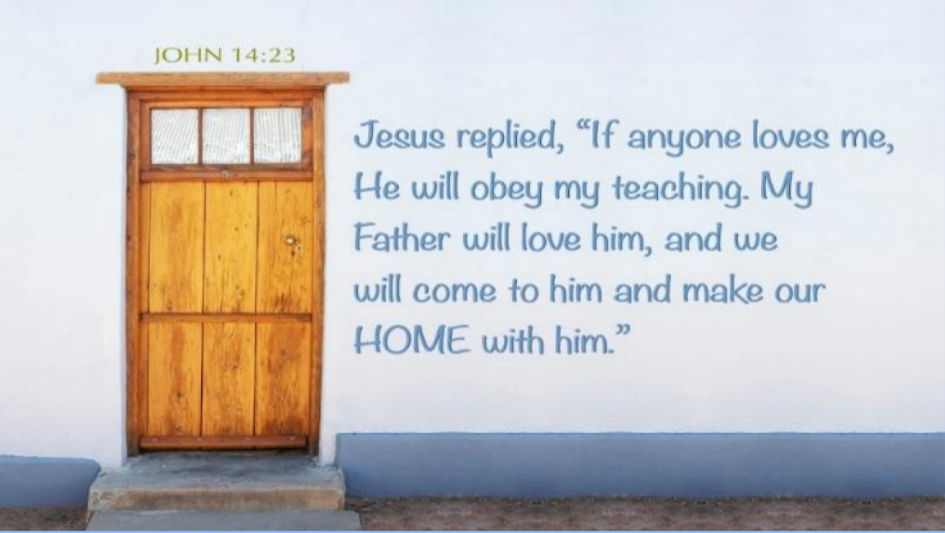
John 14:23-29
Jesus said to his disciples: “If anyone loves me, he will keep my word. My Father will love him and we will come to him and make our dwelling within him. Whoever does not love me does not keep my words. Yet, the word you hear is not mine own but that of the Father who sent me.“All of these things I have said to you while I am with you. But the Paraclete, the Holy Spirit, whom the Father will send in my name, will teach you all things and remind you of everything I have told you. Peace I leave with you; my peace I give to you. I do not give to you as the world gives. Do not let your hearts be troubled; do not be afraid.
“You heard me say to you, ‘I am going away and I am coming back to you.’ If you loved me, you would rejoice that I am going to the Father, for the Father is greater than I.
And now I have told you this before it happens, so that when it happens you may believe.”
Exegesis = Interpretation/Explanation
My Father will love him and we will come to him and make our dwelling within him. Usually, we think of the “indwelling” of the Holy spirit. What is Jesus talking about?
They will come to us in the Holy Spirit. The Father, Son, and HS are inseparable. When we get one, we get all.
Whoever does not love me does not keep my words.
As discussed earlier, these two things – love and Jesus’ words – are two sides of the same coin. Jesus’s words are descriptions of how to love. Love requires loving action. When we love, Jesus says he and the Father will come to us.
What does it mean that they will “come to us”?
It means He will communicate with us, give us grace, and illuminate us. Divine revelation is given to those who seek to love like God does.

The Paraclete, the Holy Spirit, whom the Father will send in my name, will teach you all things and remind you of everything I have told you. What is a paraclete?
Paraclete is Greek, and as usual, it has several English translations: Counsellor, Advocate, Comforter. The Holy Spirit is all of these. Counsellor 🡪 advisor; Advocate 🡪 on our side; Comforter 🡪 in times of difficulty. What greater gifts could a human being want?
“…you would rejoice that I am going to the Father, for the Father is greater than I.” What does this mean?
In this passage, Jesus is emphasizing his subordination as the Son of the Father during his earthly ministry. Jesus gave up his pure divinity to take on human flesh and our sins. If the apostles understood this (which they will soon), they would rejoice because once Jesus ascends back to the Father, Heaven will be reopened to mankind and the Holy Spirit will be sent to them.
Peace I leave with you; my peace I give to you. I do not give to you as the world gives. Do not let your hearts be troubled; do not be afraid. What peace exactly is Jesus talking about?
The peace Jesus speaks of begins with the Holy Spirit coming to us and then flows to the world around us. But it has to start within us. The world often tries to impose peace from the outside, but it’s effectiveness is always short-lived to the extent that it doesn’t exist within the parties. Moreover, the Holy Spirit brings us courage in this process.
As we can see, John’s “Last Supper Discourse” provides theologians volumes of information on the nature of the three persons of the Trinity. Interestingly, St. John Damascene – the last of the Greek Fathers (7th century) – draws from this discourse on the Trinity saying the three Persons are three degrees of divinity: the Creator, Redeemer, and Sanctifier.
Fathers, Heresies, and Councils of the Early Church

Early Fathers of the Church (called “Patristics”)
Review: The early church fathers were a group of thinkers and leaders who lived and wrote during earliest centuries of the Church, from the first century to roughly the 7th century.
The Early Church Fathers are generally grouped into three categories:
Apostolic Fathers – those church fathers who knew or were disciples of the twelve apostles.
Ante-Nicene Fathers – church fathers before the Council of Nicaea (2nd century to 325 AD).
Post-Nicene Fathers – church fathers after the Council of Nicaea (325 AD to the 7th century).
The Early Fathers of the Church contributed thousands of writings that we still have today. They could fill libraries. Augustine alone generated over a thousand works. They universally support the teachings of the Catholic Church, such as the special reverence due Mary, the Real Presence of Christ in the Eucharist, the Apostolic authority of the Church of Rome, and the existence of Purgatory, just to name a few. For many Protestant converts, it was the study of the Early Fathers that brought them into the Church (i.e., John Henry Newman, Thomas Merton, Dorothy Day, G.K. Chesterton, Dr. Scott Hahn, Dr. John Bergsma, Dr. Taylor Marshall).
Fathers of the Church
The Fathers of the Church can be divided into three categories:
Apostolic Fathers – connected to the Apostles.
Apostolic Documents: The Didache (70-85), Epistle of Barnabas (80-110AD), The Shepherd of Hermas (90-120)
St. Clement of Rome: 3rd Pope (88-97AD), disciple of Peter, ordained by Peter.
St. Ignatius of Antioch: (50-117 AD) – appointed by Peter as bishop of Antioch; later became a disciple of John.
St. Polycarp of Smyrna: (69-155) – disciple of John.
Ante-Nicene Fathers – disciples of the disciples of the Apostles, prior to the Council of Nicaea in 325 AD.
St. Justin Martyr (100-165)
St. Irenaeus of Lyons: (140-202 AD) – a disciple of Polycarp
St. Clement of Alexandria (150-216 AD)
Tertullian (160-230 AD)
Origin (185-254 AD)
St. Cyprian of Carthage (200-258 AD)
Eusebius, Bishop of Caesarea, historian (260-334)
Post-Nicene Fathers:
Aphraates, Sage of Persia (280-345 AD)
St. Ephraim (306-373 AD)
St. Athanasius (295-373AD)
St. Cyril of Jerusalem (315-386AD)
St. Hilary of Poitiers (310-368 AD)
St. Basil the Great (330-379 AD)
St. Gregory of Nazianz (330-390 AD)
St. Gregory of Nyssa (335-394 AD)
St. Epiphanius of Salamis (315-413 AD)
Theodore of Mopsuestia (428 AD)
St. Ambrose (333-397 AD)
St. John Chrysostom (349-407 AD)
St. Jerome (347-420 AD)
St. Augustine (354-430 AD)
St. Cyril of Alexandria (375-444 AD)
St. Leo the Great (400-461 AD)
St. Boethius (480-524 AD)
St. Gregory the Great (540-604 AD)
Church Councils
The purpose of the Church Councils is to settle questions of faith and practice, promote unity, and address other issues affecting the Church, including the latest heresies. With the guidance of the Holy Spirit, these councils facilitated deliberation among bishops and leaders as they sought to ensure the Church’s teachings remained aligned with its mission. The goal was to preserve the integrity and constancy of our apostolic faith.
Important Church Councils throughout history
50 AD Council of Jerusalem
325 AD First Council of Nicaea
381 AD First Council of Constantinople
393 AD Council of Hippo
397 AD Council of Carthage
431 AD Council of Ephesus
451 AD Council of Chalcedon
553 AD Second Council of Constantinople
681 AD Third Council of Constantinople
731 AD Second Council of Nicaea
869 AD Fourth Council of Constantinople
1123 AD First Council of the Lateran
1130 AD Second Council of the Lateran
1179 AD Third Council of the Lateran
1215 AD Fourth Council of the Lateran
1245 AD First Council of Lyon
1274 AD Second Council of Lyon
1311 AD Council of Vienne
1415 AD Council of Constance
1431 AD Council of Basel-Ferrara-Florence
1512 AD Fifth Council of the Lateran
1545 AD Council of Trent
1869 AD First Vatican Council
1962 AD Second Vatican Council
When was the Bible established?
It was started at the Council of Hippo (393) and finalized at the Council of Carthage (397). Before this, the writings were like the Jewish Scriptures – individual books/writings on Genesis, Isaiah, etc., but the Jews never gathered them into one, unified collection until the 3rd century, AD. Nevertheless, these books from the Old Testament had been gathered and copied into Greek around 250BC in Alexandria, Egypt (called the Septuagint). This is the OT Bible that Catholics used.
The books for the New Testament were similarly separate documents in the beginning. But with Christianity growing fast and unapproved writings starting to appear, the Church decided to formalize which books were authentic and inspired and which were not. The Church finalized 73 books – 46 Old Testament + 27 New Testament – at the Council of Carthage in 397, which was confirmed again at the Council of Trent in 1545 after the Protestant Reformation decided to remove 7 books from the Old Testament. The Protestants have 66 books – 39 Old Testament + 27 New Testament.
What was the criteria established by the Church to determine the canon of Scripture?
For the Old Testament, the Church used the Septuagint, which is what the Jews in Jesus’ time used. It was the translation of Hebrew Scriptures into Greek about 250 BC.
For the New Testament, the criteria was:
Apostolic Origin – A primary criterion was that it written or taught by one of the Apostles or their disciples (Luke…).
Orthodoxy – It had to conform to the “Rule of Faith”– the core teachings of the Gospels and the Apostles.
Universal Acceptance – The writings had to be commonly accepted and used across the entire Church.
Spiritual and Theological Value – The writings needed to demonstrate theological and salvific significance.
Guidance from the Holy Spirit – They prayed for guidance from the Holy Spirit each step of the way.
The Council of Nicaea, 325 AD was the first truly major council in the history of the Church. The major outcomes of the Council was the formal rejection of Arianism and the creation of the Nicene Creed that we now pray at Mass every Sunday. The Creed added these words about the divinity of Christ in response to Arianism: "God from God, light from light, True God from True God, begotten, not made, of the same substance as the Father, by Whom all things were made" — and setting the date on which to commemorate Jesus' resurrection (Easter).
2025 is the 1700 Year Anniversary of the Council of Nicaea. Pope Leo XIV will be meeting with Patriarch Bartholomew to celebrate the anniversary in November.
What is Donatism?
Around that same time as the Arians were the Donatists, who were followers of Donatus Magnus, a schismatic bishop of Carthage in the mid-fourth century. Donatists held that the clergy must be sinless whenever they perform sacraments, or else the sacraments were invalid. This would mean that the sacraments were dependent upon the personal virtue of the celebrant. The Donatists were so emphatic about this that when challenged, they became belligerent and even violent.
St. Augustine was instrumental in addressing the issue. The Church’s final position was that the sacrament – even the sacrifice of the Mass – did not depend on the virtue of the bishop or priest, but on the "worth of the victim and on the dignity of the chief-priest, which is none other than Jesus Christ Himself.”
This strict position of the Donatists became known as “hyperdoxy” (vs standard orthodoxy).
First Council of Constantinople (A.D. 381)

First Council of Constantinople (A.D. 381)
Key Issues:
Condemnation of Heresies: The council condemned various heresies, including:
Arianism, which denied the divinity of Christ.
Apollinarianism, which denied the full humanity of Christ.
Pneumatomachians – (“Spirit-fighters”), which denied the divinity of the Holy Spirit.
Affirmation of the Nicene Creed… The council reaffirmed the Nicene Creed and expanded it to include a more detailed description of the Holy Spirit, emphasizing His divinity and role within the Trinity:
"And in the Holy Spirit, the Lord and Giver of life, who proceeds from the Father, who together with the Father and the Son is adored and glorified."
Ecclesiastical Authority: The council reaffirmed the hierarchy of the Church, and also granted the Bishop of Constantinople a primacy among the patriarchates, second only to the Pope (Bishop of Rome).
Early Fathers
St. Irenaeus of Lyons (c. 130 – c. 202 AD)
Primary Accomplishment: A key figure in combating Gnosticism, St. Irenaeus emphasized the importance of Apostolic Tradition, the succession of bishops, and the coherence of the Old and New Testaments. His major work, Against Heresies, defended the orthodox faith and provided one of the earliest systematic expositions of Christian theology. He also emphasized the Church's faith in the Real Presence of Christ in the Eucharist.

What is Gnosticism?
Gnosticism is a collection of greatly varying pantheistic beliefs that flourished from before the Christian era to about the fifth century (although it seems to rear its head again and again). These Gnostic sects borrowed from the phraseology and tenets of major religions, especially Christianity. That was the key to their success – take the best from already flourishing religions and adapt them accordingly.
Gnosticism considered physical matter a form of evil (a deterioration of spirit) and the universe as a depravation of the Deity.
How is that similar to Buddhism and Hinduism?
Buddhism and Hinduism consider the physical realm – and especially human desire – to be the source of all suffering. Therefore, the goal is to transcend the physical realm – no matter how many lifetimes it takes – until we can shed the self entirely and merge with the Universe (Nirvana).
Gnostics believed the ultimate end of all being is to overcome matter and return to the Parent-Spirit, facilitated by a God-sent Savior (Jesus fit so perfectly!). However, because physical nature was considered evil, Jesus couldn’t possibly have become a physical human being! Therefore, his “humanity” was just an illusion, for God could not participate in evil.
Gnosticism also emphasized salvation through a quasi-intuitive knowledge of the mysteries of the universe and magic formulas indicative of that knowledge. Not everyone was given access to this knowledge. Gnostics saw themselves as a superior class, essentially different from those who lacked this saving knowledge.
When Gnosticism encountered Christianity, it adopted Christian forms of thought, nomenclature, and sacraments, claiming to be an esoteric (secret) revelation of Christ. The early Church Fathers combatted Gnosticism, affirming that matter is created by God and therefore not evil .
You may recall the movie The Da Vinci Code. It drew heavily from the beliefs of Gnosticism, which tells us that Gnosticism continues to return every few centuries, just dressed up in different clothes.
Questions…
Closing Prayer: Prayer of St. Irenaeus, Great Doctor, Martyr, and Father of the Church.
O God, who did grant that blessed Irenaeus, Your martyr and bishop,
Should both overcome heresy by the truth of his doctrine, and establish peace in Your Church:
Give to Your people, we beseech You constancy in their holy religion, and grant us Your peace in our days.
We ask this through Christ our Lord."
Hail Mary, full of grace, the Lord is with thee.
Blessed are thou among women,
and blessed is the fruit of thy womb, Jesus.
Holy Mary, Mother of God,
pray for us sinners,
now and at the hour of our death. Amen.


Comments